How to Find an AGACNP Preceptor
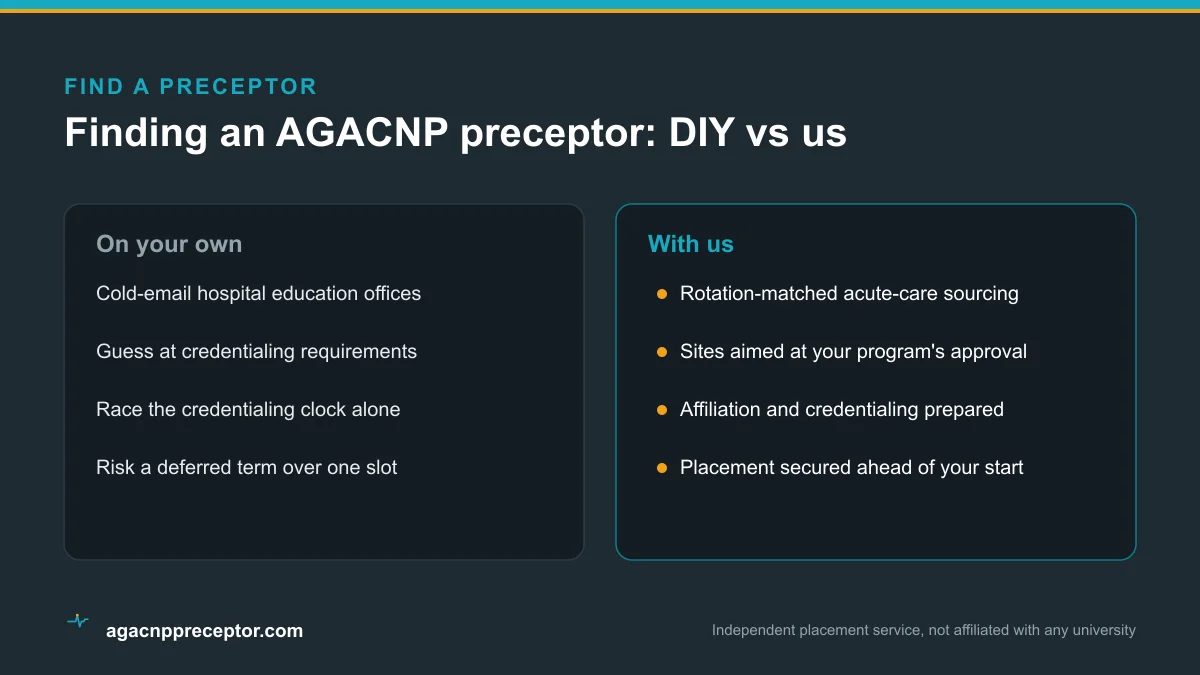
The single hardest logistical piece of an Adult-Gerontology Acute Care Nurse Practitioner degree is not the coursework, it is finding a qualified acute-care preceptor and an approved inpatient site, on your own, in time. Securing acute-care and ICU clinical sites is among the hardest placements to obtain independently, because hospitals gatekeep inpatient students through credentialing and affiliation agreements. This page explains how the acute-care preceptor search actually works, what qualifies a preceptor, and how our independent service runs that search for you. We work with students from every university.
Tell us your school and city. It is free to ask, with no obligation.
Why the acute-care preceptor search is so hard
The AGACNP search is a different order of difficulty than primary care, and it is worth being honest about why. A primary-care NP student can knock on a clinic door; you are asking a health system to credential a student inside its ICU, step-down unit, emergency department, or specialty service.
- Inpatient units credential students, they do not just accept them, so every site involves a formal process.
- Every site needs a signed affiliation agreement between the hospital and your university.
- Acute-care preceptors are few, and their bedside time is scarce, so precepting capacity is limited.
- ICU and step-down slots fill long before the term starts, and students from many programs compete for them.
- Most AGACNP programs are online and do not assign placements, so the search is yours.
The students who struggle are rarely unqualified. They are the ones who started late, approached preceptors in the wrong setting, or lined up a willing clinician whose credentialing never cleared. Time and setting fit, not effort, are the usual failure points.
What makes an AGACNP preceptor qualify?
A preceptor has to match the acute setting your rotation requires, and getting that match wrong is the most common reason hours do not count.
| Rotation | Typical qualified preceptor | Setting |
|---|---|---|
| ICU / critical care | AGACNP or ACNP, or intensivist physician | Intensive care unit |
| Step-down / PCU | AGACNP or ACNP, hospitalist, or intensivist | Progressive or intermediate care |
| Emergency department | AGACNP or ACNP, or emergency medicine physician | Emergency department |
| Inpatient specialty | AGACNP or ACNP, or specialty physician | Cardiology, pulmonary, nephrology, surgical |
| Hospitalist | AGACNP or ACNP, or hospitalist physician | Inpatient medicine service |
Beyond the setting fit, every preceptor and site has to be approved, which generally means the preceptor's CV, a signed affiliation agreement, and hospital credentialing. A willing clinician is not the same as an approved one. Your exact eligibility rules come from your program and its accreditor and state board; the table above is a planning guide, not a substitute for them.
How the acute-care search actually goes
Done well, an acute-care preceptor search is systematic, not a series of hopeful emails. It starts from your program and your city, because both narrow the field: an ICU slot in a mid-size metro is a different market than one in a rural county.
The realistic steps look like this:
- Pin down the exact requirement for each rotation from your program: hours, setting, and population.
- Map the health systems in your area that host students, and identify the units most likely to credential you.
- Approach with the requirements understood, so a willing preceptor and site can clear credentialing cleanly rather than stalling on paperwork.
- Line up more than one option where the program allows, since declines are normal and a backup protects your timeline.
- Prepare the approval package, CV, affiliation agreement, and credentialing, so the review moves quickly.
Competition is real, and inpatient credentialing is slow, so the prepared, early applicant tends to win the slot. That is the whole argument for starting sooner than feels necessary.
How we run the search for you
Our service exists to take that search off your plate. You tell us your program, your city, and the acute rotations you still need, and we do the sourcing, vetting, and credentialing-prep so you can stay focused on coursework.
- Rotation-matched sourcing. We look for the specific acute-care preceptor each rotation needs, critical care for the ICU, emergency medicine for the ED, and so on.
- Local first. We prioritize your area, because inpatient credentialing and site approval are geographically bound.
- Credentialing-ready. We help assemble the CV, affiliation agreement, and credentialing paperwork the hospital requires.
- Early. We work to secure the placement ahead of your start, so no rotation pushes your program back a term.
We aim for an approvable preceptor and site, but the university and the hospital make the final approval, and we never claim or imply a university affiliation. We do not guarantee hours, certification, or program outcomes, and nothing here is a tuition refund. We match first and you pay when the placement is secured. See how it works and what it costs, or start on the contact page.
Good to know
Why is finding an AGACNP preceptor so hard?
Because acute-care and ICU sites are gatekept by hospital credentialing and affiliation agreements. Inpatient units credential students rather than simply accepting them, acute-care preceptors are few with scarce bedside time, and slots fill early while students from many programs compete. Most AGACNP programs are online and do not place you, so the search is yours. Time and setting fit, not effort, are the usual failure points.
What qualifies someone to be my AGACNP preceptor?
It depends on the rotation and the setting. An ICU rotation needs an AGACNP, ACNP, or intensivist; an emergency rotation needs an AGACNP, ACNP, or emergency medicine physician; a specialty rotation needs a preceptor on that inpatient service. Every preceptor and site must be approved, which generally means a CV, a signed affiliation agreement, and hospital credentialing. Confirm the rules with your program and its accreditor and state board.
How early should I start looking for an acute-care preceptor?
Earlier than feels necessary. Acute-care and ICU slots are competitive, and hospital credentialing and affiliation agreements take time. Starting early is the single biggest factor in clearing your inpatient requirements without pushing your program back a term. Every rotation you need adds to the runway you want.
Do you guarantee you will find a preceptor?
We do not guarantee a specific clinician, hours, or program outcomes, and nothing we do is a tuition refund. What we offer is a systematic, early, rotation-matched search and credentialing-prep that materially reduces placement risk. You are matched first and pay when the placement is secured.
Are you affiliated with a university?
No. We are an independent placement service that works separately from any university. Final approval of any site or preceptor rests with the university and the hospital.
Secure the rotation no one else will hand you
Tell us your school, your city, and the acute rotations you still need. We will come back with a plan for the full AGACNP trace and a realistic path to placed.