Who Can Serve as an AGACNP Preceptor?
Finding a willing clinician is only half the job; the other half is confirming that clinician can actually precept your Adult-Gerontology Acute Care Nurse Practitioner hours under your program's rules. Acute-care preceptor eligibility is narrower than primary care, because the setting itself is inpatient and credentialed. This page explains who generally qualifies as an AGACNP preceptor, why the setting match matters, and how we verify every candidate before you commit. We are an independent placement service that works separately from any university or certification body.
Tell us your school and city. It is free to ask, with no obligation.
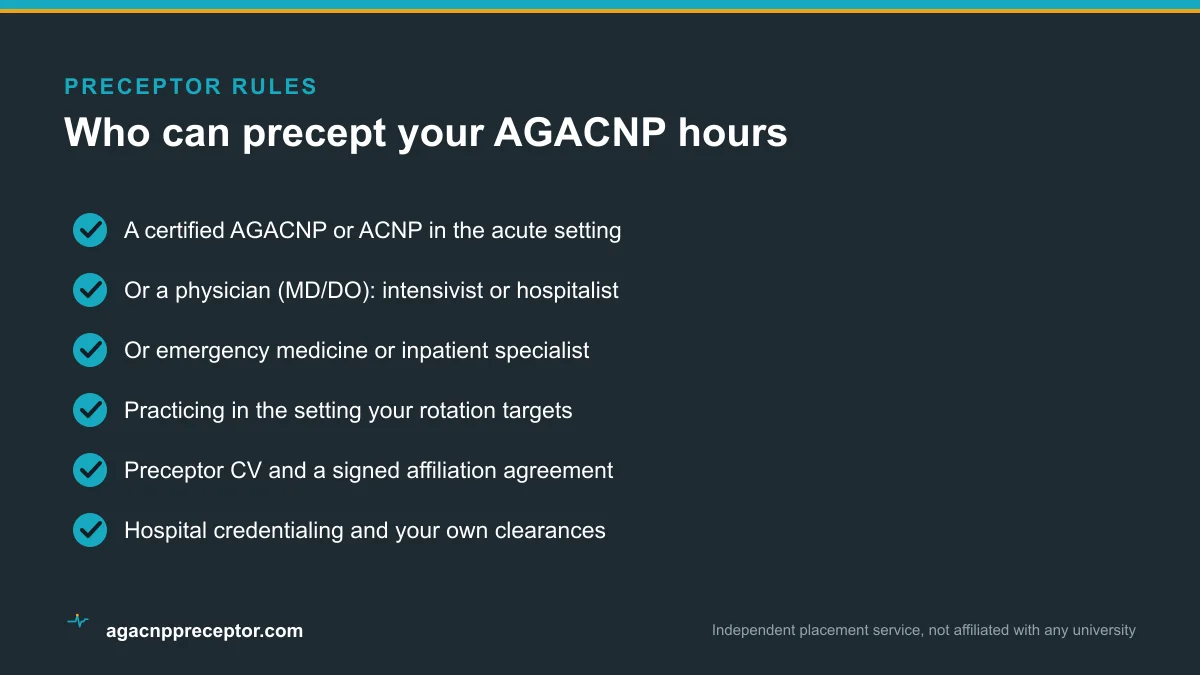
Who generally qualifies as an AGACNP preceptor?
Across most AGACNP programs, an eligible preceptor falls into one of a few categories, all defined by practicing in acute or inpatient care:
- A certified AGACNP or ACNP (acute care nurse practitioner) practicing in the acute or inpatient setting.
- A physician (MD or DO) in a relevant acute-care role: an intensivist, a hospitalist, an emergency medicine physician, or a physician in a relevant inpatient specialty.
- The setting match: whichever preceptor you have, they must practice in the acute or inpatient care setting that matches your rotation, since specific preceptor rules are set by each program and its accreditor and state board.
The unifying theme is acute practice. A primary-care NP or an outpatient physician, however experienced, is generally not an eligible AGACNP preceptor, because the role you are training for is inpatient and acute. Some programs also recognize physician assistants in acute-care settings, but whether yours does is a program-specific question you should confirm.
Why does the setting have to match?
Acute-care preceptor rules are stricter than primary care precisely because the learning is setting-dependent. You cannot learn to manage the critically ill patient in an outpatient clinic, so the preceptor has to be practicing where that learning happens.
That is why an ICU rotation needs a preceptor practicing in critical care, an emergency rotation needs an emergency-department preceptor, and a specialty rotation needs a preceptor on that inpatient service. A preceptor who is fully qualified for one acute setting may not satisfy your program's requirement for a different one. This setting-and-scope matching is the most common reason acute-care hours fail to count, and it is exactly what we screen for. The rotation-by-rotation detail is on our ICU, emergency, and inpatient specialty pages.
What documentation does a preceptor need?
Beyond clinical fit, an approvable preceptor and site generally require documentation, and it is where placements stall when students arrange them alone. While the specifics vary by program and hospital, an approvable acute-care placement usually involves:
- The preceptor's credentials and CV, so the program can verify their certification, scope, and setting.
- A signed preceptor or affiliation agreement between the hospital and your university.
- Hospital credentialing for you as a student, which inpatient units require and which takes time.
- Your own clearances, such as background checks, immunizations, and health requirements, before you begin.
A willing preceptor who cannot produce a CV or whose hospital will not sign an affiliation agreement is, functionally, not yet an approved preceptor. Confirming and assembling all of this is part of what our service does. Whatever the table above suggests, your program's Nursing Student Handbook and its accreditor and state board are the authority on your exact rules.
How we verify your preceptor
We do not hand you a name and wish you luck. We verify every candidate against your program's specific rules before you commit, so you never log hours that will not count.
- Scope and setting check, confirming the preceptor practices in the acute setting your rotation requires.
- Credential check, confirming certification or licensure that fits your program's eligibility.
- Documentation prep, gathering the CV, agreement, and credentialing paperwork the placement needs.
- Program-rules match, checked against your school's requirements, not a generic standard.
Final approval of any preceptor or site rests with the university and the hospital, and eligibility rules are set by your program and its accreditor and state board, not by us. We do not guarantee approval or outcomes, and nothing here is a tuition refund. See how it works or start on the find a preceptor page.
Good to know
Who can serve as an AGACNP preceptor?
Generally a certified AGACNP or ACNP (acute care nurse practitioner), or a physician (MD or DO) in a relevant acute-care role such as an intensivist, hospitalist, emergency medicine physician, or inpatient specialist. The preceptor must practice in the acute or inpatient setting matching your rotation. Some programs also accept physician assistants in acute-care settings. Specific rules are set by each program and its accreditor and state board.
Can a primary-care NP or outpatient physician precept AGACNP hours?
Generally no. AGACNP preceptor rules are stricter than primary care because the learning is setting-dependent; you cannot learn to manage the critically ill patient in an outpatient clinic. The preceptor must practice in the acute or inpatient setting matching your rotation. A primary-care NP or outpatient physician, however experienced, is generally not eligible.
Why does my preceptor's setting have to match my rotation?
Because acute-care learning is setting-dependent. An ICU rotation needs a preceptor practicing in critical care, an emergency rotation needs an emergency-department preceptor, and a specialty rotation needs a preceptor on that inpatient service. A preceptor qualified for one acute setting may not satisfy your program's requirement for another. Setting-and-scope mismatch is the most common reason acute-care hours fail to count.
What paperwork does an AGACNP preceptor and site need?
Generally the preceptor's credentials and CV, a signed preceptor or affiliation agreement between the hospital and your university, hospital credentialing for you as a student, and your own clearances such as background checks and immunizations. A willing preceptor whose hospital will not sign an affiliation agreement is not yet approved. We help assemble this documentation.
Are you affiliated with a university or certification body?
No. We are an independent placement service that works separately from any university or certification body. We verify preceptors against your program's rules and prepare the documentation; eligibility rules and final approval are set by the university, its accreditor, and the state board.
Secure the rotation no one else will hand you
Tell us your school, your city, and the acute rotations you still need. We will come back with a plan for the full AGACNP trace and a realistic path to placed.