AGACNP Inpatient Specialty Rotation Placement
Beyond the ICU, step-down, and emergency department, many Adult-Gerontology Acute Care Nurse Practitioner programs build in inpatient specialty rotations: focused time on a cardiology, pulmonology, nephrology, or trauma and surgical service. These rotations deepen your management of specific acute conditions, and each is its own credentialed inpatient placement. This page explains what the specialty rotations teach, which services are common, and how we source and verify a qualified specialty preceptor and an approved inpatient site for you. We are an independent placement service that works separately from any university.
Tell us your school and city. It is free to ask, with no obligation.
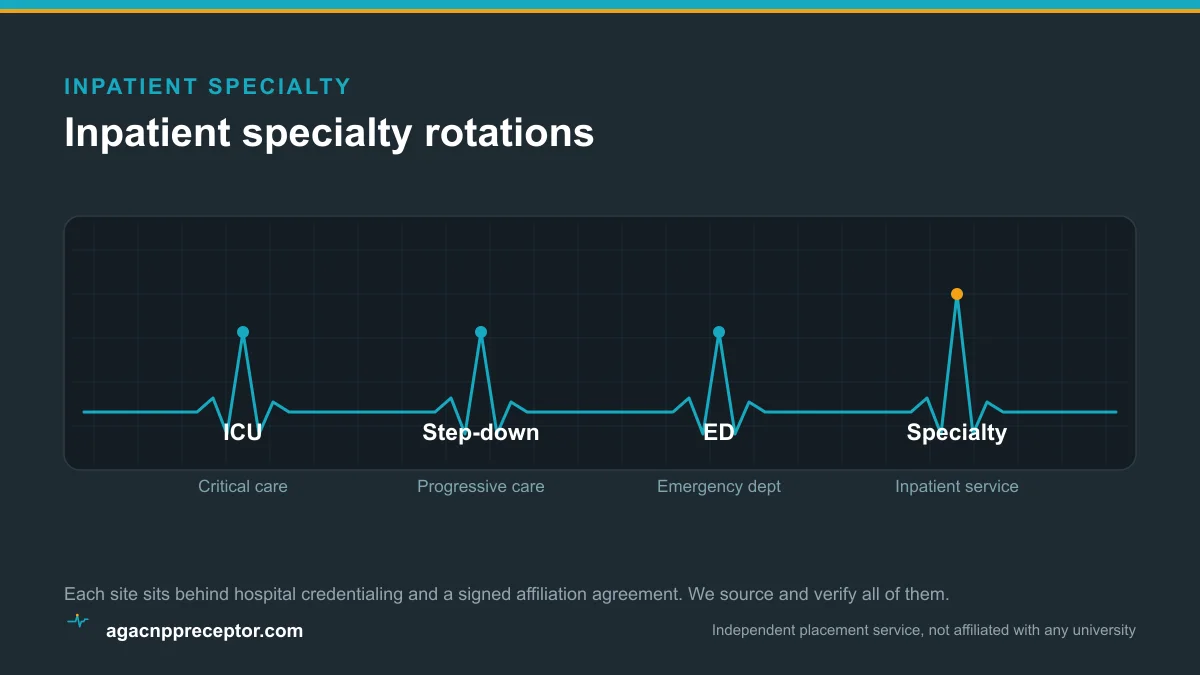
What are AGACNP inpatient specialty rotations?
An inpatient specialty rotation places you on a hospital service organized around a body system or a type of acute condition, working with the specialty team that manages those patients. Rather than the mixed acuity of an ICU or the undifferentiated flow of an ED, you focus on one domain of acute inpatient care in depth.
Common inpatient specialty services for AGACNP students include:
- Cardiology. Acute coronary syndromes, heart failure, arrhythmia management, and cardiac monitoring on an inpatient cardiology or CCU-adjacent service.
- Pulmonology. Respiratory failure, obstructive and interstitial disease, and ventilation management on an inpatient pulmonary service.
- Nephrology. Acute kidney injury, fluid and electrolyte management, and inpatient dialysis coordination.
- Trauma and surgical services. Post-operative and injured acute patients, perioperative management, and surgical co-management.
- Other inpatient specialties such as neurology, infectious disease, or oncology, where a program recognizes them for acute-care hours.
Which specialty services your program requires or accepts, and how many count toward your acute-care hours, is set by your school. Confirm your program's specialty requirements before planning around any single service.
Why do specialty rotations matter for the AGACNP?
Acute-care practice is broad, and specialty rotations are how a program makes sure you can manage the specific conditions that fill inpatient units. A cardiology rotation builds fluency with the acute cardiac presentations you will see across every acute setting; a pulmonary rotation deepens respiratory management that carries directly into the ICU; a nephrology rotation sharpens the fluid, electrolyte, and renal reasoning that acute patients demand.
These rotations also give you supervised depth with the specialists who manage the sickest patients in their domain, which is exactly the kind of exposure the acute-care role is built on. For students, the challenge is the same as any inpatient site: the service has to be willing, the preceptor has to qualify, and the hospital has to credential you, all before the term begins.
Who can precept your inpatient specialty hours?
Your specialty preceptor has to practice in the inpatient service your rotation targets. In general that is a certified AGACNP or ACNP (acute care nurse practitioner) working on the specialty service, or a physician (MD or DO) in that inpatient specialty, a cardiologist, pulmonologist, nephrologist, trauma or surgical attending, or comparable specialist.
Eligibility rules are set by each program and its accreditor and state board, and a preceptor who fits a cardiology rotation will not necessarily satisfy a pulmonary requirement. We verify each candidate against your school's exact rules, matched to the specific service, before you commit. See our preceptor requirements page for the full picture.
How we place your inpatient specialty rotations
Specialty rotations are where a search can splinter, because you may need several different services, each with its own preceptor and credentialing. We run those searches in parallel so they do not stack up against your deadline. You tell us your school, your city, and the specialty hours you still need, and we source approvable services and qualified preceptors for each.
- Local first, because specialty credentialing and affiliation agreements are geographically bound.
- Matched to each service, so your cardiology, pulmonary, nephrology, or surgical hours count toward the right requirement.
- Verified preceptors, checked against your school's eligibility rules for that specialty before you commit.
- Credentialing-ready, with paperwork prepared per service so approvals do not bottleneck.
Final approval of any site or preceptor rests with the university and the hospital, and we do not speak for either. We do not guarantee hours, grades, or outcomes, and nothing here is a tuition refund. See how it works or start on the find a preceptor page.
Good to know
What inpatient specialty rotations do AGACNP programs use?
Common services include cardiology, pulmonology, nephrology, and trauma or surgical services, and some programs recognize others such as neurology, infectious disease, or oncology. Each is a focused block on a hospital service organized around a body system or acute condition. Which specialties your program requires or accepts, and how they count toward your acute-care hours, is set by your school.
Why do AGACNP students rotate through specialty services?
Because acute-care practice is broad, and specialty rotations build supervised depth with the specific conditions that fill inpatient units: acute cardiac presentations, respiratory failure, acute kidney injury, and post-operative or injured patients. That depth carries directly into every acute setting, from the ICU to the emergency department.
Who can precept my inpatient specialty hours?
Generally a certified AGACNP or ACNP (acute care nurse practitioner) on the specialty service, or a physician (MD or DO) in that inpatient specialty, such as a cardiologist, pulmonologist, nephrologist, or trauma or surgical attending. A preceptor who fits one specialty will not necessarily satisfy another. Eligibility is set by each program and its accreditor and state board, and we verify every candidate against your school's rules.
Are you affiliated with a university?
No. We are an independent placement service that works separately from any university or certification body. We source and verify your specialty preceptors and sites; final approval always rests with the university and the hospital.
Secure the rotation no one else will hand you
Tell us your school, your city, and the acute rotations you still need. We will come back with a plan for the full AGACNP trace and a realistic path to placed.