AGACNP Emergency Department Rotation Placement
The emergency department is where an Adult-Gerontology Acute Care Nurse Practitioner learns to work up the undifferentiated patient: someone who arrives acutely ill or injured before anyone knows what is wrong. It is a demanding acute-care rotation and, like every hospital-based site, it sits behind emergency-department credentialing and an affiliation agreement. This page explains what the ED rotation teaches, how it fits the AGACNP scope, and how we source and verify a qualified preceptor and an approved emergency-department site for you. We are an independent placement service that works separately from any university.
Tell us your school and city. It is free to ask, with no obligation.
What does the AGACNP emergency department rotation cover?
The emergency department teaches something no other rotation does as directly: managing the undifferentiated acute presentation. In the ED you assess adults and older adults across the acuity spectrum, from chest pain and shortness of breath to sepsis, trauma, and acute decompensation, and you learn to prioritize, stabilize, and disposition patients under time pressure and with incomplete information.
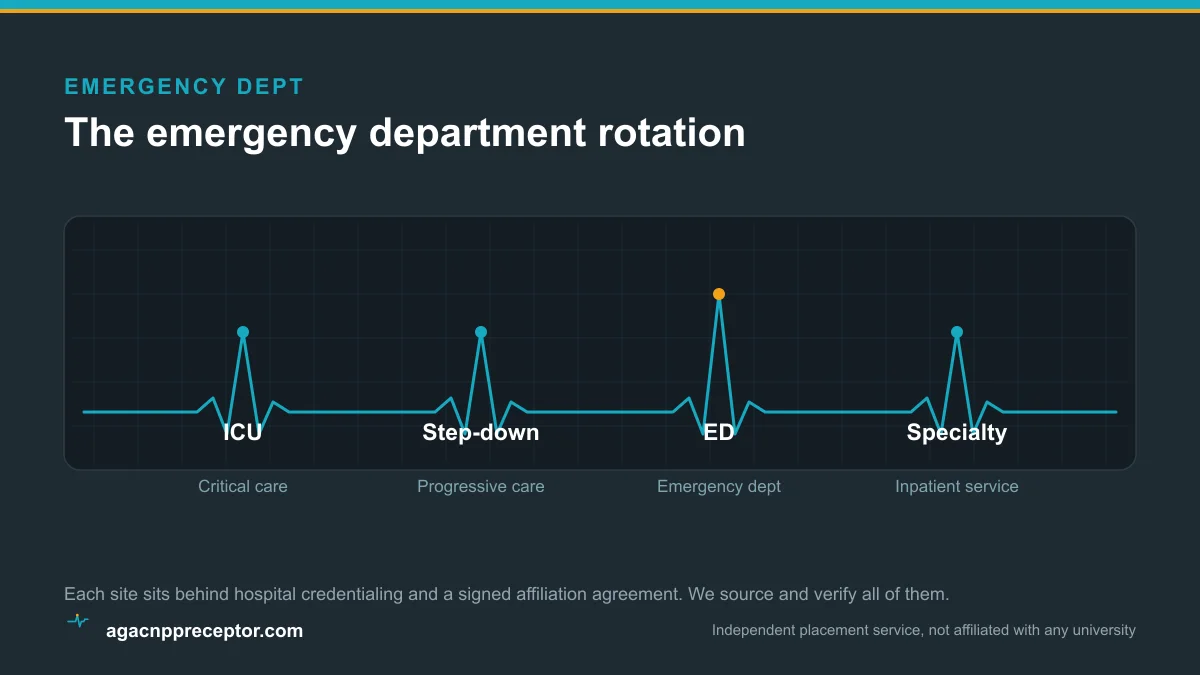
For the AGACNP, the ED rounds out the acute-care picture. Where the ICU and step-down units teach management of already-admitted acute patients, the emergency department teaches the front door: rapid assessment, resuscitation and stabilization, and the decision to admit, transfer, or discharge. It is a strong setting for building the acute-care reasoning and procedural exposure your program expects.
Note that the AGACNP scope is adult-gerontology. In a general emergency department you will focus on the adult and older-adult population your certification covers. How your program structures and counts ED hours, and whether it treats the ED as core or elective acute-care time, is set by your school.
Where does the ED fit in the AGACNP scope?
The emergency department is a natural fit for acute-care training, but it is worth being precise about scope. The AGACNP is certified for the acutely ill adult-gerontology patient, from young adults through older adults, including the frail elderly. Adolescents fall inside AGACNP practice only where a specific program defines them within its scope, and AGACNPs do not care for children.
In a general ED, that means your supervised experience centers on the adult and older-adult presentations that fit your certification. Some emergency departments are high-volume and see the full lifespan, so your program and preceptor will shape which patients count toward your acute-care hours. Our adult and older-adult population pages explain the age span the certification covers.
Who can precept your emergency department hours?
Your ED preceptor has to practice in the emergency setting your rotation targets. In general that is a certified AGACNP or ACNP (acute care nurse practitioner) working in the emergency department, or an emergency medicine physician (MD or DO). Some programs also recognize other qualified acute-care providers in the department, within their own rules.
Preceptor eligibility is set by each program and its accreditor and state board, and emergency medicine has its own supervision norms. We verify every candidate against your school's exact requirements before you commit, so your ED hours count. See the full picture on our preceptor requirements page.
How we place your emergency department rotation
We source your ED rotation alongside the rest of your acute trace so no single site holds up your term. You tell us your school, your city, and the emergency-department hours you still need, and we find an approvable ED and a qualified preceptor, early enough to clear credentialing.
- Local first, because ED credentialing and affiliation agreements are geographically bound.
- Matched to the requirement, so your emergency-department hours count toward your program.
- Verified preceptors, checked against your school's eligibility rules before you commit.
- Credentialing-ready, with the affiliation-agreement and credentialing paperwork prepared in advance.
Final approval of any site or preceptor rests with the university and the hospital, and we do not speak for either. We do not guarantee hours, grades, or outcomes, and nothing here is a tuition refund. See how it works or start on the find a preceptor page.
Good to know
What does an AGACNP emergency department rotation teach?
It teaches management of the undifferentiated acute presentation: rapid assessment, resuscitation and stabilization, prioritization under time pressure, and the decision to admit, transfer, or discharge. The ED is the acute-care front door, complementing the already-admitted acute patients you manage in the ICU and step-down units. How your program structures and counts ED hours is set by your school.
Do AGACNPs see all ages in the emergency department?
The AGACNP scope is adult-gerontology, from young adults through older adults including the frail elderly. Adolescents fall inside AGACNP practice only where a specific program defines them within scope, and AGACNPs do not care for children. In a general ED your supervised experience centers on the adult and older-adult presentations your certification covers, shaped by your program and preceptor.
Who can precept my emergency department hours?
Generally a certified AGACNP or ACNP (acute care nurse practitioner) working in the emergency department, or an emergency medicine physician (MD or DO). Some programs recognize other qualified acute-care providers within their own rules. Eligibility is set by each program and its accreditor and state board, and we verify every candidate against your school's requirements.
Are you affiliated with a university?
No. We are an independent placement service that works separately from any university or certification body. We source and verify your emergency-department preceptor and site; final approval always rests with the university and the hospital.
Secure the rotation no one else will hand you
Tell us your school, your city, and the acute rotations you still need. We will come back with a plan for the full AGACNP trace and a realistic path to placed.