AGACNP Step-Down and Progressive Care Rotation Placement
The step-down or progressive care unit is where an Adult-Gerontology Acute Care Nurse Practitioner learns to manage patients who are too sick for a general floor but no longer need full intensive care. It is a core acute-care rotation in its own right, and like every inpatient site, it sits behind hospital credentialing and an affiliation agreement. This page explains what the progressive-care rotation teaches, how it differs from the ICU, and how we source and verify a qualified preceptor and an approved step-down site for you. We are an independent placement service that works separately from any university.
Tell us your school and city. It is free to ask, with no obligation.
What is the step-down or progressive care rotation?
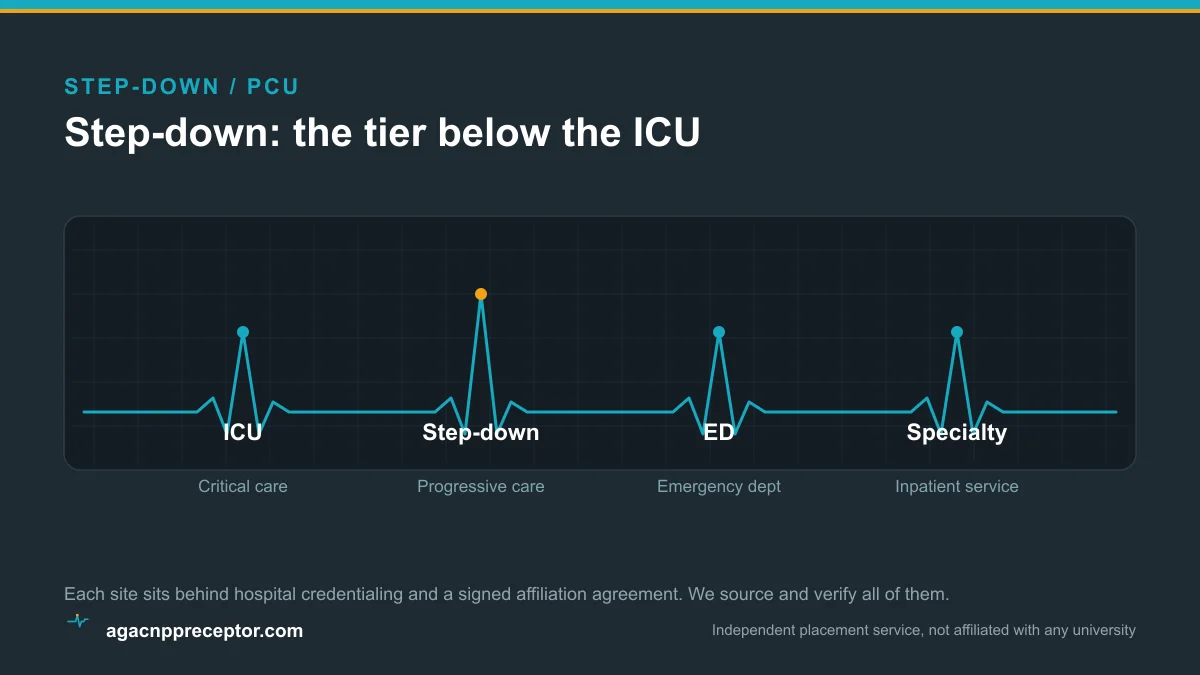
The step-down unit, often called progressive care (PCU) or intermediate care, is the tier between the intensive care unit and the general medical-surgical floor. Patients here are acutely ill and closely monitored, frequently on telemetry, but do not require the moment-to-moment intervention of the ICU. Many are transitioning down from critical care, and some are being escalated up from the floor.
For an AGACNP student, the progressive-care rotation is where you practice managing the acutely ill adult and older-adult patient at a slightly lower acuity than the ICU: titrating care, watching for deterioration, managing cardiac and respiratory monitoring, and making the judgment calls about when a patient needs to move up or is safe to move down. It builds the surveillance and clinical-reasoning skills that define acute-care practice.
How does step-down differ from the ICU rotation?
The two rotations are complementary, and many programs value both because they teach different edges of acute care. The ICU teaches management of the unstable patient; the step-down unit teaches vigilance across a larger group of monitored but more stable patients, and the transitions between levels of care.
- Acuity. Step-down patients are seriously ill but more stable than ICU patients, so the workload leans toward monitoring, escalation judgment, and managing more patients at once.
- Skills emphasis. The PCU sharpens telemetry interpretation, early-warning recognition, and the decision of when to escalate, a distinct competency from ICU stabilization.
- Transitions of care. Progressive care is where you learn the ICU-to-floor handoff and the floor-to-ICU escalation, a central acute-care skill.
Whether your program treats step-down as part of a combined critical-care block or as a separate rotation varies by school. Confirm how your program counts progressive-care hours before planning around them.
Who can precept your step-down hours?
As with every inpatient rotation, your preceptor has to practice in the setting your rotation targets. For step-down, that is generally a certified AGACNP or ACNP (acute care nurse practitioner) working in progressive or intermediate care, or a physician (MD or DO) in a matching acute role, often a hospitalist or an intensivist who covers step-down patients, or a relevant inpatient specialist.
The precise eligibility rules are set by each program and its accreditor and state board. We verify each candidate against your school's requirements before you commit, so your progressive-care hours count. The full picture is on our preceptor requirements page.
How we place your step-down rotation
We run your progressive-care search alongside your other acute rotations, so no single site becomes the bottleneck. You tell us your school, your city, and the hours you still need, and we source an approvable step-down unit and a qualified preceptor, early enough to clear credentialing.
- Local first, because credentialing and affiliation agreements are geographically bound.
- Matched to the requirement, so the progressive-care hours you log count toward your program.
- Verified preceptors, checked against your school's eligibility rules before you commit.
- Credentialing-ready, with the affiliation-agreement and credentialing paperwork prepared up front.
Final approval of any site or preceptor rests with the university and the hospital, and we do not speak for either. We do not guarantee hours, grades, or outcomes, and nothing here is a tuition refund. See how it works or start on the find a preceptor page.
Good to know
What is a step-down or progressive care rotation for AGACNP students?
It is a rotation in the unit between the ICU and the general floor, often called progressive care (PCU) or intermediate care. Patients are acutely ill and closely monitored, frequently on telemetry, but do not need full intensive care. You practice managing the acutely ill adult and older-adult patient, watching for deterioration, and judging when to escalate or de-escalate care.
How is step-down different from the ICU rotation?
The ICU teaches management of the unstable patient; step-down teaches vigilance across more monitored but more stable patients and the transitions between levels of care. Step-down emphasizes telemetry interpretation, early-warning recognition, and escalation judgment. Many programs value both. Whether yours counts step-down as part of a critical-care block or a separate rotation varies, so confirm with your school.
Who can precept my step-down hours?
Generally a certified AGACNP or ACNP (acute care nurse practitioner) in progressive or intermediate care, or a physician (MD or DO) in a matching acute role such as a hospitalist, intensivist, or relevant inpatient specialist who covers step-down patients. Specific eligibility is set by each program and its accreditor and state board, and we verify every candidate against your school's rules.
Are you affiliated with a university?
No. We are an independent placement service that works separately from any university or certification body. We source and verify your step-down preceptor and site; final approval always rests with the university and the hospital.
Secure the rotation no one else will hand you
Tell us your school, your city, and the acute rotations you still need. We will come back with a plan for the full AGACNP trace and a realistic path to placed.