AGACNP Hospitalist and Inpatient Medicine Rotation Placement
The hospitalist service is the backbone of inpatient care, and for an Adult-Gerontology Acute Care Nurse Practitioner it is one of the most versatile rotations available. Hospital medicine teaches you to manage the full range of admitted acute adults, coordinate across specialties, and run the day-to-day of an inpatient service. Like every hospital-based rotation, it requires credentialing and an affiliation agreement. This page explains what the hospitalist rotation teaches and how we source and verify a qualified preceptor and an approved inpatient-medicine site for you. We are an independent placement service that works separately from any university.
Tell us your school and city. It is free to ask, with no obligation.
What does a hospitalist rotation teach?
Hospital medicine is generalist inpatient care. On a hospitalist service you manage admitted adult and older-adult patients across a wide range of acute conditions, pneumonia, heart failure exacerbation, sepsis, acute kidney injury, uncontrolled chronic disease, and the many combinations that land patients in the hospital. You learn admission and discharge decision-making, daily management and rounding, and coordination with consultants and specialty services.
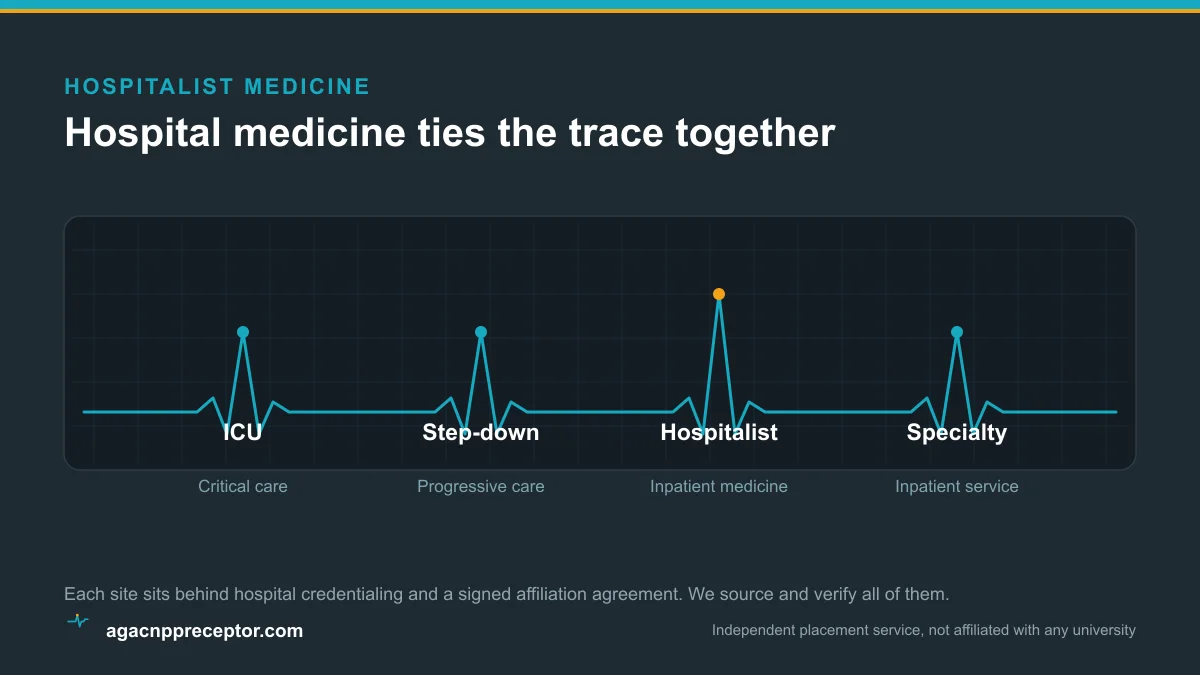
For an AGACNP student, the hospitalist rotation is where breadth comes together. It is often the setting that ties the specialty rotations into a coherent picture of how an acute inpatient service actually runs, and it is a strong fit for the core acute-care competencies your program expects. Many AGACNPs go on to practice in exactly this role, so the rotation doubles as a realistic preview of the job.
How does hospital medicine fit the AGACNP role?
Hospitalist and inpatient-medicine practice is one of the largest employment settings for practicing AGACNPs, which makes the rotation both educationally central and professionally relevant. The service manages the admitted acute patient who is not sick enough for the ICU but is too sick to be home, precisely the adult-gerontology acute population the certification targets.
Because hospital medicine is broad, it is often flexible about the mix of conditions you see, which can help you round out competencies you have not met elsewhere. Whether your program treats hospital medicine as a core rotation, an elective, or part of a general inpatient block varies by school, so confirm how your program counts these hours.
Who can precept your hospitalist hours?
Your hospitalist preceptor has to practice in inpatient medicine. In general that is a certified AGACNP or ACNP (acute care nurse practitioner) working on the hospital-medicine service, or a physician (MD or DO) practicing as a hospitalist or in inpatient internal medicine.
Eligibility rules are set by each program and its accreditor and state board. We verify each candidate against your school's exact requirements before you commit, so your inpatient-medicine hours count. See our preceptor requirements page for the full picture.
How we place your hospitalist rotation
We source your hospital-medicine rotation alongside the rest of your acute trace. You tell us your school, your city, and the inpatient-medicine hours you still need, and we find an approvable hospitalist service and a qualified preceptor, early enough to clear credentialing.
- Local first, because credentialing and affiliation agreements are geographically bound.
- Matched to the requirement, so your inpatient-medicine hours count toward your program.
- Verified preceptors, checked against your school's eligibility rules before you commit.
- Credentialing-ready, with the affiliation-agreement and credentialing paperwork prepared in advance.
Final approval of any site or preceptor rests with the university and the hospital, and we do not speak for either. We do not guarantee hours, grades, or outcomes, and nothing here is a tuition refund. See how it works or start on the find a preceptor page.
Good to know
What does an AGACNP hospitalist rotation teach?
Generalist inpatient care: managing admitted adult and older-adult patients across a wide range of acute conditions, admission and discharge decision-making, daily rounding and management, and coordination with consultants. It ties the specialty rotations into a coherent picture of how an acute inpatient service runs and previews a common AGACNP practice setting.
Is hospital medicine a common AGACNP job?
Yes. Hospitalist and inpatient-medicine practice is one of the largest employment settings for practicing AGACNPs, managing the admitted acute patient who is too sick for home but not sick enough for the ICU. That makes the rotation both educationally central and professionally relevant. Whether your program counts it as core, elective, or part of a general inpatient block varies by school.
Who can precept my hospitalist hours?
Generally a certified AGACNP or ACNP (acute care nurse practitioner) on the hospital-medicine service, or a physician (MD or DO) practicing as a hospitalist or in inpatient internal medicine. Eligibility is set by each program and its accreditor and state board, and we verify every candidate against your school's requirements before you commit.
Are you affiliated with a university?
No. We are an independent placement service that works separately from any university or certification body. We source and verify your hospitalist preceptor and site; final approval always rests with the university and the hospital.
Secure the rotation no one else will hand you
Tell us your school, your city, and the acute rotations you still need. We will come back with a plan for the full AGACNP trace and a realistic path to placed.