AGACNP ICU and Critical Care Rotation Placement
For an Adult-Gerontology Acute Care Nurse Practitioner student, the intensive care unit is the signature rotation and the single hardest one to arrange on your own. A clinic can say yes to a primary-care student in a phone call, but an ICU rotation asks a health system to credential you inside its most tightly controlled unit, alongside an acute care NP or intensivist who has almost no free hours. This page explains what the critical-care rotation is meant to teach, why ICU sites are so scarce, and how we source and verify a qualified preceptor and an approved ICU site for you. We are an independent placement service that works separately from any university.
Tell us your school and city. It is free to ask, with no obligation.
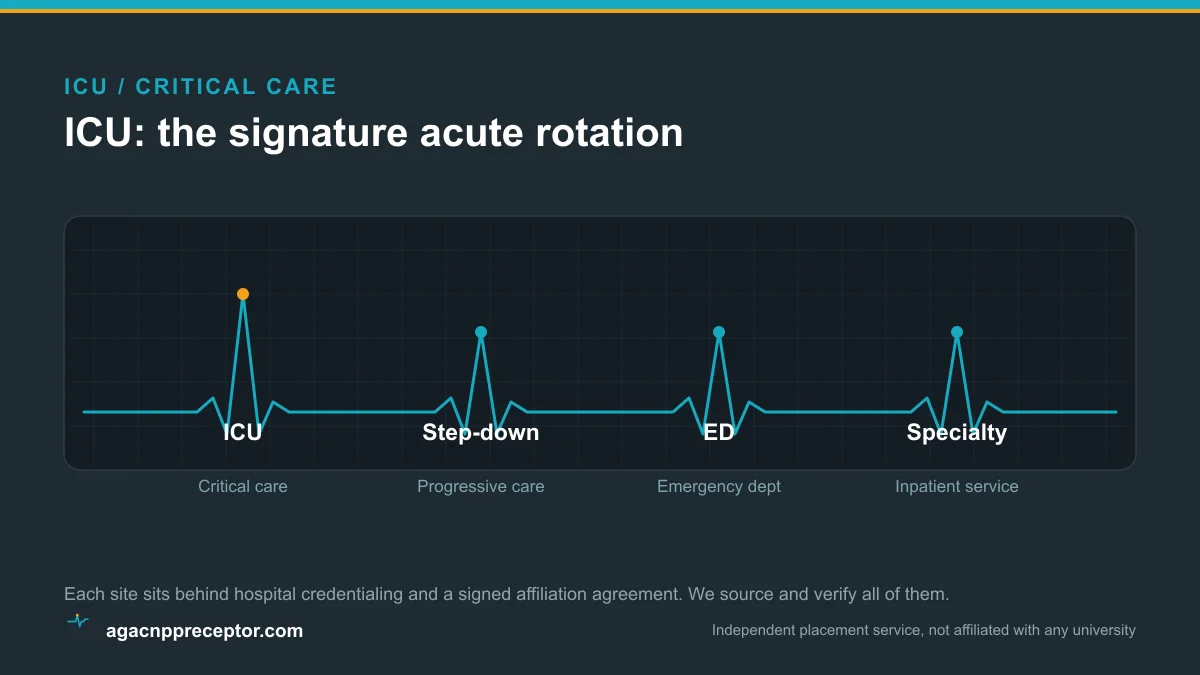
What does the AGACNP ICU rotation actually cover?
Critical care is where the AGACNP role is defined most sharply. In the ICU you are learning to assess and manage the acutely unstable adult and older-adult patient: interpreting hemodynamics, managing respiratory failure and ventilation, titrating vasoactive and sedation drips, reading the trajectory of sepsis, shock, and multi-organ dysfunction, and communicating with families through high-stakes decisions.
The unit may be a medical ICU, a surgical or trauma ICU, a cardiac or cardiovascular ICU, or a neurocritical care unit, and programs differ in which of these they will accept for core critical-care hours. What is consistent is the intensity: the ICU is where the acute-care competencies your program lists become real patient management rather than coursework.
Because critical care sits at the center of AGACNP training, most programs expect a meaningful block of hours in an ICU or comparable critical-care setting. The exact block, and which ICU types count, is set by your program, so confirm the requirement against your own school before you plan around it.
Why is an ICU rotation so hard to secure independently?
Securing acute-care and ICU clinical sites is among the hardest placements to obtain independently, and the reasons are structural, not personal.
- Credentialing, not acceptance. Inpatient units credential students; they do not simply accept them. That means a formal process, not a handshake.
- Affiliation agreements. Every ICU site needs a signed affiliation agreement between the hospital and your university before you can set foot on the unit.
- Scarce preceptors. Critical-care NPs and intensivists are few, and their time at the bedside is limited, so precepting capacity is tight.
- Slots fill early. ICU and critical-care slots are claimed long before the term starts, and students from many programs are competing for the same units.
- Online programs do not place you. Most AGACNP programs are online and expect you to arrange the site yourself.
None of that means it cannot be done. It means the ICU search rewards starting early, knowing which units are approvable, and arriving with the credentialing paperwork ready. That is exactly the work we take off your plate.
Who can precept your ICU hours?
Your ICU preceptor has to practice in the critical-care setting your rotation targets. In general that is a certified AGACNP or ACNP (acute care nurse practitioner) working in the unit, or a physician (MD or DO) in a matching acute role, most often an intensivist, but sometimes a hospitalist or specialty physician who covers critical-care patients.
The specific rules are set by each program and its accreditor and state board, and some schools are stricter than others about who may supervise inpatient hours and in what ratio. A preceptor who is perfect for a step-down unit may not satisfy a program's dedicated critical-care requirement, and a willing intensivist still has to clear your school's eligibility rules. We verify every candidate against your program's exact requirements before you commit, so you never log ICU hours that will not count. The full eligibility picture is on our preceptor requirements page.
How we place your ICU rotation
Our role is to run the inpatient search in parallel so a critical-care slot does not become the reason your program slips a term. You tell us your school, your city, and the critical-care hours you still need, and we source a qualified ICU preceptor and an approvable unit, early enough to clear credentialing before you start.
- Local first. Credentialing and affiliation agreements are geographically bound, so we search health systems in your area for ICUs that can host you.
- Matched to the requirement. We target ICU types your program will accept for core critical-care hours, so the block counts.
- Verified preceptors. We check each critical-care preceptor against your school's eligibility rules before you commit.
- Credentialing-ready. We help assemble the affiliation-agreement and credentialing paperwork the hospital requires, so approval moves rather than stalls.
Final approval of any site or preceptor rests with the university and the hospital, and we do not speak for either. We do not guarantee hours, grades, or outcomes, and nothing here is a tuition refund. What we offer is a settled ICU placement so critical care is not the rotation that leaves you one short. See how it works or start on the find a preceptor page.
Good to know
Why is the AGACNP ICU rotation the hardest to arrange?
Because inpatient units credential students rather than simply accepting them, every ICU site needs a signed affiliation agreement with your university, and critical-care preceptors are few with scarce bedside time. ICU slots fill early and students from many programs compete for them. Most AGACNP programs are online and do not place you, so the search is yours. That inpatient search is what our service takes off your plate.
What does an AGACNP ICU rotation teach?
Assessing and managing the acutely unstable adult and older-adult patient: hemodynamics, respiratory failure and ventilation, vasoactive and sedation drips, sepsis, shock, and multi-organ dysfunction, plus high-stakes family communication. The unit may be a medical, surgical or trauma, cardiac, or neurocritical care ICU. Which ICU types count toward core hours is set by your program, so confirm it with your school.
Who can precept my ICU hours?
Generally a certified AGACNP or ACNP (acute care nurse practitioner) working in the unit, or a physician (MD or DO) in a matching acute role such as an intensivist, hospitalist, or relevant specialty physician who covers critical-care patients. The preceptor must practice in the critical-care setting your rotation targets. Specific eligibility is set by each program and its accreditor and state board, and we verify every candidate against your school's rules.
Are you affiliated with a university?
No. We are an independent placement service that works separately from any university or certification body. We source and verify your ICU preceptor and site; final approval always rests with the university and the hospital.
Secure the rotation no one else will hand you
Tell us your school, your city, and the acute rotations you still need. We will come back with a plan for the full AGACNP trace and a realistic path to placed.