AGACNP Procedures and Advanced Skills Placement
Acute care is a hands-on role, and Adult-Gerontology Acute Care Nurse Practitioner programs expect you to build and log advanced procedural skills alongside your clinical hours. Central line placement, intubation assist, arterial lines, chest tubes, and other bedside procedures are part of what separates acute-care practice from primary care. This page explains what procedural competencies AGACNP training involves, how those opportunities are earned in an inpatient setting, and how we source and verify preceptors and sites where you can develop them. We are an independent placement service that works separately from any university.
Tell us your school and city. It is free to ask, with no obligation.
What procedures and advanced skills does AGACNP training involve?
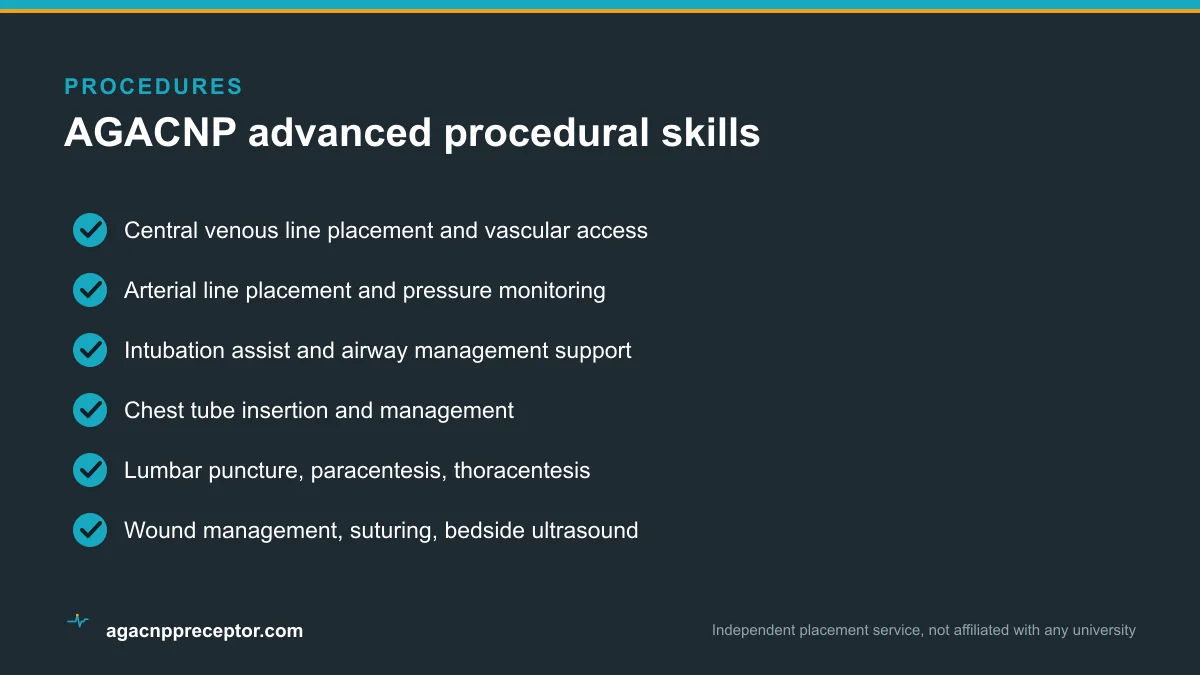
AGACNP programs define a set of advanced procedural competencies appropriate to acute and critical care. The exact list is set by each program, but common examples of the skills students are exposed to or expected to develop include:
- Central venous line placement and assisting with vascular access
- Arterial line placement and interpretation of arterial pressure monitoring
- Intubation assist and airway management support
- Chest tube insertion and management
- Lumbar puncture, paracentesis, and thoracentesis assist or performance where the program allows
- Wound management, suturing, and bedside ultrasound exposure
Programs vary widely in which procedures they require you to perform, which you only need to observe or assist with, and how many repetitions they count. Some skills are logged as competencies rather than fixed counts. Always confirm your program's procedural requirements and its rules on performance versus observation before you plan around them.
How do you get procedural opportunities on rotation?
Procedural exposure is not evenly distributed across sites, and this is where the choice of rotation and preceptor matters most. Procedures happen where acutely ill patients are, so the ICU, the emergency department, and procedure-heavy specialty services tend to offer the most opportunity, while a quieter unit may offer very little.
Just as important is the preceptor. A preceptor who involves students in bedside procedures, and a unit culture that supports supervised learning, will give you far more hands-on experience than one who does not, even in the same type of unit. When we source your acute rotations, we factor in whether a site and preceptor can realistically support the procedural competencies your program expects, so you are not left trying to log advanced skills on a unit that never performs them.
Who supervises your procedural skills?
The clinicians who supervise your procedural learning are the same acute-care preceptors who supervise your clinical hours: a certified AGACNP or ACNP (acute care nurse practitioner), or a physician (MD or DO) in a matching acute or inpatient role such as an intensivist, emergency medicine physician, hospitalist, or relevant specialist, practicing in the setting where the procedures occur.
Each program sets its own rules on who may supervise a student performing a given procedure, and hospitals have their own privileging and supervision policies on top of that. We verify preceptors against your school's requirements and factor procedural fit into the match. Full eligibility detail is on our preceptor requirements page.
How we place you where the skills are
Building procedural competency comes down to being in the right setting with the right preceptor, early enough to get real repetitions. We factor that into every acute-care placement we source. You tell us your school, your city, and the procedural competencies you still need, and we target sites and preceptors that can support them.
- Procedure-rich settings, prioritizing ICUs, emergency departments, and procedure-heavy services where the opportunities exist.
- Supportive preceptors, matched with attention to whether they involve students in supervised procedures.
- Matched to the requirement, so the competencies you log satisfy your program's procedural expectations.
- Credentialing-ready, with the paperwork prepared so you can start on schedule.
Final approval of any site or preceptor rests with the university and the hospital, and the procedures you are permitted to perform are governed by your program and the hospital's policies, not by us. We do not guarantee specific procedural volumes or outcomes, and nothing here is a tuition refund. See how it works or start on the find a preceptor page.
Good to know
What procedures do AGACNP students learn?
Common advanced acute-care skills include central and arterial line placement, intubation assist and airway support, chest tube management, lumbar puncture, paracentesis and thoracentesis, wound management and suturing, and bedside ultrasound exposure. The exact list, and whether you must perform, assist, or only observe each, is set by your program. Confirm your program's procedural requirements before planning around them.
How do I get procedural opportunities on rotation?
Procedures happen where acutely ill patients are, so ICUs, emergency departments, and procedure-heavy specialty services offer the most opportunity. The preceptor matters as much as the unit: one who involves students in supervised bedside procedures gives far more hands-on experience. We factor procedural fit into the sites and preceptors we source for you.
Who supervises my procedural skills?
The same acute-care preceptors who supervise your clinical hours: a certified AGACNP or ACNP, or a physician (MD or DO) in a matching acute role such as an intensivist, emergency medicine physician, hospitalist, or specialist, practicing where the procedures occur. Each program sets its own supervision rules and hospitals add their own privileging policies, and we verify preceptors against your school's requirements.
Are you affiliated with a university?
No. We are an independent placement service that works separately from any university or certification body. We source and verify preceptors and sites; the procedures you may perform are governed by your program and the hospital, and final approval always rests with them.
Secure the rotation no one else will hand you
Tell us your school, your city, and the acute rotations you still need. We will come back with a plan for the full AGACNP trace and a realistic path to placed.