AGACNP preceptor support for Quinnipiac University students
Students in the Quinnipiac University AGACNP program can use our independent service to source potential preceptors and acute or inpatient clinical sites. We build the request around the requirements confirmed by the student, while the program keeps every approval decision for the preceptor, setting, and paperwork.
Tell us your school and city. It is free to ask, with no obligation.
Quinnipiac University AGACNP pathway snapshot
- Program: Adult-Gerontology Acute Care Nurse Practitioner
- School: Quinnipiac University
- Directory location: Hamden, Connecticut
- Verified pathways: MSN
- Official evidence checked: July 21, 2026
- Clinical population: adults and older adults with complex, acute, critical, or unstable conditions
- Approval authority: the student's current program
The evidence explains why Quinnipiac University appears in this directory. It cannot be stretched into a claim about how the school arranges placements, which clinicians it accepts, how long review takes, or how many hours a particular student needs.
What the official Quinnipiac University evidence confirms
The source set was checked on July 21, 2026. It identifies MSN AGACNP evidence for Quinnipiac University. Source language can change, so save the current program instructions that govern the student's term and ask the program to resolve anything the public page leaves open.
- Official AGACNP source 1, MSN: Official page explicitly identifies the AGACNP specialty (Master of Science in Nursing: Adult-Gerontology Acute Care Nurse Practitioner - Quinnipiac University Academic Catalog).
- Official AGACNP source 2, MSN: Official page explicitly identifies the AGACNP specialty (MSN in Adult-Gerontology Acute Care Nurse Practitioner).
These citations are included for verification, not as an endorsement of our service. Read the current official page and ask the program to confirm any requirement that affects the proposed preceptor or site.
Build the adult-gerontology acute-care spine
Keep the adult-gerontology acute-care population at the center of the request. The setting needs enough complex and unstable adult care to support the approved competencies. Routine primary care, a general family practice, or an unrelated outpatient role cannot substitute for that clinical spine.
An acute practicum can be distributed across critical care, step-down, emergency, hospitalist, trauma, surgical, or focused inpatient teams when the course permits it. The name on the unit door is not enough. The student needs an appropriate adult and older-adult population plus supervised opportunities that map to the required competencies.
Turn the Quinnipiac University pathway label into a clinical brief
The record identifies MSN. Those credential labels help route the inquiry, but they do not reveal the student's entry point, course sequence, remaining hours, or clinical dates. Bring the exact course and current plan of study into the search so a pathway label is never treated as a policy.
A useful clinical request names what the student must actually do under supervision. Define the target population, acuity, care setting, procedures or skills, and expected level of participation. That detail lets a prospective preceptor assess fit without making promises on the program's behalf.
Confirm hours and preceptor eligibility
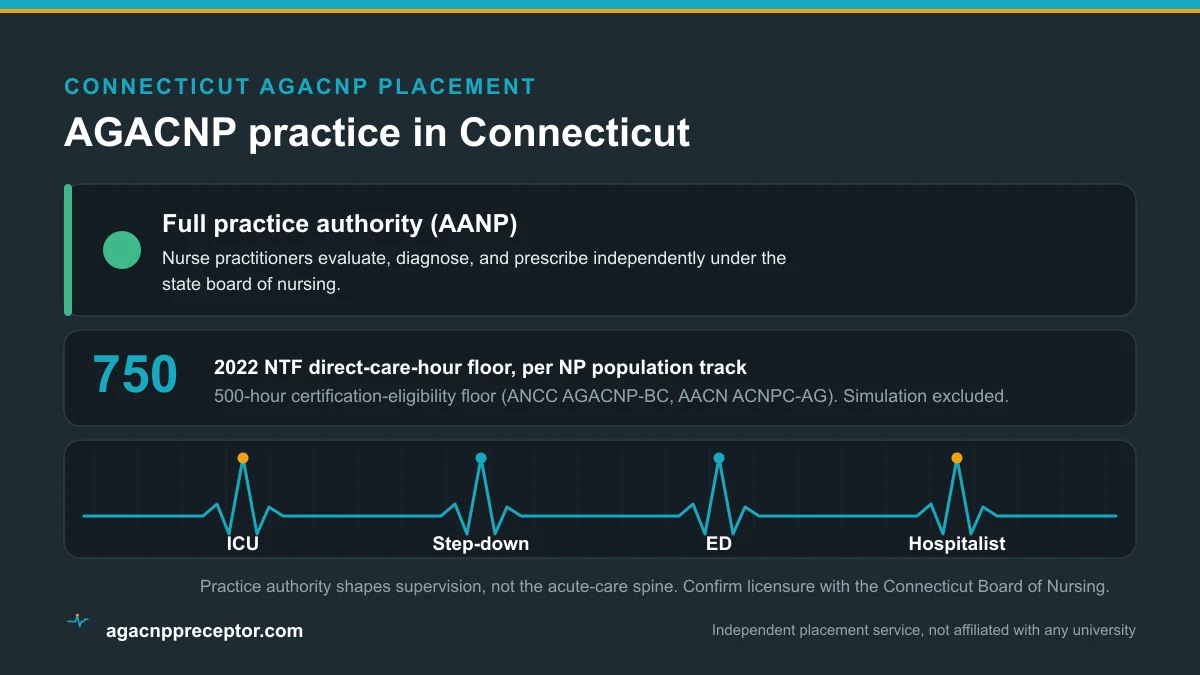
The hour plan must come from the student's program record. Nationally, NTF recommends a 750-hour direct patient care minimum for an NP population track, and the certification bodies publish a 500-hour faculty-supervised eligibility floor. Neither figure is presented here as Quinnipiac University's rule. Confirm the exact current requirement before sourcing.
Use the AGACNP clinical hours guide for national context and the preceptor requirements guide for screening questions. Neither guide replaces the program's current instructions.
Role alignment comes before convenience. A board-certified AGACNP or acute-care NP may fit, and a physician in critical care, hospital medicine, emergency medicine, or a relevant inpatient specialty may fit when the program allows it. The current program criteria determine the answer for each candidate.
Plan the acute-care search from Hamden
Start from the geography the program approves, not an assumption based on the Hamden campus listing. Acute capacity may be concentrated in larger referral centers, while a student's allowed area may be broader or narrower. Every proposed site still needs program review.
The AGACNP placement guide for Connecticut adds state-level context about acute and inpatient settings. Use it to frame the search, then apply the exact location and approval rules confirmed by the program.
Prepare a complete proposal for Quinnipiac University review
- The exact course, clinical objectives, term dates, and remaining approved hours
- The approved geography, adult-gerontology population, patient acuity, and setting
- The proposed clinician's license, certification, specialty, acute role, and availability
- The site's service line, patient mix, and opportunities tied to the objectives
- Every current preceptor, site, compliance, and submission form supplied by the program
A strong packet connects evidence to the course. Include the proposed preceptor's credentials and acute role, the site's service and patient mix, the expected experiences, dates, schedule, and every program form the student has received. Missing rules should be confirmed, not inferred from another school.
Independent AGACNP placement support
Once the current checklist is clear, send the course, term dates, approved geography, required setting, patient population, remaining hours, candidate criteria, and forms. Our placement process uses that brief to look for a possible match before the program evaluates it.
This is independent placement support, not a school service or endorsement. We can source and organize a candidate file for Quinnipiac University to review, but we cannot promise placement, acceptance, contracts, credentialing, or a timeline.
Good to know
Which AGACNP pathways are verified for Quinnipiac University?
The official source set checked July 21, 2026 identifies MSN. Those labels do not establish clinical hours, delivery format, placement policy, or approval steps. Confirm the active pathway and course requirements directly with the program.
How many AGACNP clinical hours does Quinnipiac University require?
This page does not assign an exact school total. NTF recommends at least 750 direct patient care hours for an NP track, while certification eligibility sources use a minimum of 500 faculty-supervised clinical hours. Programs vary, so confirm the student's exact current requirement with Quinnipiac University.
Who can precept a Quinnipiac University AGACNP student?
A board-certified acute-care NP or an appropriately licensed physician in a matching acute or inpatient role is a reasonable search target. The program decides whether a particular candidate, credential, role, and site meet the course rules.
Which clinical settings can support AGACNP objectives?
An inpatient or acute service may fit if the student can meet the required adult-gerontology population, acuity, and clinical activities under an eligible preceptor. The current program makes that determination.
Is AGACNP Preceptor affiliated with Quinnipiac University?
No. AGACNP Preceptor is an independent service and does not represent or receive endorsement from Quinnipiac University. We cannot guarantee placement, a timeline, paperwork completion, or program approval.
Related
Secure the rotation no one else will hand you
Tell us your school, your city, and the acute rotations you still need. We will come back with a plan for the full AGACNP trace and a realistic path to placed.