Finding acute-care AGACNP preceptors in Connecticut
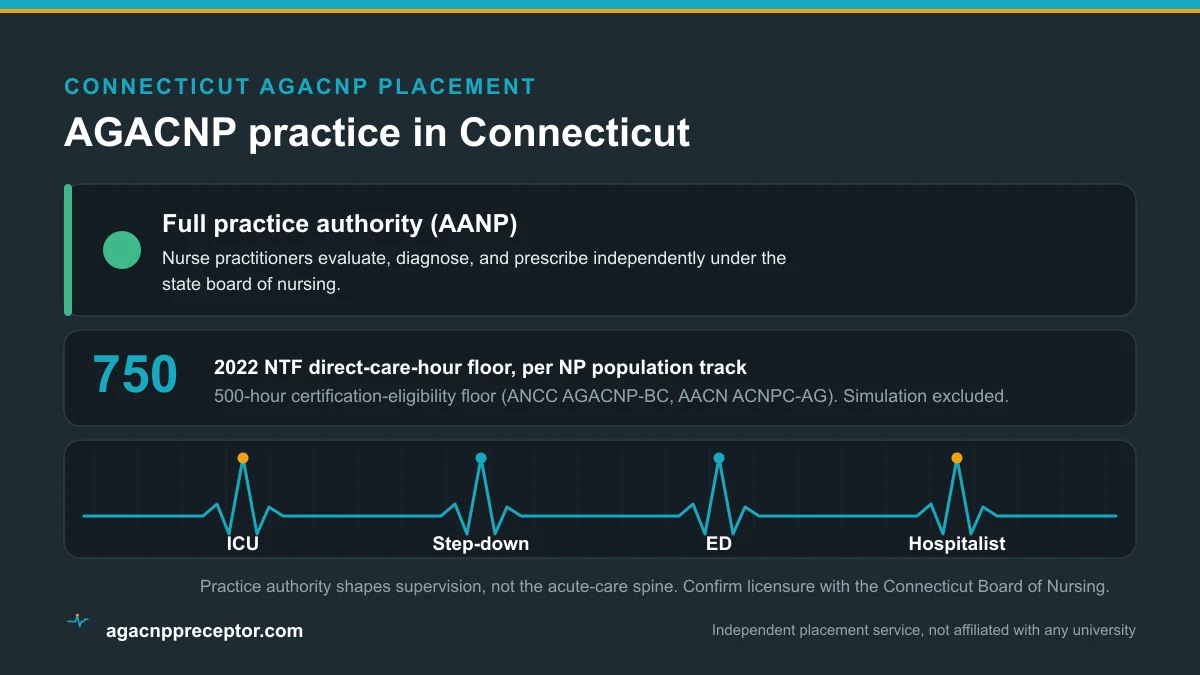
Connecticut packs a lot of high-acuity care into a small state, and that works in your favor as an adult-gerontology acute care nurse practitioner student. Your hours belong in ICUs, step-down units, emergency departments, and hospitalist services, and most of that capacity sits in a tight corridor between New Haven and Hartford. Connecticut grants full practice authority, though newer nurse practitioners work under a collaborative arrangement before they reach independence.
Tell us your school and city. It is free to ask, with no obligation.
The New Haven to Hartford acute-care corridor
Connecticut's high-acuity care is unusually concentrated. Two systems, Yale New Haven Health and Hartford HealthCare, together hold a large share of the market, and the state's Level I trauma centers sit in just two cities. Yale New Haven Hospital is a major academic and teaching hospital, Hartford Hospital is a large regional referral center, and Saint Francis Hospital adds a third Level I center in the Hartford area.
Because the state is compact, roughly two hours end to end, students can reach a tertiary center from most towns without relocating. Bridgeport, Stamford, Norwalk, Danbury, Waterbury, and New London add community and regional hospitals with real ICU and emergency volume. The trade-off is competition, since strong programs across the region draw on the same handful of high-acuity hospitals.
The northeast Quiet Corner and the northwest Litchfield hills are more rural, with smaller community hospitals and thinner critical care. Students there usually commute toward New Haven, Hartford, or a nearby regional center for intensive care and specialty blocks.
Inpatient services that host AGACNP students
AGACNP training is inpatient and high-acuity by design. It centers on unstable and complex adults from adolescence, near age 13, through the frail elderly, which points your hours squarely at hospital units rather than clinics.
- Intensive care across medical, surgical, cardiac, and neuro units
- Step-down and progressive care for the still-fragile patient
- Emergency departments for acute, undifferentiated presentations
- Hospitalist and inpatient medicine services managing the admitted census
- Inpatient specialty consults in cardiology, pulmonology, nephrology, and trauma
We keep AGACNP students out of primary care placements. Family and outpatient clinics belong to other tracks and will not develop the critical care judgment your certification exam and your future employer expect.
Full practice authority with a collaboration runway
Connecticut sits in the AANP full-practice category, and advanced practice registered nurses are licensed through the state's Board of Examiners for Nursing within the Department of Public Health. The detail that matters for new graduates is the runway: state law requires a period of physician collaboration, commonly described as three years and at least 2,000 hours, before a nurse practitioner practices fully independently.
In acute care this rarely changes daily life, because ICU and hospitalist teams are physician-led anyway, and an early-career AGACNP naturally works within that team. For your preceptor search it means an experienced nurse practitioner well past the transition can precept independently, while a newer NP may co-precept alongside a collaborating physician. A board-certified AGACNP-BC or ACNPC-AG, or an intensivist or hospitalist physician, can all serve as preceptor.
Where Connecticut hours get competitive
The same concentration that makes Connecticut convenient also makes certain hours tight. High-acuity ICU blocks, procedural and advanced-skills exposure, and continuity with one preceptor across a rotation are the usual bottlenecks, because the strongest sites field requests from many programs at once.
The adolescent slice of the AGACNP range is harder to capture in adult ICUs, which seldom admit patients under 18. If your program expects exposure to younger acute patients or to the frail elderly end of geriatrics, we plan those blocks deliberately rather than hoping they appear.
Clinical hours and certification, briefly
Your hour total is set by your program. The 2022 National Task Force standards recommend at least 750 direct patient care hours for an NP track, and ANCC or AACN Certification Corporation eligibility requires a minimum of 500 faculty-supervised hours. Many accredited AGACNP programs publish totals between roughly 500 and 750 or more, and some fall below 750, so verify your own figure and remember that simulation is generally excluded.
Preceptors are typically credentialed as AGACNP-BC or ACNPC-AG, or are physicians practicing in the acute setting. When you know your remaining hours and units, we can target the match instead of guessing. Read more on clinical hours if you are still mapping your plan.
How placement works with us
We are independent and unaffiliated with any school, and we help students from any program. Send us your town, your remaining unit needs, your program's hour requirement, and your timeline, and we search for a credentialed acute-care preceptor and site that fit. We advocate for you, but we do not guarantee placement or your school's sign-off, since that approval is your program's to give.
If you have an unmet ICU, step-down, or hospitalist requirement, start with how it works, review preceptor requirements, or reach us through the match form or contact page. Fees are explained plainly on our cost page.
Good to know
Is Connecticut a good state for AGACNP clinical placements?
It can be, because a lot of high-acuity care is packed into a small area. The Level I trauma centers and largest academic hospitals cluster around New Haven and Hartford, so most students can reach a tertiary center without moving. The flip side is competition for those same sites.
Does Connecticut's collaboration requirement affect my preceptor?
It can. Connecticut grants full practice authority but requires new nurse practitioners to complete a collaboration period, often cited as three years and 2,000 hours, before full independence. An experienced NP past that point can precept on their own, while a newer NP may work with a collaborating physician. Either way, a physician can also precept you.
Where do rural Connecticut students go for ICU hours?
The northeast and northwest corners are more rural, with smaller community hospitals. Students there usually commute toward New Haven, Hartford, or a regional center for intensive care and specialty blocks. Because the state is small, the drive is often manageable, and we help you find the closest workable site.
Can I use a primary care clinic for AGACNP hours?
No. The acute care track is about unstable, complex, and critically ill patients in the hospital. Outpatient primary care belongs to other tracks and will not build the skills your certification requires, so we place acute-care students in inpatient and high-acuity settings only.
Do you guarantee a placement?
No. We search for and help arrange acute-care preceptors and sites and advocate strongly on your behalf, but we cannot guarantee a placement or your program's approval of any preceptor or site. Those decisions rest with your school.
Related
Secure the rotation no one else will hand you
Tell us your school, your city, and the acute rotations you still need. We will come back with a plan for the full AGACNP trace and a realistic path to placed.