Adolescents and the Boundary of the AGACNP Scope
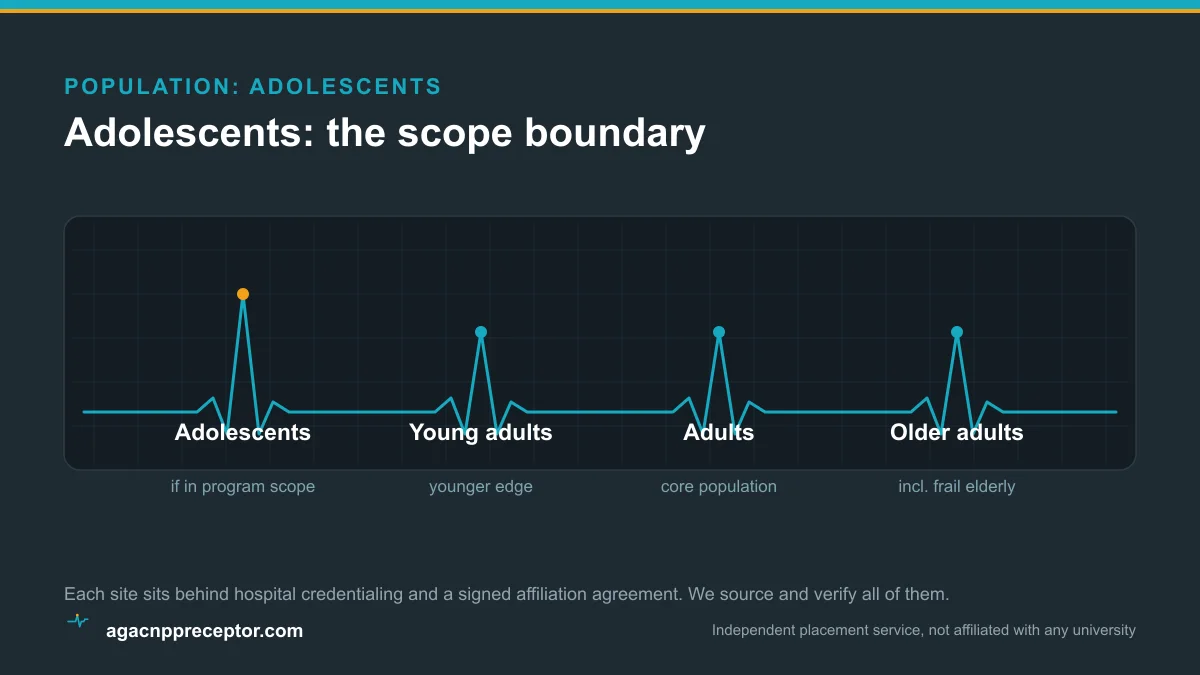
The younger edge of the Adult-Gerontology Acute Care Nurse Practitioner population is where the scope needs care. Adolescents are sometimes included in AGACNP practice, but only where a specific program defines them within its scope, and AGACNPs never care for children. Getting this boundary right matters for planning rotations and understanding what your certification does and does not authorize. This page explains where the AGACNP age floor sits, when adolescents are in scope, and how we place your acute rotations accordingly. We are an independent placement service that works separately from any university.
Tell us your school and city. It is free to ask, with no obligation.
Where does the AGACNP age floor sit?
The AGACNP population is adult-gerontology, which distinguishes it sharply from the pediatric and family roles. The population runs from adolescents through adults to older adults, including the frail elderly, with an age floor at roughly adolescence. AGACNPs do not care for children or infants, and the neonatal and pediatric populations belong to other certifications entirely.
The reason to be precise here is that the adolescent boundary is not uniform. Where the youngest end of the adolescent range falls, and whether a given program treats adolescents as part of its acute-care scope at all, is defined by the program and its accreditor, not by a single national line you can assume. This is why every mention of adolescents on this site carries the caveat that they are included only where a specific program defines them within scope.
When are adolescents actually in scope?
In practice, whether you will care for adolescents during your AGACNP training depends on your program and your clinical sites. Some programs and settings include older adolescents within the acute adult-gerontology population; others focus squarely on adults and older adults and do not.
The honest planning guidance is this: do not assume adolescents are in or out of your scope. Confirm with your program how it defines the youngest end of its population, whether adolescent acute-care experience is expected, and how any such hours count. Building a rotation plan on an assumption about the adolescent boundary is exactly the kind of thing that can leave hours miscounted. The broader adult population is covered on our young adults and adults pages.
How we place your acute rotations
We build your placement plan around the population your program actually defines, not an assumption. You tell us your school, your city, and the rotations and hours you still need, and we source qualified preceptors and approved inpatient sites that match your program's scope.
- Scope-matched planning, so your rotations fit the population your program defines, adolescents included only where your program says so.
- Verified preceptors, checked against your school's eligibility rules before you commit.
- Local first, because inpatient credentialing and affiliation agreements are geographically bound.
- Credentialing-ready, with the paperwork prepared so you can start on schedule.
Final approval of any site or preceptor, and the definition of your program's scope, rests with the university, and we do not speak for it. We do not guarantee hours, grades, or outcomes, and nothing here is a tuition refund. See how it works or start on the find a preceptor page.
Good to know
Do AGACNPs care for adolescents?
Sometimes, but only where a specific program defines adolescents within its scope. The AGACNP population is adult-gerontology with an age floor at roughly adolescence. AGACNPs do not care for children or infants. Whether adolescents are part of your acute-care scope, and where the youngest boundary falls, is defined by your program and its accreditor, so confirm it with your school.
Where does the AGACNP age range start?
At roughly adolescence. The population runs from adolescents (where a program defines them within scope) through adults to older adults, including the frail elderly. This distinguishes the AGACNP from pediatric, neonatal, and family roles. AGACNPs do not care for children, and the exact adolescent boundary is set by each program, not a single national line.
Should I assume adolescents are in my scope?
No. Do not build a rotation plan on an assumption about the adolescent boundary. Confirm with your program how it defines the youngest end of its population, whether adolescent acute-care experience is expected, and how any such hours count. We plan your placements around the population your program actually defines.
Are you affiliated with a university?
No. We are an independent placement service that works separately from any university or certification body. We source and verify your acute-care preceptors and sites; the definition of your program's scope and final approval always rest with the university.
Related
Secure the rotation no one else will hand you
Tell us your school, your city, and the acute rotations you still need. We will come back with a plan for the full AGACNP trace and a realistic path to placed.