The Young Adult Population in AGACNP Acute Care
The Adult-Gerontology Acute Care Nurse Practitioner cares for patients across the adult lifespan, and young adults sit at the younger end of that span. Understanding where the AGACNP population begins, and how young-adult acute care differs from older-adult care, helps you plan rotations that cover the range your certification expects. This page explains the young-adult population within the AGACNP scope, where you encounter these patients, and how we place your acute rotations so the population breadth is covered. We are an independent placement service that works separately from any university.
Tell us your school and city. It is free to ask, with no obligation.
Where do young adults fit in the AGACNP population?
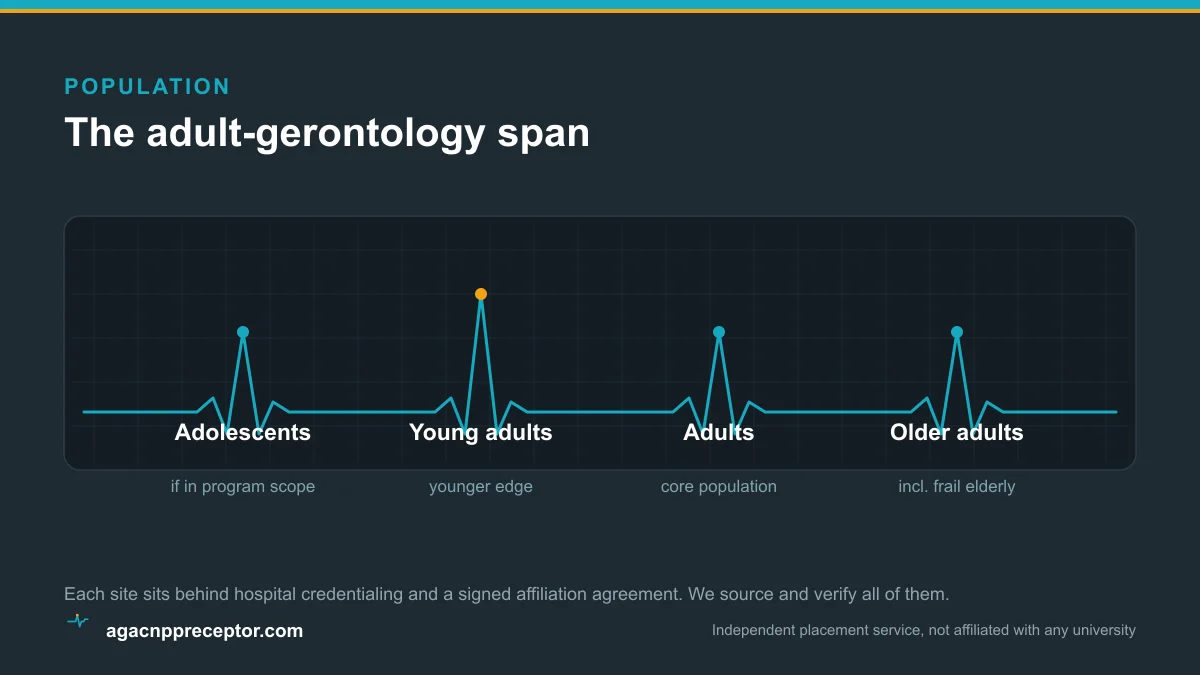
The AGACNP population is adult-gerontology, running from adolescents (where a specific program defines them within scope) and young adults through adults to older adults, including the frail elderly. Young adults, broadly those in early adulthood, form the younger edge of that span. Unlike a Family Nurse Practitioner, the AGACNP does not care for children, and the population floor sits at roughly adolescence rather than pediatrics.
In acute care, young adults present a distinct clinical picture. They are more likely to arrive through trauma, overdose, acute infection, complications of chronic disease that began in youth, or acute presentations of conditions like asthma, diabetes, and sickle cell disease. Managing the acutely ill young adult means attending to a different risk profile than the frail elderly, even when the setting, the ICU, the emergency department, or an inpatient service, is the same.
Where do you see young adults on rotation?
You will encounter young adults across the same acute settings that define AGACNP training. Trauma and surgical services, the emergency department, and medical and surgical ICUs all see a meaningful share of young-adult patients, and inpatient specialty services care for the young adults whose acute or chronic conditions bring them in.
Because the AGACNP population spans the full adult range, programs generally do not carve out a separate young-adult rotation; instead the population breadth is built into the acute settings you rotate through. What matters is that your rotations, taken together, give you supervised experience across the age span your certification covers. Our adults and older adults pages cover the rest of that span, and the adolescents page explains the scope caveat at the youngest end.
How we place your acute rotations across the population
Our job is to secure the acute-care rotations that, together, cover the population and clinical breadth your program expects, young adults included. You tell us your school, your city, and the rotations and hours you still need, and we source qualified preceptors and approved inpatient sites across the acute trace.
- Full-trace coverage, so your rotations span the acute settings where the adult-gerontology population is seen.
- Verified preceptors, checked against your school's eligibility rules before you commit.
- Local first, because inpatient credentialing and affiliation agreements are geographically bound.
- Credentialing-ready, with the paperwork prepared so you can start on schedule.
Final approval of any site or preceptor rests with the university and the hospital, and we do not speak for either. We do not guarantee hours, grades, or outcomes, and nothing here is a tuition refund. See how it works or start on the find a preceptor page.
Good to know
Are young adults part of the AGACNP population?
Yes. The AGACNP population is adult-gerontology, running from adolescents (where a program defines them within scope) and young adults through adults to older adults, including the frail elderly. Young adults form the younger edge of that span. AGACNPs do not care for children, and the population floor sits at roughly adolescence rather than pediatrics.
Is there a separate young-adult rotation?
Generally no. Because the AGACNP population spans the full adult range, programs build population breadth into the acute settings you rotate through rather than a dedicated young-adult rotation. Young adults appear across trauma and surgical services, the emergency department, ICUs, and inpatient specialties. What matters is that your rotations together cover the age span your certification requires.
How is acute care for young adults different?
Young adults present a distinct risk profile: more trauma, overdose, acute infection, and acute presentations of conditions like asthma, diabetes, and sickle cell disease, compared with the frail elderly. Managing the acutely ill young adult means attending to that profile even when the setting is the same ICU, emergency department, or inpatient service.
Are you affiliated with a university?
No. We are an independent placement service that works separately from any university or certification body. We source and verify your acute-care preceptors and sites; final approval always rests with the university and the hospital.
Secure the rotation no one else will hand you
Tell us your school, your city, and the acute rotations you still need. We will come back with a plan for the full AGACNP trace and a realistic path to placed.