AGACNP preceptor support for Seton Hall University students
Our role for Seton Hall University AGACNP students is focused: search for a qualified acute-care preceptor and a site that can support the approved clinical objectives. We do not represent the school, and no candidate is described as accepted until the program completes its own review.
Tell us your school and city. It is free to ask, with no obligation.
Seton Hall University AGACNP pathway snapshot
- Program: Adult-Gerontology Acute Care Nurse Practitioner
- School: Seton Hall University
- Directory location: South Orange, New Jersey
- Verified pathways: MSN
- Official evidence checked: July 21, 2026
- Clinical population: adults and older adults with complex, acute, critical, or unstable conditions
- Approval authority: the student's current program
A published AGACNP page confirms a current pathway, not every operational detail around clinical education. Use the links below as the source record, then verify the student's course documents before contacting a preceptor or site.
What the official Seton Hall University evidence confirms
We verified the listed MSN evidence on July 21, 2026. Each link belongs to the institution or its official catalog and names the AGACNP specialty. The student's present course materials still control the clinical request.
- Official AGACNP source 1, MSN: Official page explicitly identifies the AGACNP specialty (Master of Science in Nursing (M.S.N.) - Adult-Gerontology Acute Care Nurse Practitioner).
- Official AGACNP source 2, MSN: Official page explicitly identifies the AGACNP specialty (Adult-Gerontology Acute Care Nurse Practitioner (M.S.N.) at Seton Hall University, New Jersey).
These citations are included for verification, not as an endorsement of our service. Read the current official page and ask the program to confirm any requirement that affects the proposed preceptor or site.
Match the practicum to complex and unstable adults
Begin with the patient acuity and course outcomes. AGACNP preparation concerns episodic, complex, and critical illness across adulthood and older adulthood, including frail older adults. It is not an FNP or adult-gerontology primary-care rotation, and an ambulatory setting does not become acute care simply because an NP works there.
Depending on the objectives, the search may include ICU or critical care, step-down or progressive care, emergency care, hospitalist or inpatient medicine, trauma and surgical services, or an inpatient specialty such as cardiology, pulmonology, or nephrology. No setting is automatically acceptable. The program must decide whether the patient mix, acuity, clinician role, and available activities fit the course.
Turn the Seton Hall University pathway label into a clinical brief
The published pathway set is MSN. Before sourcing, separate that public fact from the student's individual clinical need. Confirm the active course, required outcomes, remaining approved hours, site boundaries, and candidate credentials with the program.
Break the practicum into the competencies that remain unmet. The search can then prioritize the right service and clinician instead of asking broadly for any AGACNP preceptor. The program still reviews the combined picture and can request a different arrangement.
Confirm hours and preceptor eligibility
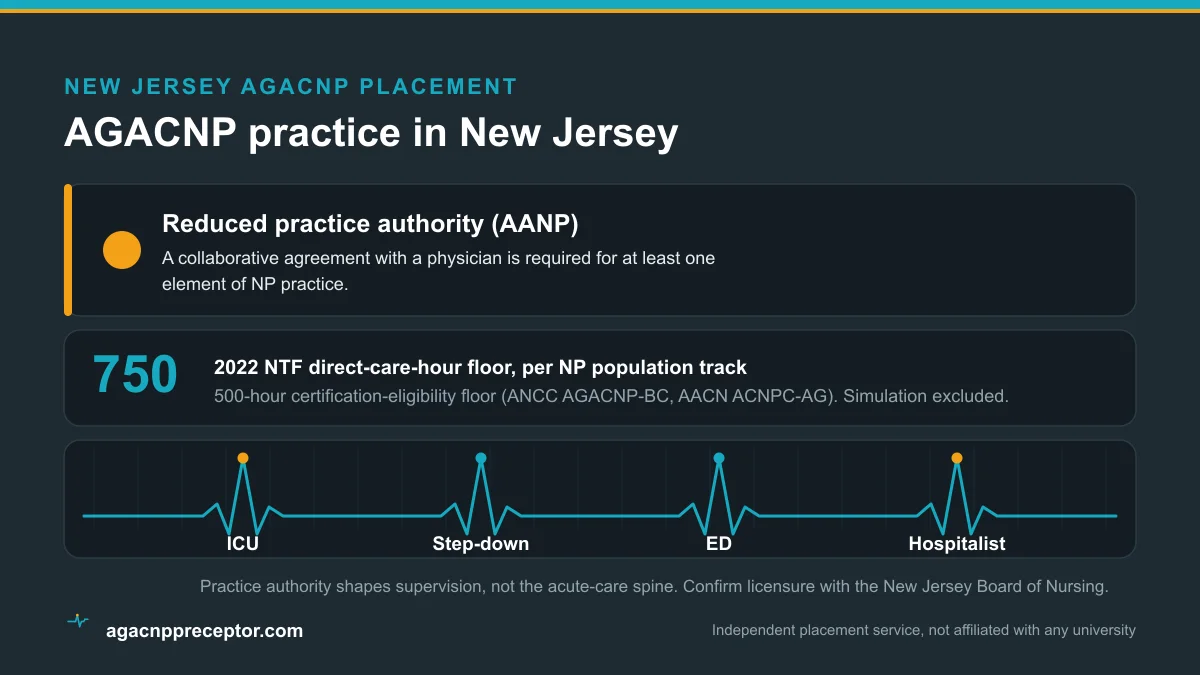
Do not calculate this student's need from a national number. NTF recommends at least 750 direct patient care hours for an NP track, while AGACNP certification eligibility materials refer to a minimum of 500 faculty-supervised clinical hours. The current program determines the applicable total, course allocation, simulation treatment, and remaining balance.
Use the AGACNP clinical hours guide for national context and the preceptor requirements guide for screening questions. Neither guide replaces the program's current instructions.
The clinician should actively practice in the acute or inpatient work the student needs. A matching board-certified acute-care NP or licensed physician is a reasonable search target, but credentials alone do not establish eligibility. The program reviews the person's role, background, site, and proposed supervision.
Plan the acute-care search from South Orange
South Orange, New Jersey identifies the school record, but it does not define a clinical territory. A student may need to consider nearby or more distant acute-care services if the program permits travel. We confirm the allowed location before screening sites so outreach stays inside the student's actual boundaries.
For wider geographic context, read the AGACNP placement guide for New Jersey. It describes the state's acute-care landscape without assigning a policy to Seton Hall University or claiming that a named hospital accepts students.
Prepare a complete proposal for Seton Hall University review
- The exact course, clinical objectives, term dates, and remaining approved hours
- The approved geography, adult-gerontology population, patient acuity, and setting
- The proposed clinician's license, certification, specialty, acute role, and availability
- The site's service line, patient mix, and opportunities tied to the objectives
- Every current preceptor, site, compliance, and submission form supplied by the program
A strong packet connects evidence to the course. Include the proposed preceptor's credentials and acute role, the site's service and patient mix, the expected experiences, dates, schedule, and every program form the student has received. Missing rules should be confirmed, not inferred from another school.
Independent AGACNP placement support
The first useful step is a complete clinical brief rather than a broad request for any preceptor. Share the student's approved requirements through the matching form. We can then search for acute-care fit without claiming authority we do not have.
We do not represent Seton Hall University and have no authority to approve a clinician, site, schedule, or clinical plan. Our independent role is limited to searching and documenting a possible match. Availability, review time, and the final program decision cannot be guaranteed.
Good to know
Which AGACNP pathways are verified for Seton Hall University?
The official source set checked July 21, 2026 identifies MSN. Those labels do not establish clinical hours, delivery format, placement policy, or approval steps. Confirm the active pathway and course requirements directly with the program.
How many AGACNP clinical hours does Seton Hall University require?
This page does not assign an exact school total. NTF recommends at least 750 direct patient care hours for an NP track, while certification eligibility sources use a minimum of 500 faculty-supervised clinical hours. Programs vary, so confirm the student's exact current requirement with Seton Hall University.
Who can precept a Seton Hall University AGACNP student?
A board-certified acute-care NP or an appropriately licensed physician in a matching acute or inpatient role is a reasonable search target. The program decides whether a particular candidate, credential, role, and site meet the course rules.
Which clinical settings can support AGACNP objectives?
An inpatient or acute service may fit if the student can meet the required adult-gerontology population, acuity, and clinical activities under an eligible preceptor. The current program makes that determination.
Is AGACNP Preceptor affiliated with Seton Hall University?
No. AGACNP Preceptor is an independent service and does not represent or receive endorsement from Seton Hall University. We cannot guarantee placement, a timeline, paperwork completion, or program approval.
Related
Secure the rotation no one else will hand you
Tell us your school, your city, and the acute rotations you still need. We will come back with a plan for the full AGACNP trace and a realistic path to placed.