AGACNP acute-care placement across New Jersey
New Jersey has one of the densest hospital networks in the country, with three academic Level I trauma centers and several large multi-hospital systems packed into a small, urban state. For an Adult-Gerontology Acute Care NP student, the challenge here is rarely finding a hospital; it is competing for slots and getting credentialed inside systems that many students are trying to enter at once. As a full-practice state since 2026, New Jersey shapes your supervision arrangement more than your preceptor's qualifications, and we source those acute-care preceptors and sites for students at any university.
Tell us your school and city. It is free to ask, with no obligation.
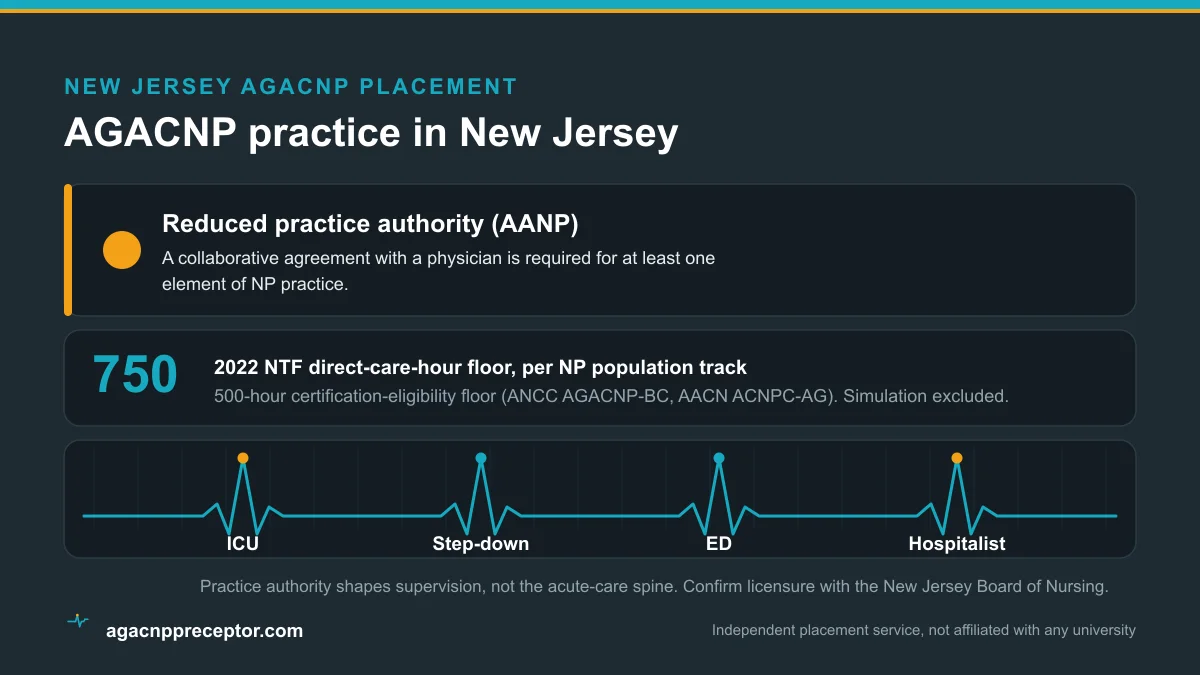
New Jersey's dense acute-care network
Because AGACNP training is inpatient and high-acuity, your hours follow the state's intensive-care and referral capacity, and New Jersey has an unusual amount of it for its size. Three state-designated Level I trauma centers anchor the map: University Hospital in Newark, a public academic medical center in the north; Robert Wood Johnson University Hospital in New Brunswick, an academic center in the central corridor; and Cooper University Hospital in Camden, the academic referral center for the south.
Around those three sit some of the largest health systems in the region, running deep ICU, step-down, and inpatient-specialty services across the northern, central, and shore areas, along with a tier of Level II trauma centers in cities like Morristown, Hackensack, Jersey City, Trenton, and Atlantic City. For an acute-care student, that means the medical, surgical, cardiac, and neuro units your program cares about exist in real quantity here, which is a genuine advantage over rural states.
The units where AGACNP students rotate
Your clinical hours come from acute and inpatient settings, and across New Jersey's hospitals the ones that carry those hours are consistent:
- Intensive care in medical, surgical, cardiac, and neuro forms, the core AGACNP rotation.
- Step-down and progressive care for high-risk patients short of ICU level.
- Emergency departments, many of them high-volume urban centers.
- Hospitalist and inpatient medicine services that run admitted-patient care.
- Inpatient specialty services in cardiology, pulmonology, nephrology, and trauma or surgical care.
- Procedures and advanced skills, best planned rather than left to chance.
The patients span the acute-care range, from adolescents near age 13 through older adults and the frail elderly. The adolescent end still takes intention to reach, but New Jersey's volume across large systems makes a full age range more attainable than in thinner states.
Practice authority in New Jersey
New Jersey moved to full practice authority in 2026. A law signed on March 30, 2026 removed the long-standing joint-protocol requirement, so a qualified nurse practitioner can now practice and prescribe independently, without a collaborating-physician agreement. The change followed a turbulent stretch early that year when pandemic-era waivers were set to expire, and it settled the question on a permanent footing.
The reality has a threshold worth understanding. The law ties full independence to accrued licensed clinical experience, so more seasoned NPs practice on their own while those earlier in their careers work under a transitional arrangement, and a narrow exception applies in aesthetics. For a student, none of this changes the core qualifications of a good preceptor. In an ICU, a collaborating or supervising physician is usually on the team by design, so your preceptor may be a board-certified acute-care NP, a physician, or both. Confirm current details with the New Jersey Board of Nursing.
Density is not the same as easy access
Having many hospitals nearby does not make placement simple. New Jersey's academic and system hospitals are precisely the sites that students from numerous programs pursue, and inpatient units credential students rather than merely accepting them, which means formal affiliation agreements, background and health requirements, and lead time. Popular ICU and specialty blocks fill early, and a late start is the most common reason a strong candidate ends up scrambling.
There is also a border effect. Northern New Jersey sits across the river from New York City and the southwest sits across from Philadelphia, so some students look to those cities for tertiary exposure. That widens the field but adds another jurisdiction's licensing and credentialing. We help you decide which blocks to keep in state and which are worth arranging across a river.
Which hours take the most work to secure
Even in a hospital-rich state, the tight rotations are the high-acuity ones: sustained critical-care time, structured procedures and advanced skills, and adolescent acute care. Demand for these outpaces the number of qualified preceptors who have room to teach, which is why competition, not geography, is the binding constraint here.
On hours, work from your own program rather than a rumor. The 2022 National Task Force standards recommend a minimum of 750 direct patient care hours, national certification eligibility requires at least 500 faculty-supervised hours, and accredited AGACNP programs commonly publish totals from roughly 500 to 750 or more. Verify the number your school uses, and our clinical hours guide shows how the counts fit together.
How we place AGACNP students in New Jersey
We match you with a board-certified acute-care NP (AGACNP-BC or ACNPC-AG) or a qualifying acute-care physician at a real New Jersey hospital, then carry the affiliation-agreement and credentialing work that inpatient units demand and that fills so much of a student's timeline. See the steps on how it works and who qualifies on our preceptor requirements page. We are independent, we help students at any university, and we never guarantee placement or a school's approval of any site.
To get your New Jersey ICU, step-down, or hospitalist hours in motion, send your program's requirements and your location through the form at #match or our contact page. Pricing is spelled out on the cost page.
Good to know
Is New Jersey a full-practice state now?
Yes. A law signed on March 30, 2026 removed the joint-protocol requirement, so qualified nurse practitioners can practice and prescribe independently. Full independence is tied to accrued licensed clinical experience, with a transitional arrangement for newer NPs and a narrow aesthetics exception, so confirm your situation with the New Jersey Board of Nursing.
If there are so many hospitals, why use a placement service?
Because density is not access. New Jersey's academic and system hospitals are the ones many students chase, and inpatient units credential rather than simply accept students, with affiliation agreements and long lead times. Popular ICU and specialty slots fill early, and we do the sourcing and paperwork so yours are locked in.
Can I do part of my rotation in New York City or Philadelphia?
Some students near the borders do, for tertiary exposure. It broadens your options but adds another state's licensing and credentialing. We help you weigh which blocks are worth arranging across a river and which stay in New Jersey.
Who can precept my AGACNP hours in New Jersey?
Generally a board-certified acute-care NP (AGACNP-BC or ACNPC-AG) or a physician in the acute setting, such as an intensivist, hospitalist, or specialist. Your program sets the final requirements, and we match to them and to a New Jersey-licensed preceptor.
Do you work with students from any school?
Yes. We are an independent placement service for AGACNP students at any university. We work independently of any program, and we cannot guarantee placement or approval of a specific preceptor or site.
Secure the rotation no one else will hand you
Tell us your school, your city, and the acute rotations you still need. We will come back with a plan for the full AGACNP trace and a realistic path to placed.