Sourcing AGACNP acute-care rotations across Maryland
We place Adult-Gerontology Acute Care Nurse Practitioner students at Maryland hospitals, in a state with unusually deep acute-care capacity clustered along the Baltimore and Washington corridor. Your rotations are inpatient, built in intensive care, step-down, the emergency department, and on hospitalist and specialty services, which is why an acute site takes more to arrange than a clinic. We are independent and serve students at any university.
Tell us your school and city. It is free to ask, with no obligation.
Baltimore's academic core
Maryland packs a lot of high-acuity medicine into a small state, and Baltimore holds the center of it. Johns Hopkins Hospital is a quaternary academic medical center with national referral reach. The University of Maryland Medical Center houses the R Adams Cowley Shock Trauma Center, the first fully integrated trauma center in the world, which runs dedicated critical-care units for multi-system and neurologic trauma and takes thousands of admissions a year.
Around them, MedStar, LifeBridge, and other systems add large inpatient hospitals, and the academic depth means specialty ICUs, cardiac, surgical, and neuro, are unusually well represented. These are real institutions, not guaranteed seats; each runs its own student credentialing, and we work whichever system near you can host your block.
The settings and the specialty depth
AGACNP is an inpatient, high-acuity role, so your Maryland hours run through the intensive care units, medical, surgical, cardiac, and neuro, the step-down and progressive care floors, the emergency department, and the hospitalist teams that carry admitted patients.
Because the Baltimore systems are academic and specialized, inpatient specialty blocks in cardiology, pulmonology, nephrology, and trauma or surgical care are more available here than in most states, and Shock Trauma makes concentrated critical-care exposure realistic. Long-term acute care hospitals add another setting, and the census spans young adults through the frail elderly.
Beyond the corridor: Eastern Shore and Western Maryland
Away from the I-95 corridor, Maryland gets rural fast. On the Eastern Shore, TidalHealth Peninsula Regional in Salisbury is the region's largest hospital and its tertiary anchor, with critical-care and specialty services that keep more care local. In the far west, UPMC Western Maryland in Cumberland carries the acute load for the mountains. Both sit a long way from Baltimore.
Between them, the Shore and Western Maryland rely on smaller community and critical-access hospitals that stabilize and transfer high-acuity patients. Students in those regions often plan to train at the local tertiary hospital or travel toward Baltimore for the deepest ICU and specialty hours. We map that geography before it becomes a scheduling problem, since credentialing is tied to place.
Full practice authority and your hospital preceptor
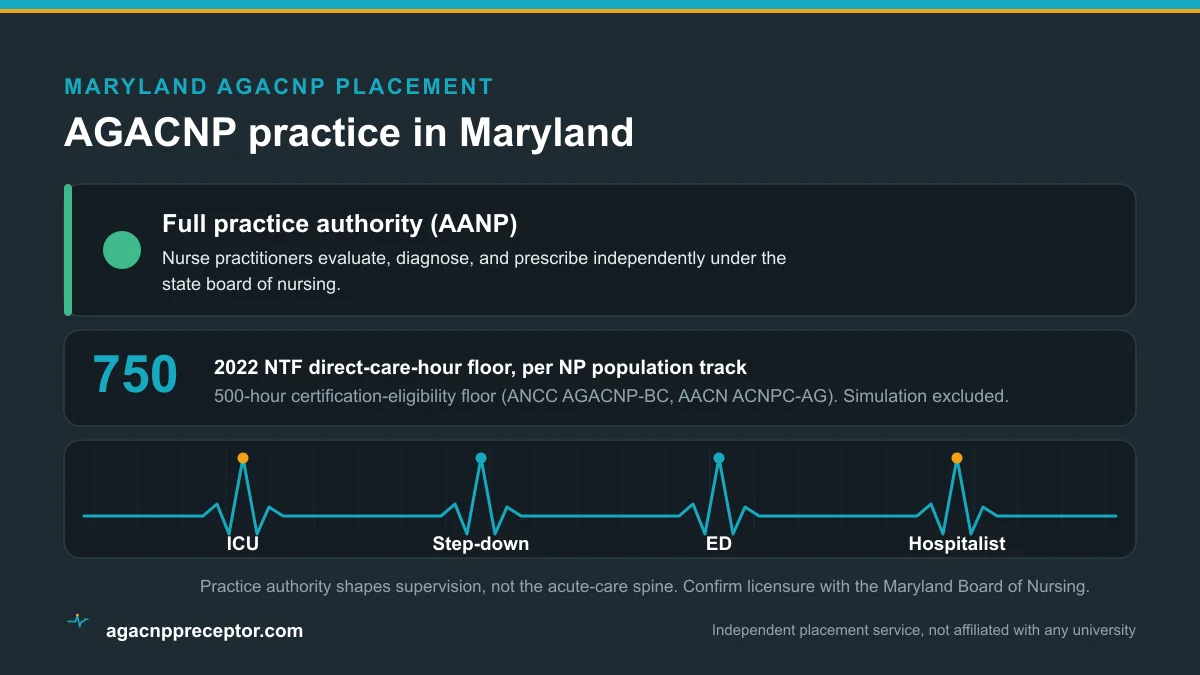
Maryland is a full practice authority state. Under the Maryland Board of Nursing, a certified nurse practitioner diagnoses, treats, and prescribes without a collaborative agreement, with one transition rule: a physician or experienced NP must be available for consultation for the first 18 months for someone who has never held certification in any state.
For your placement, full authority means an experienced acute-care NP or an intensivist team can precept with more independence rather than through a required supervising physician. In critical care, a collaborating physician is common regardless. Practice authority shapes the supervision arrangement more than a preceptor's qualifications. Your preceptor is generally an AGACNP-BC or ACNPC-AG acute-care NP or a physician in a matching inpatient role, per your program.
Which hours are hardest to secure locally
Even in a deep market, the tight spots are high-acuity ICU time, procedures and advanced skills, and the adolescent end of the adult-gerontology range, which begins at roughly age 13. In the Baltimore systems these are more attainable than in most states, but the adolescent inpatient piece is limited everywhere, so we flag it early if your program counts it.
Your total hours are a program matter. The 2022 National Task Force standards recommend at least 750 direct patient care hours per track, certification eligibility requires at least 500, and accredited AGACNP programs publish totals across a wide range, with many below 750. Simulation is excluded. Confirm your number with your school and see our clinical hours guide.
How we place your Maryland acute rotations
You give us your school, your city, and the acute rotations you still need, and we run the inpatient search in parallel so a missing ICU slot does not stall your term. We source a qualified preceptor and an approvable Maryland site, verify the preceptor against your program's rules, and help assemble the affiliation and credentialing paperwork.
Final approval rests with the hospital and your university, and we do not speak for either or guarantee hours or grades. What we handle is the sourcing and vetting, whether your block sits in a Baltimore academic ICU or a regional hospital on the Shore. See how it works or tell us your rotations at the match form.
Good to know
Does Maryland's academic depth make acute placements easier?
The Baltimore corridor holds unusually deep ICU and specialty capacity, including Shock Trauma at the University of Maryland Medical Center and the Johns Hopkins system, so specialty and critical-care hours are more attainable here than in most states. The limits are that each hospital credentials its own students and that the Eastern Shore and Western Maryland are much thinner, so location still drives the search.
What does full practice authority mean for my preceptor?
Maryland nurse practitioners have full practice authority through the Maryland Board of Nursing, with an 18-month consultation requirement only for someone never certified in any state. For your rotation, an experienced acute-care NP or intensivist can precept with more independence, though a collaborating physician is common in critical care regardless. The preceptor must be licensed in Maryland and practicing in your rotation's acute setting.
How many acute-care hours will my program require?
Your program sets the number, not the state. The 2022 NTF standards recommend a minimum of 750 direct patient care hours per track, certification eligibility requires at least 500, and accredited programs publish a range, with many below 750. Simulation does not count toward the direct-care total. Always confirm your exact requirement with your own school.
Can you place students on the Eastern Shore or in Western Maryland?
Yes. Those regions have tertiary anchors, TidalHealth Peninsula Regional in Salisbury and UPMC Western Maryland in Cumberland, that carry real acute capacity. For the deepest ICU and specialty blocks, students there sometimes travel toward Baltimore, and we plan that distance in advance because credentialing is tied to geography.
Are you affiliated with my university?
No. We are an independent placement service for AGACNP students at any university, working separately from every school and certification body. We source and vet preceptors and acute sites; the final approval belongs to your program and the hospital.
Related
Secure the rotation no one else will hand you
Tell us your school, your city, and the acute rotations you still need. We will come back with a plan for the full AGACNP trace and a realistic path to placed.