Acute-care AGACNP preceptors across South Dakota
South Dakota is a full-practice state, and almost all of its high-acuity beds sit in two places: Sioux Falls in the east and Rapid City in the west. That is where the intensive care units, step-down floors, emergency departments, and hospitalist services that host AGACNP students actually run. We help you secure those inpatient rotations even when your program leaves the search to you.
Tell us your school and city. It is free to ask, with no obligation.
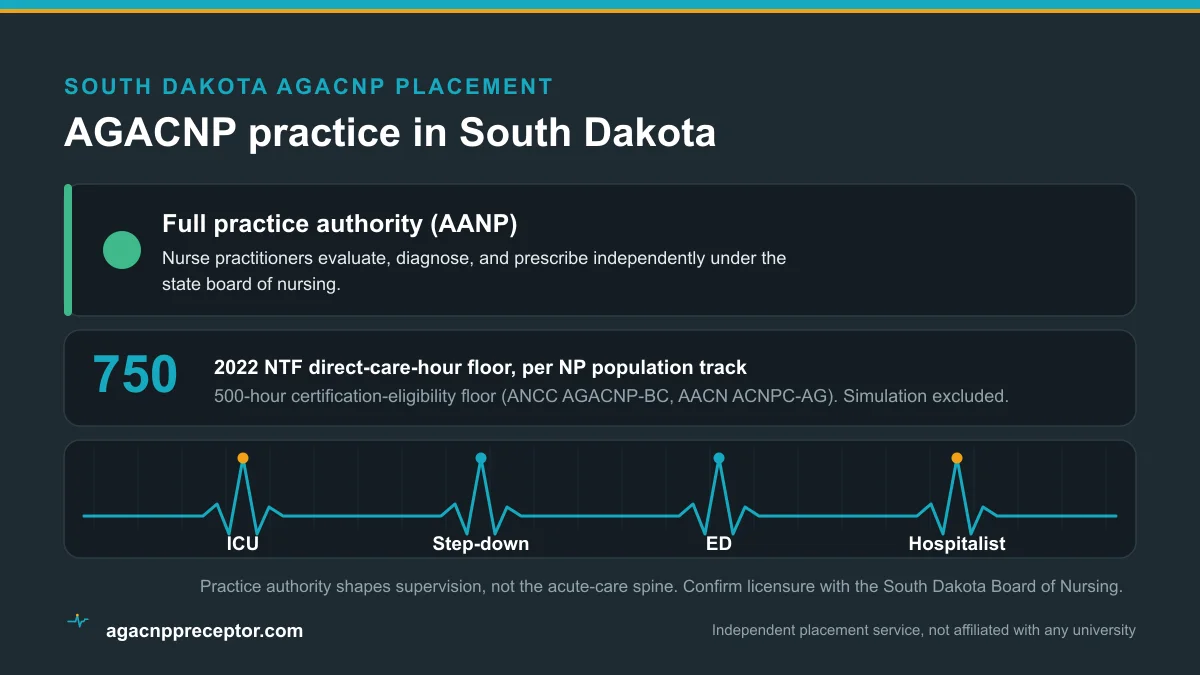
Two hubs hold the state's acute-care beds
South Dakota is a rural state with a concentrated core. The east side runs through Sioux Falls, home to Sanford USD Medical Center, verified as the state's only Level I adult trauma center, and Avera McKennan Hospital and University Health Center, a Level II trauma center and the tertiary hub for a wide referral region. The west side runs through Rapid City, where Monument Health Rapid City Hospital serves as the Level II trauma center and referral base for the Black Hills and beyond.
For an AGACNP student, that geography decides almost everything. The medical, surgical, cardiac, and neuro intensive care units, the progressive care and step-down floors, and the busy hospitalist services all cluster in those two cities. If you live near Sioux Falls or Rapid City your acute hours are close, and if you live in the wide middle of the state you will likely travel to one of them for the high-acuity blocks.
- ICU rotation hours in medical, surgical, cardiac, and neuro units
- Step-down and progressive care for the stabilizing patient
- Emergency department shifts feeding the inpatient services
- Hospitalist and inpatient medicine that carries most admitted adults
Critical access country and the rural transfer line
Outside those hubs, most South Dakota hospitals are small critical access facilities with 25 beds or fewer. They stabilize and transfer rather than hold complex, unstable patients, and one large system reports that roughly three quarters of its own hospitals fall into that category. Reservation communities served by the Indian Health Service add another layer of rural care, again with high-acuity cases routed to the metros.
The practical result is a steady transfer line into Sioux Falls and Rapid City. That is useful for acute placement, because it means the ICU, cardiology, pulmonology, nephrology, and trauma volume you need for AGACNP training is genuinely there. It also means the seats are limited and spoken for early, since those same units train other students and residents.
Full practice authority and who signs as your preceptor
South Dakota grants nurse practitioners full practice authority, though newly licensed NPs complete a collaborative period of 1,040 practice hours before moving to fully independent practice. Prescriptive authority is tied to that early collaboration and can be retired once the hours are documented. Confirm the current rule with the South Dakota Board of Nursing before you rely on any summary.
In the hospital, that authority shapes the supervision arrangement more than your preceptor's core qualifications. A board-certified acute-care nurse practitioner, holding AGACNP-BC or ACNPC-AG, can precept, and in the intensive care unit an intensivist or a critical-care team commonly signs on as well, which is normal in high-acuity settings regardless of state law. Your preceptor needs to be licensed in South Dakota and practicing in the acute setting that matches your rotation.
The hours that are hardest to secure locally
The scarce pieces here are the same ones that are scarce nationally, only sharper in a two-hub state. High-acuity intensive care, procedures and advanced skills such as central lines, airway support, and ventilator management, and the younger end of the adult-gerontology range are the blocks students struggle to arrange alone.
AGACNP practice runs from adolescence, roughly age 13, through the frail elderly, and the adolescent end is thin outside a large referral hospital. Much of that capacity lives inside the Sioux Falls and Rapid City centers, which is exactly where competition for seats is highest. Planning ahead is how you avoid a gap in your clinical hours.
How we place AGACNP students in South Dakota
We source and vet acute-care preceptors, then work the hospital credentialing and site paperwork that stalls most students. Tell us your city, your program, and the rotations you still need, and we build a plan around the Sioux Falls and Rapid City hubs plus any regional hospital within reach. Matched first, and you can read how the process and pricing work before you commit.
Ready to start? Use the match form on this page or contact us, and we will map a realistic route to your acute-care hours.
Good to know
Do I have to train in Sioux Falls or Rapid City?
Not always, but the high-acuity blocks usually happen there. Most South Dakota intensive care, step-down, and inpatient specialty capacity sits in those two cities. Regional hospitals can cover some hours, while the toughest ICU and procedure hours often mean traveling to a hub.
Does full practice authority mean I do not need a physician preceptor?
It changes the arrangement, not the standard. A certified acute-care nurse practitioner can precept in South Dakota, and in critical care an intensivist or physician often co-signs, which is common in high-acuity units everywhere. Your program sets the final preceptor rules.
How many clinical hours will I need?
The 2022 NTF Standards recommend at least 750 direct patient care hours per track, while ANCC and AACN certification eligibility require at least 500 supervised hours. Many AGACNP programs publish totals from roughly 500 to 750 or more, so confirm the exact figure with your own program.
Can you place me if my school is online or out of state?
Yes. We are independent and work with students at any university. What matters is your South Dakota location, your license eligibility, and the acute rotations you still need, not which school you attend.
Which rotations are hardest to find here?
High-acuity intensive care, procedures and advanced skills, and the adolescent end of the age range are the usual gaps, and most of that capacity is in the Sioux Falls and Rapid City referral centers. We plan those first because they fill early.
Secure the rotation no one else will hand you
Tell us your school, your city, and the acute rotations you still need. We will come back with a plan for the full AGACNP trace and a realistic path to placed.