Securing AGACNP acute-care rotations in Kentucky
We place Adult-Gerontology Acute Care Nurse Practitioner students at Kentucky hospitals, and the state's acute capacity leans heavily on two academic centers with a wide rural reach around them. Your hours are inpatient by design, built in intensive care, step-down, the emergency department, and on hospitalist and specialty services, so the site is harder to land than a clinic rotation. We are independent and work with students at any university.
Tell us your school and city. It is free to ask, with no obligation.
The two academic anchors, Lexington and Louisville
Kentucky's deepest acute-care capacity sits in its two university systems. In Lexington, UK HealthCare's Albert B. Chandler Hospital is an academic medical center and a Level I trauma center, and it houses the state's only National Cancer Institute cancer center. In Louisville, the University of Louisville's hospital runs the city's Level I trauma program. These are where the heaviest ICU and inpatient specialty volume concentrates.
Around them, Louisville adds large systems such as Norton and Baptist Health, Lexington adds Baptist Health and CHI Saint Joseph, and regional acute hubs sit in Bowling Green, Owensboro, and Paducah, with northern Kentucky drawing on St. Elizabeth near the Cincinnati line. Each hospital sets its own student credentialing, so we work the ones near you that can host your block.
Appalachia and the rural reach
Kentucky's acute-care geography is shaped by its mountains. UK's Level I center is the tertiary referral point for the 49 Appalachian counties of eastern Kentucky, a largely rugged region where local hospitals stabilize and transfer the sickest patients toward Lexington. Larger eastern facilities carry real inpatient load, but high-acuity depth still funnels toward the academic centers.
Rural hospitals across the state have been downsizing, and some have closed, which thins local acute capacity and pushes ICU and specialty hours toward the metros. Students in the coalfields and the western counties usually plan to travel for their critical-care blocks, and we build that distance into the search from the start.
Which inpatient settings carry your hours
AGACNP training is inpatient and high-acuity, so your Kentucky rotations run through the intensive care units, medical, surgical, cardiac, and neuro, the step-down and progressive care floors, the emergency department, and the hospitalist service that admits and manages most inpatients.
Specialty hours land on inpatient services such as cardiology, pulmonology, nephrology, and trauma or surgical care, and some students add time in a long-term acute care hospital. The population runs from young adults through older adults and the frail elderly, which is the everyday census of a Kentucky medical center.
Reduced practice and your hospital preceptor
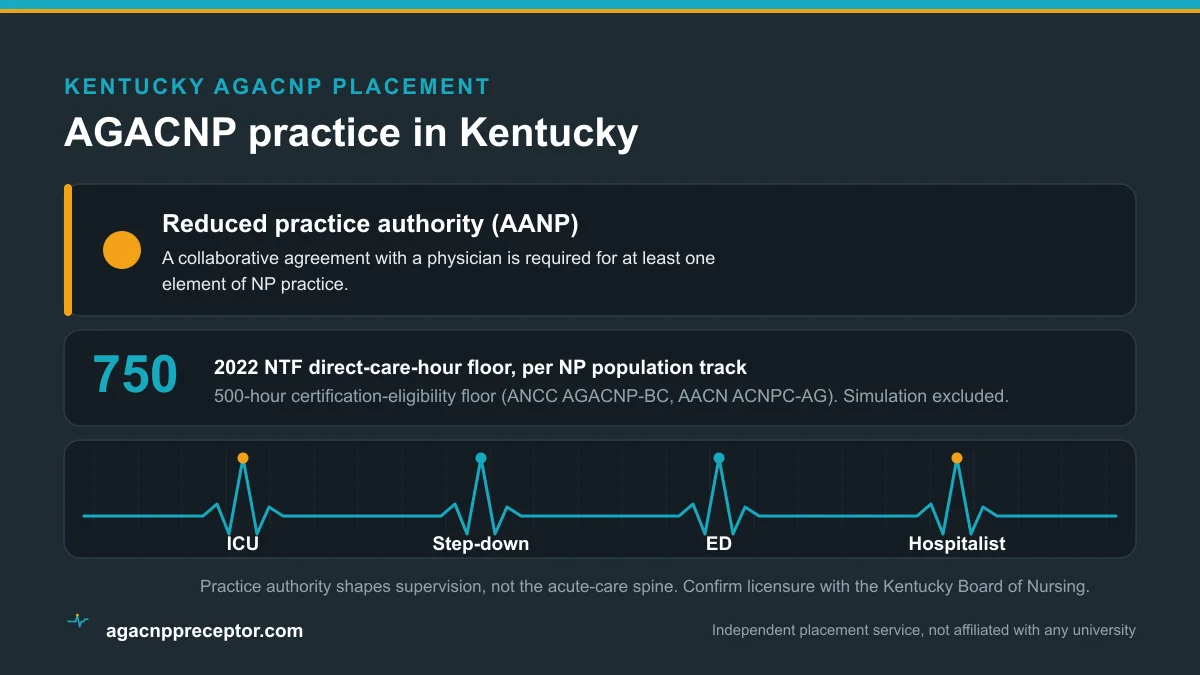
Kentucky is a reduced practice state under the Kentucky Board of Nursing. Nurse practitioners prescribe under written collaborative agreements: one for non-controlled drugs, known as a CAPA-NS, and a separate one for controlled substances, a CAPA-CS. After four years of prescribing in good standing, an NP may drop the non-controlled agreement, while the controlled-substance agreement carries its own ongoing requirements.
For your rotation, the everyday effect is that a collaborating or supervising physician is usually folded into the arrangement, which in critical care is common no matter the state. It shapes who signs on as your preceptor more than it changes the preceptor's core qualifications. Your preceptor is generally an AGACNP-BC or ACNPC-AG acute-care NP or a physician in a matching inpatient role, and eligibility is set by your program.
The hours hardest to place near you
The tight spots in Kentucky are high-acuity ICU time, procedures and advanced skills, and the adolescent end of the adult-gerontology range, which begins at roughly age 13. Adolescent inpatient exposure is limited, so if your program counts it, we surface that early rather than late.
How many hours you owe is a program question, not a state one. The 2022 National Task Force standards recommend at least 750 direct patient care hours per track, certification eligibility sits at a 500-hour floor, and accredited AGACNP programs publish totals across a wide range, many below 750. Simulation does not count. Check your figure with your school, and read our clinical hours guide.
Working the Kentucky search with you
Tell us your school, your city, and the acute rotations you still need, and we run the inpatient search alongside your coursework so a missing site does not push your graduation. We source a qualified preceptor and an approvable Kentucky hospital, check the preceptor against your program's rules, and help pull together the affiliation and credentialing paperwork.
The final yes belongs to the hospital and your university, and we do not guarantee hours, grades, or a specific site. What we take off your plate is the search itself in a state where the deepest acute capacity clusters in a few cities. See how it works or send your rotations through the match form.
Good to know
Will I have to travel to Lexington or Louisville for acute hours?
Often, yes, for the high-acuity blocks. The two academic systems hold the deepest ICU and specialty volume, and rural and Appalachian hospitals, while essential, run thinner critical-care capacity. We look for the closest approvable site first and only widen the radius when a specific block, such as a specialty ICU, is not available nearby.
What does reduced practice mean for my preceptor in Kentucky?
Kentucky nurse practitioners prescribe under collaborative agreements filed with the Kentucky Board of Nursing, so a collaborating physician is commonly part of the arrangement. In critical care that is normal regardless of state law. It affects who signs on as preceptor more than the preceptor's qualifications; they still must be licensed in Kentucky and practicing in your rotation's acute setting.
How many clinical hours does a Kentucky AGACNP program require?
Your program sets the number, not the state. The 2022 NTF standards recommend a minimum of 750 direct patient care hours per track, certification eligibility requires at least 500, and accredited programs publish a range, with many below 750. Simulation is excluded from the direct-care total. Always confirm your exact requirement with your own school.
Do you build the Appalachian travel distance into the plan?
Yes. Because credentialing and affiliation agreements are tied to geography, we plan around where you live and where the acute volume actually is. For students in eastern or western Kentucky that usually means mapping a realistic drive to a metro system for the ICU and specialty hours that rural hospitals cannot carry.
Are you connected to my university?
No. We are an independent service for AGACNP students at any university, working separately from every school and certification body. We find and vet preceptors and acute sites; your program and the hospital hold final approval of both.
Related
Secure the rotation no one else will hand you
Tell us your school, your city, and the acute rotations you still need. We will come back with a plan for the full AGACNP trace and a realistic path to placed.