Placing AGACNP students in Maine's acute-care units
Yes, we place Adult-Gerontology Acute Care Nurse Practitioner students at Maine hospitals, in a state where the acute-care map is short and the distances are long. Your inpatient hours happen in intensive care, step-down, the emergency department, and on hospitalist and specialty services, so an acute site takes more to arrange than a clinic rotation. We are independent and work with students at any university.
Tell us your school and city. It is free to ask, with no obligation.
Maine's acute-care map at a glance
Maine's high-acuity capacity centers on a few systems. In Portland, Maine Medical Center is the state's largest hospital and its only Level I trauma center, the tertiary and quaternary referral point for the southern half of the state. In Bangor, Northern Light Eastern Maine Medical Center is a Level II trauma center that serves central, eastern, and northern Maine and takes transfers from more than twenty community hospitals across a huge land area.
Lewiston and Augusta add regional acute hospitals through Central Maine Healthcare and MaineGeneral, and the two big systems, MaineHealth and Northern Light Health, run much of the inpatient network. Each hospital handles its own student credentialing, so we work the ones within reach of where you live.
The most rural state, and the drive that comes with it
Maine is one of the most rural states in the country, and its hospital map shows it. Aroostook County in the far north, the Downeast coast, and the western mountains lean on critical-access hospitals that stabilize patients and transfer the sickest cases south. Those small hospitals run limited or no intensive-care beds, so they rarely carry a full AGACNP acute block.
For most students that means the high-acuity hours happen in Portland or Bangor, with a real drive attached. Because affiliation agreements and credentialing are tied to geography, we plan around where you live from the start, and we are honest when a specific block, such as a specialty ICU, will only be found in the south.
The inpatient settings that host AGACNP hours
Your Maine rotations run through the settings that manage unstable adults: the intensive care units, medical, surgical, cardiac, and neuro, the step-down and progressive care floors, the emergency department, and the hospitalist service that admits and manages most inpatients.
Higher-acuity and specialty hours fall to inpatient services such as cardiology, pulmonology, nephrology, and trauma or surgical care. The census runs from young adults through older adults and the frail elderly, and in a state with an older-than-average population, geriatric acute care is a large part of the picture.
Full practice authority and your ICU preceptor
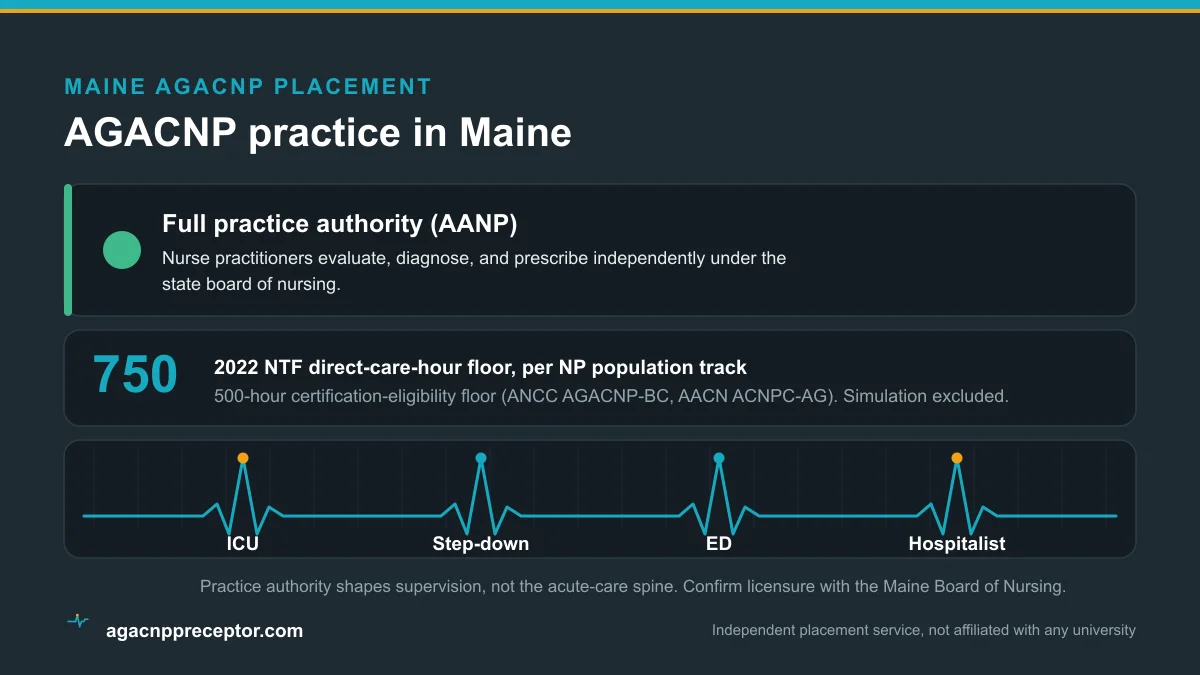
Maine is a full practice authority state under the Maine State Board of Nursing. Historically an NP reached independent practice after a supervised period, and a law signed in early 2026 moves to remove that transition-to-practice bridge once the board sets new practice standards, so confirm the current rule with the board before you plan around it.
For your placement, full authority means an experienced acute-care NP or an intensivist team can precept with more independence rather than through a required supervising physician. Even then, a collaborating physician is common in critical care regardless of state law. It shapes the supervision arrangement more than a preceptor's qualifications; your preceptor is generally an AGACNP-BC or ACNPC-AG acute-care NP or a physician in a matching inpatient role, per your program.
The hours hardest to secure in Maine
The scarce blocks are high-acuity ICU time, procedures and advanced skills, and the adolescent end of the adult-gerontology range, which begins at roughly age 13. With so much acute depth in two cities, these are the hours most likely to require travel, and adolescent inpatient exposure in particular is limited.
Your total is a program question, not a state one. The 2022 National Task Force standards recommend at least 750 direct patient care hours per track, certification eligibility requires at least 500, and accredited AGACNP programs publish totals across a wide range, many below 750. Simulation does not count. Confirm your number with your school, and read our clinical hours guide.
How we place your Maine rotations
Tell us your school, your city, and the acute rotations you still need, and we run the inpatient search in parallel so a missing ICU slot does not push back your term. We source a qualified preceptor and an approvable Maine site, verify the preceptor against your program's rules, and help assemble the affiliation and credentialing paperwork the hospital requires.
Final approval rests with the hospital and your university, and we do not speak for either or guarantee hours or grades. What we handle is the sourcing and vetting in a state where acute capacity is concentrated and the drives are long. Start on the find a preceptor page or send your rotations through the match form.
Good to know
Will my acute hours be in Portland or Bangor?
Usually one of them for the high-acuity blocks, because Maine Medical Center in Portland and Northern Light Eastern Maine in Bangor hold the state's Level I and Level II trauma capacity and the deepest ICU volume. Critical-access hospitals across rural Maine run limited intensive care, so students outside the two hubs generally plan to travel for those rotations.
Is Maine really full practice authority?
Maine grants full practice authority to nurse practitioners through the Maine State Board of Nursing. A 2026 law moves to remove the earlier supervised transition period once the board sets practice standards, so the exact current requirement is worth confirming with the board. For your placement, full authority mainly makes the supervision arrangement more flexible; a collaborating physician is still common in critical care.
How many clinical hours will my AGACNP program require?
Your program sets that, not the state. The 2022 NTF standards recommend a minimum of 750 direct patient care hours per track, certification eligibility requires at least 500, and accredited programs publish a range, with many below 750. Simulation is excluded from the direct-care total. Confirm your exact requirement with your own school.
Are you affiliated with my university?
No. We are an independent placement service for AGACNP students at any university, working separately from every school and certification body. We source and vet preceptors and acute sites; the final approval belongs to your program and the hospital.
Related
Secure the rotation no one else will hand you
Tell us your school, your city, and the acute rotations you still need. We will come back with a plan for the full AGACNP trace and a realistic path to placed.