Finding your AGACNP acute-care hours in Montana
Montana is a full-practice state for nurse practitioners, so an experienced acute-care NP can precept your rotations without a physician contract required by law. The harder part here is geography: the high-acuity beds that Adult-Gerontology Acute Care NP training depends on sit in a short list of hospitals in Billings, Missoula, Great Falls, and a few other cities, while much of the state is served by small critical-access facilities. We source AGACNP preceptors and inpatient sites so your ICU, step-down, and hospitalist hours are confirmed before the term begins.
Tell us your school and city. It is free to ask, with no obligation.
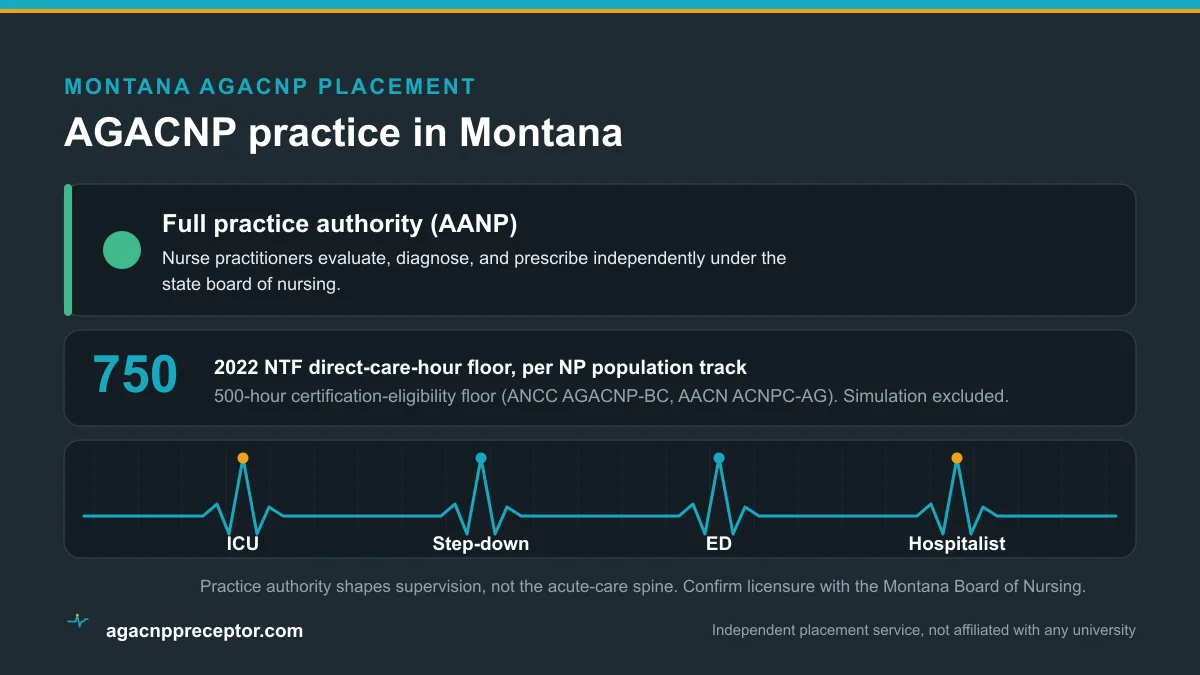
Where AGACNP students actually train in Montana
AGACNP is a hospital role, not a clinic role, so your clinical hours follow the state's intensive-care and inpatient capacity rather than its map of towns. In Montana that capacity concentrates in a handful of regional referral centers. Billings is the anchor, home to Billings Clinic, which built the region's first Level I trauma program, along with St. Vincent Healthcare. Great Falls, Missoula, Bozeman, Kalispell, Helena, and Butte carry the other large hospitals with intensive care units, progressive care beds, emergency departments, and inpatient medicine services.
For an acute-care student, that geography sets the whole plan. The medical, surgical, and cardiac ICUs, the step-down units, and the specialty services in cardiology, pulmonology, nephrology, and trauma care are where your competencies become real patient management, and in Montana those services live in the referral cities. A student's home town may have an excellent hospital, but if it does not run the unit your rotation targets, the hours have to be arranged where that unit exists.
Practice authority in Montana, kept simple
Montana grants nurse practitioners full practice authority. On licensure through the Montana Board of Nursing, an NP may assess, diagnose, and prescribe independently, with no state-mandated transition period or collaborating-physician contract. That is the legal backdrop; the day-to-day supervision inside a hospital is a separate matter.
In critical care, a collaborating or supervising physician is often part of the team no matter what the practice law says, because intensivists and specialists co-manage the sickest patients by design. What full practice changes is who is allowed to sign as your preceptor: an experienced board-certified acute-care NP (AGACNP-BC or ACNPC-AG) can take that role on their own, and a physician in the unit can as well. Confirm any current licensure detail directly with the Montana Board of Nursing.
The hospital units that host your hours
Acute-care rotations are built from inpatient and high-acuity settings, and the ones that matter most in Montana are the same ones that fill first everywhere:
- Intensive care, including medical, surgical, and cardiac units, the signature AGACNP setting.
- Step-down and progressive care, where unstable patients are watched closely short of the ICU.
- Emergency departments, for undifferentiated and rapidly changing presentations.
- Hospitalist and inpatient internal medicine, the backbone of inpatient volume.
- Inpatient specialty services in cardiology, pulmonology, nephrology, and trauma or surgical care.
- Procedures and advanced skills, which many students have to seek out deliberately.
Your patients across these units run from adolescence, which the acute-care population begins at around age 13, through the frail elderly. The adolescent end of that range is often the hardest to reach in an adult-focused hospital, and it is worth planning for early.
Rural Montana and the travel question
Montana runs one of the largest networks of critical-access hospitals in the country, and those small facilities are the backbone of care across the eastern plains, the Hi-Line, and the mountain valleys. They keep communities served, but by design they are not where high-acuity ICU volume or inpatient specialty services accumulate. A student who lives hours from a referral city will usually complete a critical-care block by traveling to Billings, Missoula, or Great Falls.
We plan around that reality rather than pretending it away. When we build your placement we account for driving distance, block scheduling, and the housing question that comes with a rotation away from home, and we try to cluster your hardest hours so a single trip does more work.
The hours students struggle to secure alone
In a state with few referral centers, the scarce pieces of an AGACNP program are predictable: high-acuity ICU time, hands-on procedures and advanced skills, and the younger adolescent patients who sit at the edge of the adult-gerontology range. All of it concentrates in the same few hospitals, and slots there are claimed early by students from many programs.
Hours themselves vary by program, and it is worth being precise about the numbers. The 2022 National Task Force standards recommend at least 750 direct patient care hours, and national certification eligibility requires at least 500 faculty-supervised hours. Many accredited AGACNP programs publish totals somewhere between about 500 and 750 or more, so check your own program's requirement rather than assuming a single figure. Our clinical hours guide walks through how the counts work.
How we place you in Montana
We match you with a board-certified acute-care NP or an acute-care physician at a real Montana hospital, then handle the affiliation agreement and credentialing paperwork that inpatient units require. You can see the steps on our how it works page, and our preceptor requirements page covers who qualifies. We are independent, we work with students at any university, and we never guarantee a placement or your school's approval of any site.
If you want your Montana ICU, step-down, or hospitalist hours locked in early, tell us your program's requirements and your location using the form at #match or through our contact page. Fees are listed plainly on our cost page.
Good to know
Is Montana a full-practice state for AGACNPs?
Yes. Montana grants nurse practitioners full practice authority, so on licensure through the Montana Board of Nursing an NP can diagnose and prescribe independently. In an ICU, a collaborating physician is still commonly part of the care team, which shapes the supervision arrangement more than your preceptor's core qualifications.
Will I have to travel for my ICU hours?
Often, yes, if you live far from a referral city. High-acuity intensive care in Montana concentrates in Billings, Missoula, and Great Falls, and critical-access hospitals closer to home usually cannot offer the same volume. We plan blocks and distances with that in mind.
Who can serve as my AGACNP preceptor here?
Generally a board-certified acute-care nurse practitioner (AGACNP-BC or ACNPC-AG) or a physician such as an intensivist, hospitalist, or specialist working in the acute setting. Your program sets the final rules, so we match to both your school's requirements and the unit.
How many clinical hours will my program require?
It depends on your program. National standards recommend at least 750 direct patient care hours and certification requires at least 500 faculty-supervised hours, but published program totals vary, with many landing between roughly 500 and 750 or more. Confirm the exact number with your school.
Do you only work with one university's students?
No. We are an independent placement service and help AGACNP students at any university. We work independently of any school, and we cannot guarantee placement or a school's approval of a given preceptor or site.
Related
Secure the rotation no one else will hand you
Tell us your school, your city, and the acute rotations you still need. We will come back with a plan for the full AGACNP trace and a realistic path to placed.