Placing AGACNP students in Ohio's acute-care hospitals
Ohio is a reduced practice state, so an AGACNP works under a standard care arrangement with a collaborating physician, an arrangement that fits how hospital critical care already runs. On placement, Ohio is an advantage, because several large metros carry academic medical centers and Level I trauma centers spread across the state. We source acute-care preceptors and inpatient sites for AGACNP students at any university, and this page shows where the hours are.
Tell us your school and city. It is free to ask, with no obligation.
Ohio's acute-care map: several metros, not one
Ohio has an unusually even spread of high-acuity care for a single state, anchored by several metros rather than one. Cleveland carries deep capacity, with the Cleveland Clinic's quaternary main campus, University Hospitals Cleveland Medical Center, and MetroHealth, the last two verified as Level I trauma centers. Columbus is a second major hub, where the Ohio State Wexner Medical Center and OhioHealth run Level I trauma care, giving central Ohio several top-level centers.
Cincinnati anchors the southwest with University of Cincinnati Medical Center and other large systems, and Toledo, Dayton, and the Akron and Canton area each add tertiary hospitals and Level I trauma coverage. For an AGACNP student, this means more than one realistic region in which to build high-acuity hours, which is not true in most states.
The hospital settings that carry your hours
AGACNP hours come from hospitalized, complex, and critically ill adults, not clinic patients. Across Ohio's teaching and community hospitals, that includes a full set of high-acuity services.
- Medical, surgical, cardiac, and neuro intensive care units.
- Step-down and progressive care units.
- Hospitalist and inpatient medicine teams.
- Inpatient cardiology, pulmonology, nephrology, and trauma or surgical services.
- Emergency departments and rapid response.
The academic centers in Cleveland, Columbus, and Cincinnati add the deepest subspecialty mix, while strong community systems in the mid-size metros carry heavy hospitalist and general critical-care volume. Patients range from adolescence near age 13 through the frail elderly.
Rural and Appalachian Ohio
The gap in Ohio is mostly rural. Southeastern Appalachian Ohio and pockets of the northwest are served by smaller community and critical-access hospitals with limited intensive care and specialty coverage. Students there can often find emergency and general inpatient hours locally but travel to Columbus, Cincinnati, or Cleveland for high-acuity ICU and inpatient specialty time.
Because Ohio's metros are relatively close together, that travel is usually shorter than in the rural western states, which makes combining a home-region rotation with a big-city high-acuity block more practical here.
Reduced practice and your preceptor
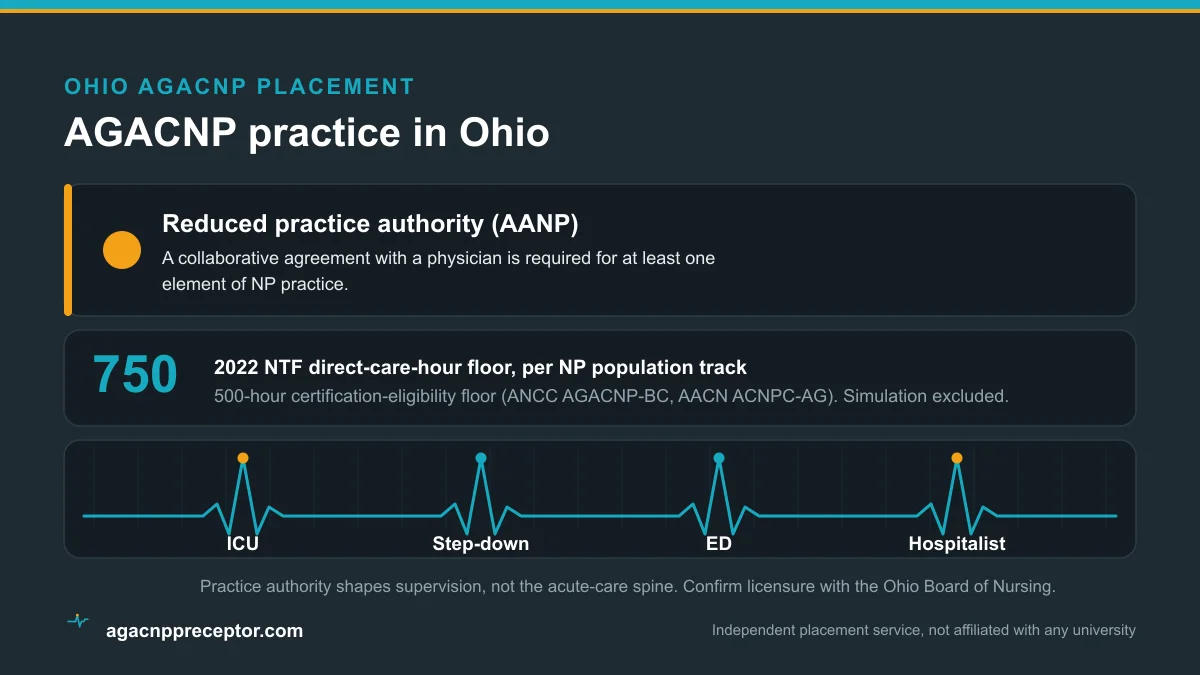
Ohio is a reduced practice state. A certified nurse practitioner enters a standard care arrangement with one or more collaborating physicians under the Ohio Board of Nursing and state law, and the collaborating physician must work in the same or a similar specialty. Board approval of the arrangement is not required in advance, though the board may review it.
In acute care, this collaboration requirement lines up with how ICU and hospitalist teams already function, since a physician is part of the care team anyway. For your placement it usually means your preceptor is a board-certified acute-care NP (AGACNP-BC or ACNPC-AG) working under a standard care arrangement, or a physician such as an intensivist or hospitalist. Your program sets the final preceptor requirements.
Which rotations are hardest to arrange
Even with Ohio's depth, some hours take planning. Competitive ICU rotations at the big academic centers are shared with residents, fellows, and other advanced-practice students, so they fill early. Procedures and advanced skills require a preceptor who will supervise them at the bedside.
The adolescent end of the adult-gerontology range, from about age 13, is a common gap as well, since most inpatient beds hold adults and the frail elderly. On totals, the 2022 National Task Force standards recommend at least 750 direct patient care hours, and certification eligibility through ANCC or the AACN Certification Corporation requires at least 500 faculty-supervised hours. Programs vary and many publish fewer than 750, so confirm your own clinical hours total. Simulation does not count.
How we place you in Ohio
We match you with a board-certified acute-care NP or an acute-care physician at a real Ohio hospital, then handle the affiliation agreement and credentialing paperwork that inpatient units and the standard care arrangement require. Our find a preceptor and how it works pages explain the process. We are independent, we work with students at any university, and we never guarantee placement or a school's approval of any preceptor or site.
To get moving on your Ohio hours, share your program's requirements and your location through the form at #match or our contact page, and review plain pricing on our cost page.
Good to know
What does reduced practice mean for an AGACNP student in Ohio?
It means the nurse practitioner works under a standard care arrangement with a collaborating physician in the same or a similar specialty. In acute care this fits the existing team model, so it mostly determines who signs on as preceptor rather than changing the daily work.
Which Ohio cities have the most AGACNP acute-care hours?
Cleveland, Columbus, and Cincinnati carry the deepest capacity, with additional Level I trauma and tertiary hospitals in Toledo, Dayton, and the Akron and Canton area. Rural students, especially in Appalachian southeast Ohio, usually travel to one of the metros for high-acuity time.
Does the collaborating-physician rule limit who can precept me?
Your preceptor is often a board-certified acute-care NP working under a standard care arrangement, or a physician directly, such as an intensivist or hospitalist. The collaboration requirement is a state rule, but your school sets the final preceptor criteria.
How many clinical hours does the program require?
It depends on your school. The 2022 National Task Force standards recommend at least 750 direct patient care hours, and certification eligibility requires at least 500 faculty-supervised hours. Many accredited AGACNP programs publish totals below 750, so confirm your own number. Simulation is excluded.
Do you place students from any university?
Yes. We are independent and work with AGACNP students at any Ohio school. We handle acute-care and inpatient matches only and never guarantee a school's approval of a specific preceptor or site.
Related
Secure the rotation no one else will hand you
Tell us your school, your city, and the acute rotations you still need. We will come back with a plan for the full AGACNP trace and a realistic path to placed.