Acute-care AGACNP rotations across Tennessee's grand divisions
Tennessee is a restricted-practice state, and its acute-care training runs through three grand divisions, each anchored by a Level I trauma metro: Memphis in the west, Nashville in the middle, and Knoxville and Chattanooga in the east, with the Tri-Cities holding the northeast corner. Those hospitals carry the intensive care, step-down, emergency, and hospitalist volume AGACNP students need. We help you secure a seat inside them, even when your program leaves the search to you.
Tell us your school and city. It is free to ask, with no obligation.
Three grand divisions, five acute anchors
Tennessee spreads its high-acuity care across a long state. In the west, Memphis is built around Regional One Health and its Elvis Presley Trauma Center, a Level I center serving a wide multistate region, alongside large systems such as Methodist Le Bonheur and Baptist Memorial. In middle Tennessee, Nashville carries Vanderbilt University Medical Center and TriStar Skyline, both Level I trauma centers, plus Ascension Saint Thomas and the HCA hospitals headquartered in the city.
In the east, Knoxville is anchored by the University of Tennessee Medical Center and Chattanooga by Erlanger, both Level I trauma centers, while the northeast Tri-Cities region runs largely through Ballad Health and its Level I center at Johnson City Medical Center. For an AGACNP student, this means five realistic metro engines rather than one, and your home division usually decides where your acute hours begin.
- Intensive care in medical, surgical, cardiac, and neuro units
- Step-down and progressive care for patients moving off the ICU
- Emergency department exposure to undifferentiated acute presentations
- Hospitalist and inpatient medicine managing the bulk of admissions
- Inpatient specialty services in cardiology, pulmonology, nephrology, and trauma or surgical care
Why the inpatient setting suits AGACNP training
AGACNP is an inpatient, high-acuity role, so your rotations live inside the hospital rather than the clinic. The metro referral hospitals concentrate the sickest patients, which is where adult-gerontology acute-care learning is richest and where a student sees the full arc from resuscitation through step-down.
The patient mix runs from young adults through the frail elderly, with episodic, complex, and often unstable presentations. That is the core of the AGACNP focus, and it is why the Level I and tertiary centers, rather than community clinics, are the settings your program expects you to train in.
Tennessee practice law in one section
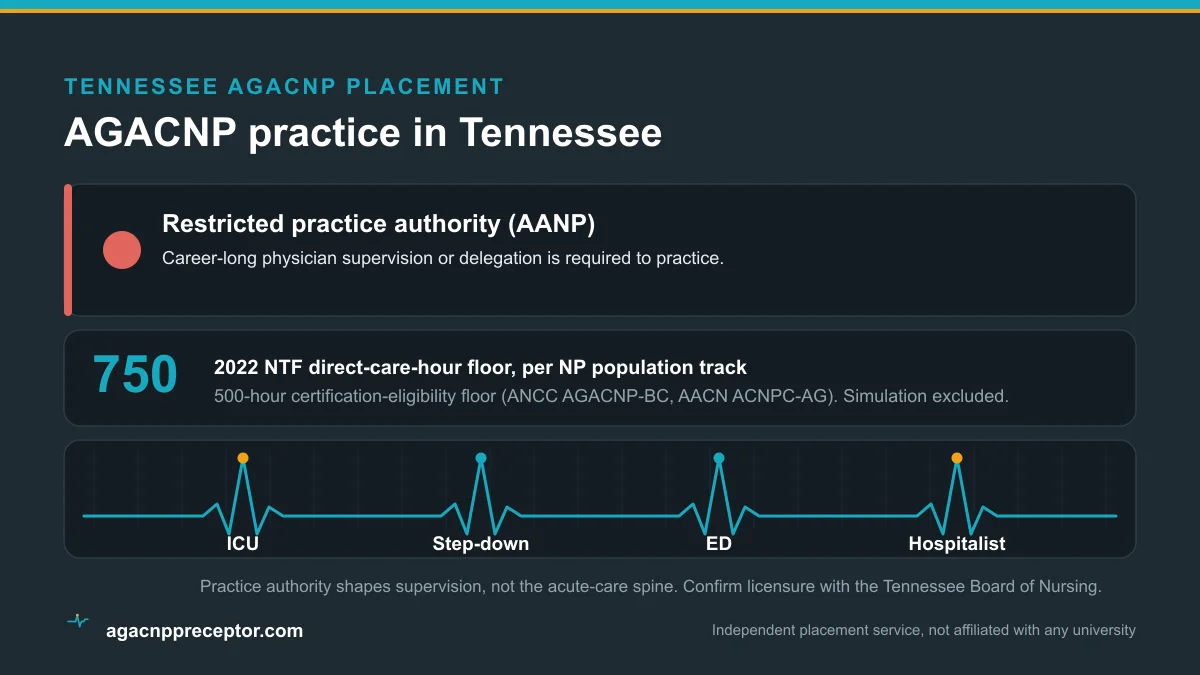
Tennessee is a restricted-practice state. Nurse practitioners work under a supervising physician relationship, with a certificate of fitness for prescribing, periodic chart review, and physician availability for consultation, and controlled-substance prescribing carries added conditions. The Tennessee Board of Nursing sets the current terms, so confirm them there rather than relying on any summary.
Inside a hospital, this matters less to your day than it might sound. Critical care already runs on a team model with an intensivist or attending physician present, so a collaborating or supervising physician is a normal part of the acute setting. Your preceptor can be a board-certified acute-care nurse practitioner or a physician in a matching inpatient role, licensed in Tennessee and practicing where you rotate.
Rural Tennessee and the closure problem
Between the metros, much of Tennessee is rural, and the state has seen one of the higher rates of rural hospital closures in the country. Remaining rural and critical access hospitals stabilize and transfer complex cases rather than hold them, which pushes intensive care and inpatient specialty volume toward the grand-division hubs.
For placement, that concentration cuts both ways. The acute hours you need are genuinely available in the metros, but students from rural counties often travel or relocate for a block to reach a Level I or tertiary center. Planning that travel early is part of a realistic schedule.
Which AGACNP hours are hardest to lock down
The scarce blocks in Tennessee mirror the national pattern. High-acuity intensive care, procedures and advanced skills, and the adolescent end of the adult-gerontology range, which starts at roughly age 13, are the hours students most often cannot arrange on their own.
Most of that capacity sits inside the referral centers in Memphis, Nashville, Knoxville, Chattanooga, and the Tri-Cities, where competition for seats is highest. Securing those blocks early is the difference between finishing your clinical hours on time and stalling a term.
How we place AGACNP students in Tennessee
We source and verify acute-care preceptors, then handle the affiliation agreements and hospital credentialing that slow most students down. Tell us your grand division, your program, and the rotations you still need, and we build a plan around the nearest metro engine and any regional hospital within reach. See how it works and start with the match form on this page.
Good to know
Does Tennessee's restricted status make placement harder?
Not in the way students expect. In the hospital a supervising physician is already part of critical care, so the restriction mostly shapes paperwork rather than daily practice. The harder part is hospital credentialing and seat scarcity, which is the work we take on.
Where are the acute-care hours concentrated?
In the Level I and tertiary hospitals of Memphis, Nashville, Knoxville, Chattanooga, and the Tri-Cities. Rural and critical access hospitals stabilize and transfer, so intensive care, step-down, and inpatient specialty volume clusters in those metros.
Can a physician be my preceptor?
Yes. A licensed physician in a matching acute role, such as an intensivist or hospitalist, can precept, as can a board-certified acute-care nurse practitioner. Your program sets the final requirements, and the preceptor must be licensed in Tennessee.
How many clinical hours does AGACNP require?
The 2022 NTF Standards recommend at least 750 direct patient care hours, while ANCC and AACN certification eligibility require at least 500 supervised hours. Programs commonly publish totals from roughly 500 to 750 or more, so confirm your own number.
Do you only work with certain Tennessee schools?
No. We are independent and place students from any university. Your Tennessee location and the acute rotations you still need drive the plan, not your school.
Related
Secure the rotation no one else will hand you
Tell us your school, your city, and the acute rotations you still need. We will come back with a plan for the full AGACNP trace and a realistic path to placed.