Securing AGACNP acute-care rotations across Texas
Texas is a restricted-practice state and, at this scale, really a set of metro acute-care engines rather than one. Houston, Dallas and Fort Worth, San Antonio, and Austin hold most of the intensive care, step-down, emergency, and hospitalist volume, with west Texas and the border adding their own referral centers. We help AGACNP students secure inpatient seats inside them when a program leaves the search to the student.
Tell us your school and city. It is free to ask, with no obligation.
Texas trains in metros, starting with the Texas Medical Center
Texas holds hundreds of designated trauma facilities, but the high-acuity teaching volume concentrates in a handful of metro cores. Houston is anchored by the Texas Medical Center, the largest medical complex in the country, where Memorial Hermann-Texas Medical Center and Harris Health's Ben Taub Hospital are Level I trauma centers surrounded by major systems such as Houston Methodist. Dallas and Fort Worth run through Parkland Memorial, the state's first Level I trauma center, along with UT Southwestern's hospitals, Baylor Scott and White, and Texas Health Resources.
San Antonio carries University Health and the region's Level I trauma capacity, Austin runs through Dell Seton Medical Center, and the west and the border add University Medical Center in Lubbock and El Paso as Level I referral hubs. For an AGACNP student, your metro usually decides where your acute hours start.
- Intensive care across medical, surgical, cardiac, and neuro units
- Step-down and progressive care for stabilizing patients
- Emergency department shifts at high-volume centers
- Hospitalist and inpatient medicine services
- Inpatient specialty care in cardiology, pulmonology, nephrology, and trauma or surgical services
The inpatient settings that carry AGACNP training
AGACNP is a hospital-based, high-acuity role, so your rotations sit inside inpatient services rather than clinics. Long-term acute care hospitals in the major metros add another setting for the chronically critically ill, on top of the intensive care, step-down, emergency, and specialty services that anchor most rotations.
The referral centers concentrate the sickest patients, from young adults through the frail elderly, which is where AGACNP learning is deepest and where seats are most contested. That is the trade at the heart of Texas placement: the volume is enormous, and so is the competition for it. Rapid response, cardiac and neuro intensive care, and busy step-down floors all sit within a short walk of each other in the largest metros, which is what makes a well-placed Texas rotation so productive.
Restricted practice and the prescriptive authority agreement
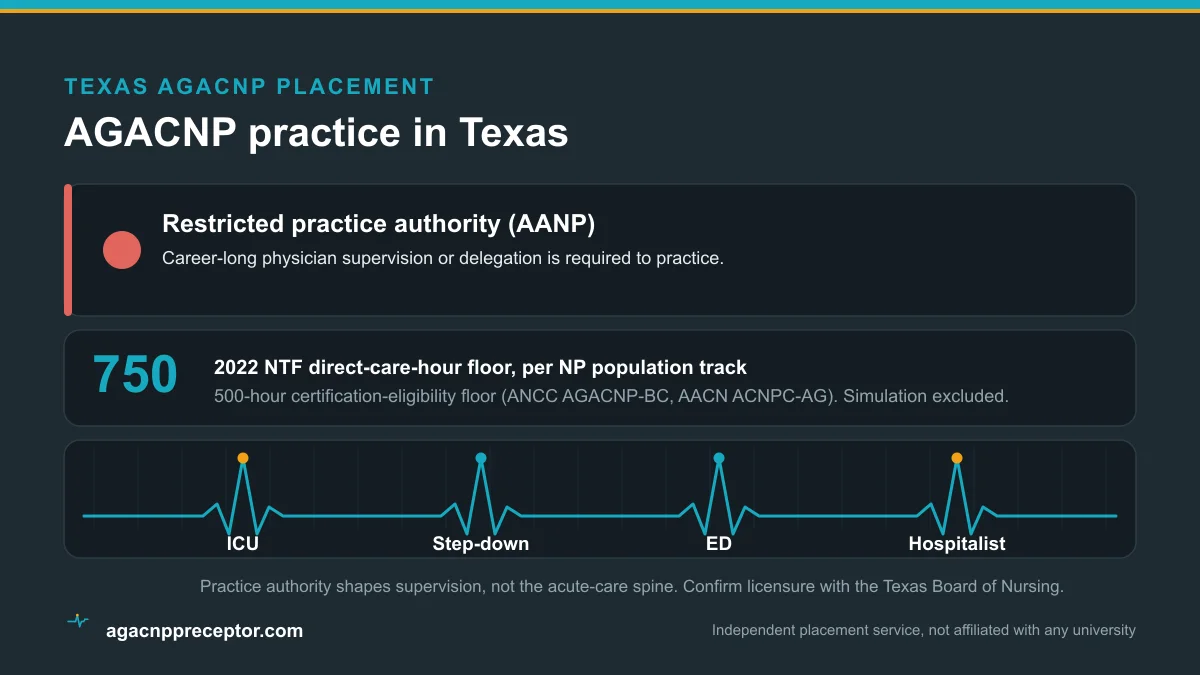
Texas is a restricted-practice state. A nurse practitioner practices under a prescriptive authority agreement with a delegating physician, with defined meetings, chart review, and consultation. The Texas Board of Nursing publishes the current terms, so confirm them there before relying on any summary.
In the acute setting this is less disruptive than it reads. Intensive care already runs on a physician-led team, so a delegating or collaborating physician is part of the environment regardless. Your preceptor can be a board-certified acute-care nurse practitioner or a physician such as an intensivist or hospitalist, licensed in Texas and practicing where you rotate.
Rural and border Texas: distance and thin capacity
Away from the metros, Texas is vast and thinly covered. The state has had one of the highest rates of rural hospital closures in the country, and many remaining rural and critical access hospitals stabilize and transfer rather than hold complex, unstable patients. The Panhandle, west Texas, deep east Texas, and stretches of the Rio Grande Valley can sit hours from a Level I center.
For placement, that means intensive care, procedures, and inpatient specialty hours cluster in the metros, and students from rural counties often relocate for a block to reach them. Building that travel into your schedule early keeps a rotation from slipping.
The AGACNP hours that are hardest to secure
Even in a state this large, the scarce blocks are predictable. High-acuity intensive care, procedures and advanced skills, and the adolescent end of the adult-gerontology range, which begins at roughly age 13, are the hours students struggle to arrange alone.
That capacity lives inside the academic and Level I referral centers, where residents and other students compete for the same preceptors. Locking those blocks early is what keeps your clinical hours on schedule.
How we place AGACNP students in Texas
We source and vet acute-care preceptors, then carry the affiliation and credentialing paperwork that stalls most students. Tell us your metro, your program, and the rotations you still need, and we build a plan around the nearest engine and any regional center within reach. Review the pricing, then start with the match form on this page. Matched first, so you know the site and preceptor are real before anything is due.
Good to know
Is placement harder because Texas is restricted?
Less than students fear. A delegating physician is already standard in critical care, so the prescriptive authority agreement mostly affects paperwork, not your daily inpatient work. Credentialing and seat scarcity are the real hurdles, and those are the work we handle.
Which Texas cities have the most acute-care capacity?
Houston's Texas Medical Center, the Dallas and Fort Worth metro, San Antonio, and Austin hold the most intensive care and specialty volume, with Lubbock and El Paso anchoring west Texas and the border. Rural areas stabilize and transfer into these hubs.
Can a physician precept my AGACNP rotation?
Yes. A Texas-licensed physician in a matching acute role, such as an intensivist or hospitalist, can precept, as can a board-certified acute-care nurse practitioner. Your program sets the final requirements.
How many clinical hours will I need?
The 2022 NTF Standards recommend at least 750 direct patient care hours, while ANCC and AACN certification eligibility require at least 500 supervised hours. Many programs publish totals from roughly 500 to 750 or more, so confirm your own program's number.
Do you place students from any school?
Yes. We are independent and work with AGACNP students at any university. Your Texas location and the rotations you still need shape the plan, not which school you attend.
Related
Secure the rotation no one else will hand you
Tell us your school, your city, and the acute rotations you still need. We will come back with a plan for the full AGACNP trace and a realistic path to placed.