Where Washington AGACNP students log their acute-care hours
For an Adult-Gerontology Acute Care Nurse Practitioner student in Washington, the hours that count are inpatient and high-acuity: intensive care, step-down and progressive care, emergency departments, and hospitalist services caring for unstable adults from roughly age 13 through the frail elderly. Washington grants nurse practitioners full practice authority, which widens the pool of experienced acute-care NPs who can precept independently. We help you find a board-certified preceptor and site that match your program, and we do not promise placement or your school's approval.
Tell us your school and city. It is free to ask, with no obligation.
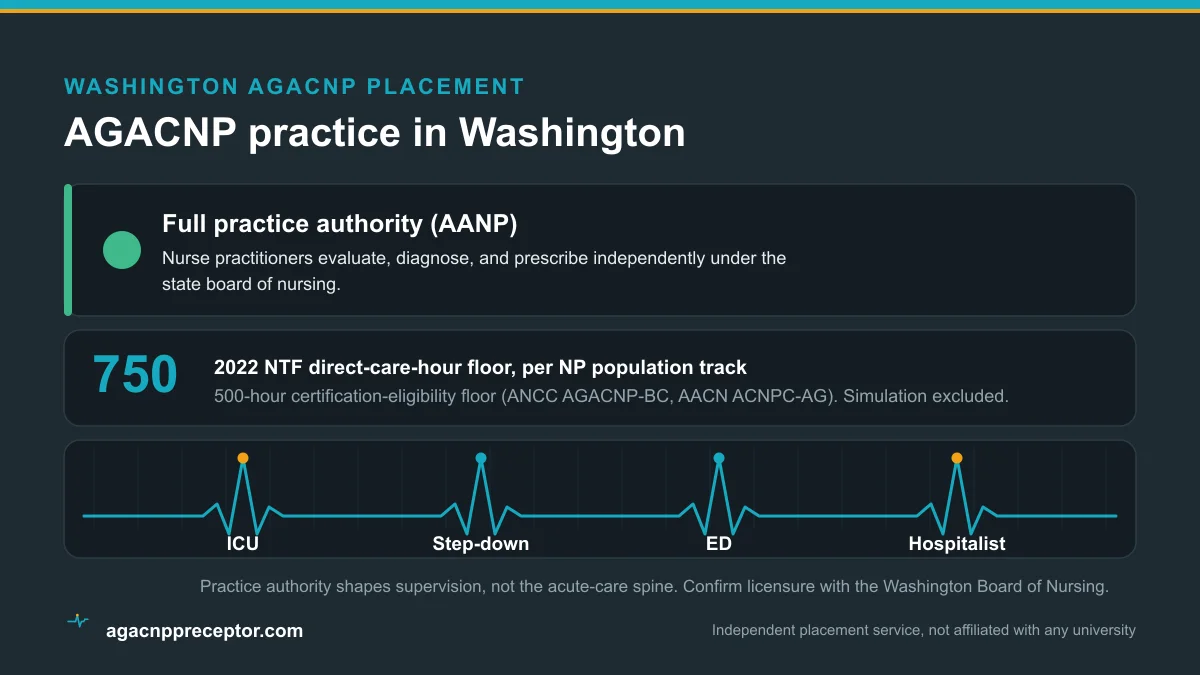
The inpatient settings where you will train
AGACNP training in Washington happens where the sickest patients are admitted, not in outpatient clinics. Expect blocks in medical, surgical, cardiac, and neuroscience intensive care, in progressive care and step-down, in the emergency department, and on hospitalist and inpatient medicine teams. Larger centers add inpatient specialty consult services in cardiology, pulmonology, nephrology, and trauma or surgery, where the acute-care nurse practitioner role is common.
- ICU rotations across medical, surgical, cardiac, and neuro units
- Step-down and progressive care for high-risk but stabilizing patients
- Emergency department time for rapidly changing presentations
- Hospitalist and inpatient medicine that carries the bulk of admissions
- Procedures and advanced skills that many students seek out deliberately
Harborview and the referral geography of Washington
Washington's acute-care map has one obvious apex. Harborview Medical Center in Seattle, managed by the state's university medicine system, is the only Level I adult and pediatric trauma and verified burn center in Washington, and it serves as the regional referral center for a multi-state area that includes Alaska, Montana, and Idaho. The most complex cases in the Pacific Northwest tend to arrive there, which makes it a strong pull for high-acuity and procedural hours.
Beyond Seattle, the Puget Sound region concentrates most of the state's hospital capacity across Tacoma, Everett, and Bellevue, with large systems running Level II trauma centers and full ICU services; MultiCare Tacoma General is one such Level II center. Spokane anchors the eastern side of the state, where Providence Sacred Heart Medical Center is a Level II center, Vancouver serves the southwest, and central hubs near Wenatchee and Yakima cover the interior. Proximity to Puget Sound or Spokane usually means shorter travel to a true ICU.
Full practice authority and the hospital teaching relationship
The Washington State Nursing Care Quality Assurance Commission licenses advanced registered nurse practitioners, and the American Association of Nurse Practitioners lists Washington as a full-practice state. In practical terms an experienced acute-care NP can diagnose, prescribe, and precept without a mandated collaborating physician. That tends to broaden who can take a student, because a seasoned AGACNP-BC or ACNPC-AG on an ICU or hospitalist team may sign on as your primary preceptor.
Full practice does not remove physicians from critical care. Intensivist-led teams still run most ICUs, and a physician preceptor, whether an intensivist, hospitalist, or specialist, is equally valid. What matters to your school is that the preceptor is a qualified acute-care provider; see our preceptor requirements for the specifics.
Crossing the Cascades: Puget Sound versus rural Washington
Washington splits sharply between its wet, urban west and its dry, rural east. West of the Cascades the population and the hospitals cluster; east of them, wide stretches rely on critical-access hospitals that stabilize and transfer. The Olympic Peninsula, the northeast corner, and the rural central counties all carry thinner acute capacity. Students in those areas often plan a high-acuity block in Seattle, Tacoma, or Spokane to reach a full ICU and specialty services.
This is also why the university system's regional education footprint reaches across neighboring states. If you live far from a trauma center, the realistic plan is local acute hours plus a scheduled rotation in a metro, and we help arrange that pairing.
The hours that fill up first
The scarcest hours in Washington are the same ones students compete for everywhere: high-acuity ICU time, hands-on procedures, and the adolescent end of the acute-care age range that starts near 13. Procedural exposure such as central and arterial lines, airway assistance, and bedside ultrasound concentrates at higher-volume centers. Meanwhile older adult and frail elderly acute cases are abundant on nearly every medicine floor, so a log weighted too heavily toward geriatric medicine is the more common problem to correct.
Working with our Washington placement desk
We match AGACNP students at any Washington program with board-certified acute-care preceptors, independent of any single school or health system. Tell us your location, your program's requirements, and the settings you still need, and we work our network to find a fit. We assist with the search and coordination and never guarantee a placement or a school's approval of a preceptor or site.
Ready to start? Use the form at #match here or reach us through our contact page. Our how it works page walks through the steps, and fees are listed on our cost page.
Good to know
Does full practice authority make it easier to find an AGACNP preceptor in Washington?
It can help. Because Washington nurse practitioners can practice without a mandated collaborating physician, an experienced acute-care NP is more likely to precept you independently. That said, ICU teaching still often involves an intensivist, and a physician preceptor is just as acceptable to your program.
Where are the highest-acuity hours in Washington?
They concentrate around Seattle's Level I trauma and burn center and the larger Puget Sound systems, with Spokane serving the east. If you live outside those areas, a scheduled high-acuity block in a metro is the usual way to reach a full ICU and procedures.
How many clinical hours does an AGACNP student need?
Your program sets the number. National standards from 2022 recommend at least 750 direct patient care hours, and certification eligibility requires at least 500 supervised hours. Accredited programs vary and some publish fewer than 750, so verify your own total. See our AGACNP clinical hours guide.
I am in eastern or rural Washington. Can you still help?
Yes. We frequently combine acute hours near your home with a block in Seattle, Tacoma, or Spokane so you reach the ICU, step-down, and specialty time that rural hospitals cannot always provide.
Are you affiliated with a university?
No. We are independent and work with students at any school. We help with the search and paperwork and do not guarantee placement or your program's approval of a given site.
Secure the rotation no one else will hand you
Tell us your school, your city, and the acute rotations you still need. We will come back with a plan for the full AGACNP trace and a realistic path to placed.