Placing AGACNP students in Alabama's acute-care hospitals
Alabama concentrates its high-acuity care in a handful of metros, so planning your acute-care rotations here is largely a question of geography. Birmingham, Huntsville, and Mobile hold the state's Level I trauma centers and the deepest intensive care, while long rural stretches lean on critical access hospitals that transfer their sickest patients. This page maps where AGACNP students actually rotate in Alabama and how we help you secure those inpatient hours. We are an independent service, open to students at any university.
Tell us your school and city. It is free to ask, with no obligation.
Where Alabama concentrates its acute-care hours
Alabama's high-acuity capacity clusters in a few cities, and that geography decides where your inpatient hours are realistic. Birmingham's academic medical center holds the state's only American College of Surgeons verified Level I trauma center and the widest bench of intensive care, from medical and surgical ICUs to cardiac and neurocritical units.
North Alabama leans on Huntsville's large regional referral hospital and its trauma program, while the Gulf Coast is anchored by Mobile's academic medical center, home to a Level I trauma center that serves as the referral hub for the southwestern corner of the state. Montgomery, Tuscaloosa, and Dothan each carry regional systems with meaningful inpatient and ICU capacity.
Away from those hubs, much of Alabama is rural. The Black Belt and the smaller counties are served largely by critical access and community hospitals, where intensive care is limited or absent and unstable patients are stabilized and moved to a metro. For students, that usually means the ICU and specialty blocks happen where the tertiary beds are, even when it means traveling.
The units that host AGACNP students in Alabama
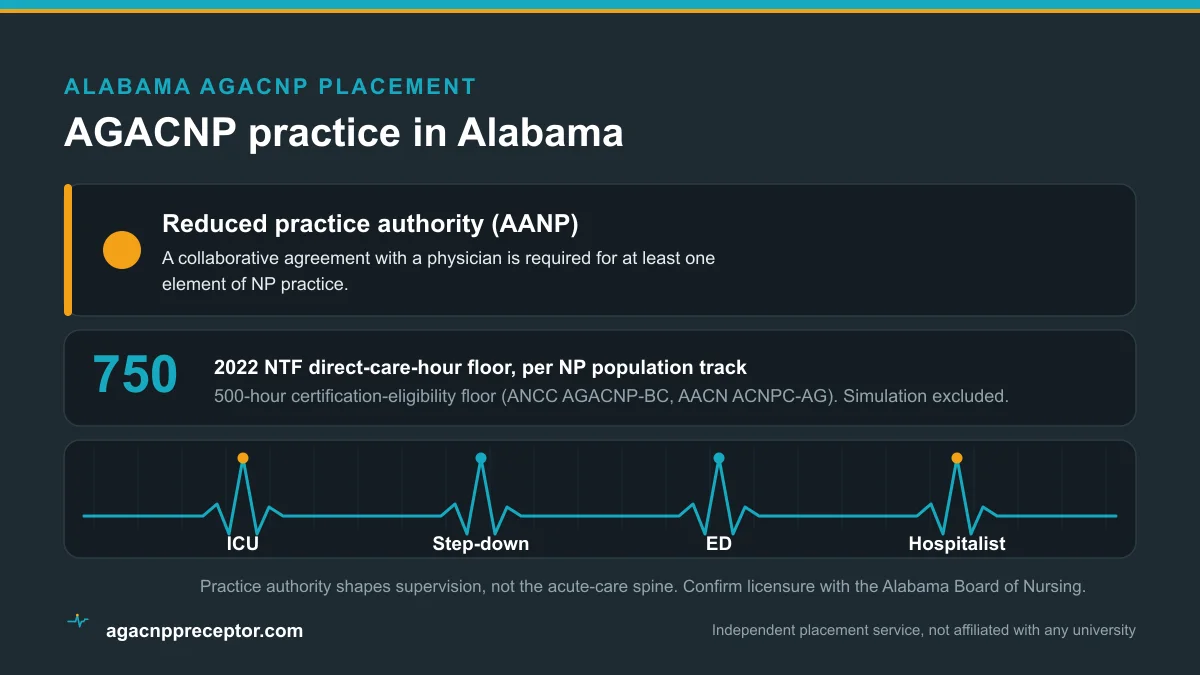
AGACNP training is inpatient and high-acuity, so your rotations sit inside the hospital rather than the clinic. Across Alabama's larger systems, the settings that take acute-care NP students include the intensive care unit, the step-down or progressive care unit, the emergency department, the hospitalist and inpatient medicine service, and inpatient specialty services such as cardiology, pulmonology, nephrology, and trauma or surgical care.
The metros carry the widest mix, including the ICU subtypes and procedure-heavy services that are hard to find elsewhere in the state. Smaller regional hospitals can be strong sites for general inpatient medicine and step-down hours, which helps students who cannot relocate for every block. What each unit counts toward is set by your program, so confirm your requirements before you build a rotation around a given site.
How Alabama's reduced-practice rules shape your preceptor
Alabama is a reduced-practice state. A certified registered nurse practitioner works under a collaborative practice agreement that the Alabama Board of Nursing and the Alabama Board of Medical Examiners approve jointly, and controlled-substance prescribing runs through a separate state certificate. That framework governs practice, and it also shapes who tends to sign on as your preceptor.
In day-to-day critical care this matters less than students expect. ICUs, trauma services, and hospitalist teams already run on a physician-and-NP model, so a collaborating intensivist, hospitalist, or specialist is often part of the picture regardless of state law. Your preceptor is generally a board-certified acute care NP (AGACNP-BC or ACNPC-AG) or a physician in a matching acute role, and the collaborative arrangement decides the supervision structure, not the preceptor's core qualifications. Our preceptor requirements page covers who qualifies.
The Alabama hours that are hardest to line up
The scarce pieces in Alabama are the same ones that are scarce nationally, made tighter by how few tertiary centers the state has. High-acuity ICU time, hands-on procedures and advanced skills, and dedicated subspecialty blocks concentrate in the Birmingham, Mobile, and Huntsville systems, and slots there are claimed early by students from many programs.
The youngest end of the adult-gerontology range can also be hard to cover. AGACNP scope reaches down to roughly age 13, and adolescent acute exposure depends on the site, while the older-adult and frail elderly load is heavy across every Alabama ICU and medicine service. Planning early is what keeps the hard blocks from stalling your term.
How we place your Alabama acute rotations
We run the inpatient search for you, matched to where Alabama's acute capacity actually sits. You tell us your city, your program, and the rotations you still need, and we source a qualified acute-care preceptor and an approvable hospital site, early enough to clear credentialing and any affiliation agreement your school requires.
We serve students at any university and never guarantee placement, hours, or your school's approval of a given site, and final sign-off always rests with the hospital and your program. To start, use the match form on this page or reach us through contact, and see how it works for the full process.
Good to know
Is Alabama a full-practice state for nurse practitioners?
No. Alabama is a reduced-practice state. A CRNP practices under a collaborative practice agreement approved jointly by the Alabama Board of Nursing and the Alabama Board of Medical Examiners, with a separate certificate for controlled substances. In acute care a collaborating physician is commonly part of the team anyway, so this shapes the supervision structure more than your preceptor's qualifications. Confirm current rules with the state board.
Where are AGACNP acute-care rotations concentrated in Alabama?
In the metro tertiary centers. Birmingham holds the state's only verified Level I trauma center and the widest ICU mix, Mobile anchors the Gulf Coast with a Level I trauma center, and Huntsville anchors the north. Montgomery, Tuscaloosa, and Dothan add regional capacity. Rural areas rely on critical access hospitals with limited intensive care, so high-acuity blocks usually happen in the metros.
How many acute-care hours will I need in Alabama?
That is set by your program, not the state. The 2022 NTF Standards recommend a minimum of 750 direct patient care hours per NP track, while certification eligibility through ANCC and the AACN Certification Corporation sets a floor of 500. Many AGACNP programs publish totals between roughly 500 and 750 or more, and some sit below 750, so confirm your own program's requirement. See our clinical hours guide.
Can you guarantee an ICU placement in Alabama?
No honest service can. Inpatient units credential students and slots are limited, especially in the tertiary ICUs. What we do is source and verify a qualified preceptor and an approvable site, prepare the credentialing paperwork, and start early so critical care is not the block that runs you short. Final approval rests with the hospital and your school.
Related
Secure the rotation no one else will hand you
Tell us your school, your city, and the acute rotations you still need. We will come back with a plan for the full AGACNP trace and a realistic path to placed.