How AGACNP acute-care hours come together in Alaska
Alaska concentrates almost all of its high-acuity care in a few places, so planning your acute-care rotations here is really a question of geography. The state has no Level I trauma center, its highest-level hospitals sit in Anchorage, and vast rural regions depend on critical access hospitals and medevac to reach them. This page maps where AGACNP students actually log inpatient hours in Alaska and how we help you secure them. We are an independent service, open to students at any university.
Tell us your school and city. It is free to ask, with no obligation.
Alaska's acute-care map is unusually concentrated
Anchorage is the center of gravity for high-acuity care in Alaska. The state's largest hospital, a roughly 400-bed Providence facility, and the Alaska Native Medical Center both carry Level II trauma designation, the highest in the state, and together they hold most of Anchorage's intensive care, step-down, and inpatient specialty capacity. There is no Level I trauma center anywhere in Alaska.
Outside Anchorage the tiers drop quickly. Fairbanks anchors the interior with a regional hospital designated at a lower trauma level, and the Mat-Su valley and Juneau carry regional facilities, but subspecialty depth thins fast. A large share of serious trauma and critical illness statewide is transferred into Anchorage from rural communities, which tells you where the acute beds and the preceptors are.
Much of Alaska is frontier. Tribal health centers, community health aide clinics, and small hospitals cover enormous distances, and unstable patients are stabilized and flown to Anchorage or, at times, out of state. For an AGACNP student that means the ICU, procedure, and specialty blocks realistically happen in Anchorage, even for students who live elsewhere in the state.
What full practice authority means for your Alaska preceptor
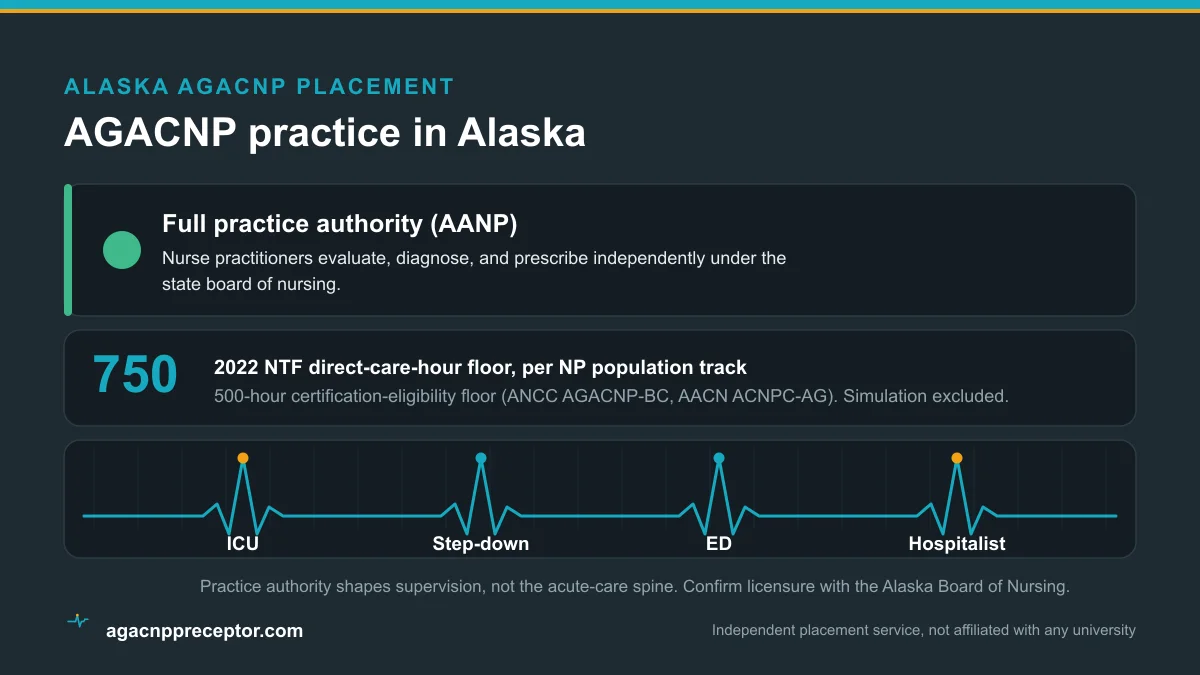
Alaska is a full-practice-authority state and has been for many years. A nurse practitioner licensed by the Alaska Board of Nursing evaluates, diagnoses, and prescribes without a required collaborative agreement with a physician. That independence shapes who can serve as your preceptor.
In a full-practice state, an experienced acute care NP (AGACNP-BC or ACNPC-AG) can precept with more autonomy, so a seasoned AGACNP running an ICU or hospitalist service may sign on without the physician co-signature that other states fold in. Intensivist and specialist physicians still precept widely, because critical care runs as a team regardless of state law. Either way the hospital still credentials you, and your preceptor must practice in the setting your rotation targets. Our preceptor requirements page has the detail.
The inpatient settings that take AGACNP students here
Because Alaska's high-acuity bench is small, the units that host acute-care NP students are concentrated but real: the intensive care unit, the step-down or progressive care unit, the emergency department, the hospitalist and inpatient medicine service, and inpatient specialty services where the state has them.
The trade-off is capacity and competition. With only a couple of hospitals holding the deepest ICU and specialty resources, slots are limited and fill early, and students from every program in the state are drawn to the same units. Which settings count toward your hours is set by your program, so confirm your requirements before committing to a plan.
The Alaska hours that are hardest to secure
High-acuity ICU time and procedures and advanced skills are the tightest, because the volume that generates them sits in a short list of Anchorage units. Central line placement, airway management, and the sickest medical and surgical cases are concentrated where the tertiary beds are.
The youngest end of the age range is another gap. AGACNP scope reaches down to roughly age 13, and adolescent acute exposure is uneven in a state with limited specialty volume, while older adults and the frail elderly fill Alaska's medicine and ICU beds. Distance is the other real cost: securing a rotation often means arranging to be in Anchorage for a block.
How we place your Alaska acute rotations
We take on the inpatient search and the logistics that come with Alaska's geography. You tell us where you are, your program, and the rotations you still need, and we source a qualified acute-care preceptor and an approvable site, planned around the reality that your high-acuity hours will likely run through Anchorage.
We serve students at any university and never guarantee placement, hours, or your school's approval of a site, and final sign-off rests with the hospital and your program. Start with the match form here or reach us through contact, and see how it works for the steps.
Good to know
Do nurse practitioners have full practice authority in Alaska?
Yes. Alaska is a full-practice-authority state, so an NP licensed by the Alaska Board of Nursing can evaluate, diagnose, and prescribe without a required physician collaborative agreement. In acute care, physician intensivists and specialists still precept alongside acute care NPs because critical care runs as a team. Confirm current rules with the state board.
Where will I do my ICU hours in Alaska?
Most likely in Anchorage. The state's highest-level hospitals, both Level II trauma centers, sit there and hold most of Alaska's intensive care and specialty capacity. There is no Level I trauma center in the state, and serious cases are frequently transferred into Anchorage from rural areas, so students commonly arrange to be there for high-acuity blocks.
How many acute-care hours does an AGACNP program require?
Your program sets the number. The 2022 NTF Standards recommend at least 750 direct patient care hours per NP track, while ANCC and AACN Certification Corporation eligibility sets a 500-hour floor. Many AGACNP programs publish totals from roughly 500 to 750 or more, and some sit below 750, so confirm your own total. See our clinical hours page.
Can you place a student who lives in rural Alaska?
We can help, but honesty matters: the deepest acute-care resources are in Anchorage, so a rural student usually travels for ICU, procedure, and specialty blocks. We source and verify the preceptor and site and prepare credentialing; we cannot guarantee a placement close to home when the high-acuity beds simply are not there.
Related
Secure the rotation no one else will hand you
Tell us your school, your city, and the acute rotations you still need. We will come back with a plan for the full AGACNP trace and a realistic path to placed.