AGACNP acute-care rotations across Arizona's hospitals
In Arizona, acute-care training runs through two big metros. The Phoenix Valley and Tucson hold the state's Level I trauma centers, academic ICUs, and busiest inpatient services, while the desert counties and tribal lands in between depend on smaller hospitals that transfer their sickest patients to the cities. This page explains where AGACNP students actually rotate in Arizona and how we secure those inpatient hours. We are an independent service, open to students at any university.
Tell us your school and city. It is free to ask, with no obligation.
Arizona concentrates acute care in two metros
The Phoenix metro carries the largest share of the state's high-acuity capacity. It holds several Level I trauma centers, including a county safety-net hospital with a trauma and burn program, Banner Health's academic hospital, a large Dignity Health medical center known for its neuroscience institute, and the HonorHealth network's trauma sites. Deep ICU coverage, medical, surgical, cardiac, and neurocritical, sits across these systems, and a major national clinic operates in the Phoenix and Scottsdale area.
Tucson is the second hub, anchored by Banner Health's academic medical center and its Level I trauma program, with additional community systems across the metro. Between and beyond the two cities, much of Arizona is rural, and tribal health facilities and small hospitals cover long distances. Those sites stabilize and transfer critically ill patients to Phoenix or Tucson, which is where the ICU, procedure, and specialty hours concentrate.
The units where AGACNP students log hours in Arizona
AGACNP rotations are inpatient and high-acuity, so your hours sit in the hospital. Across Arizona's metro systems the settings that take acute-care NP students include the intensive care unit and its subtypes, the step-down or progressive care unit, the emergency department, the hospitalist and inpatient medicine service, and inpatient specialty services such as cardiology, pulmonology, nephrology, and trauma or surgical care.
The academic and trauma centers carry the widest mix, including neurocritical and cardiac ICUs and procedure-heavy services that smaller hospitals cannot offer. Rapid response and progressive care teams in the busy metro hospitals give students steady exposure to deterioration and escalation, the day-to-day of acute practice, and a few long-term acute care hospitals in the Phoenix area add ventilator-weaning and complex-recovery time. What each rotation counts toward is set by your program, so confirm your requirements before you build a plan around a specific unit.
Full practice authority and your Arizona preceptor
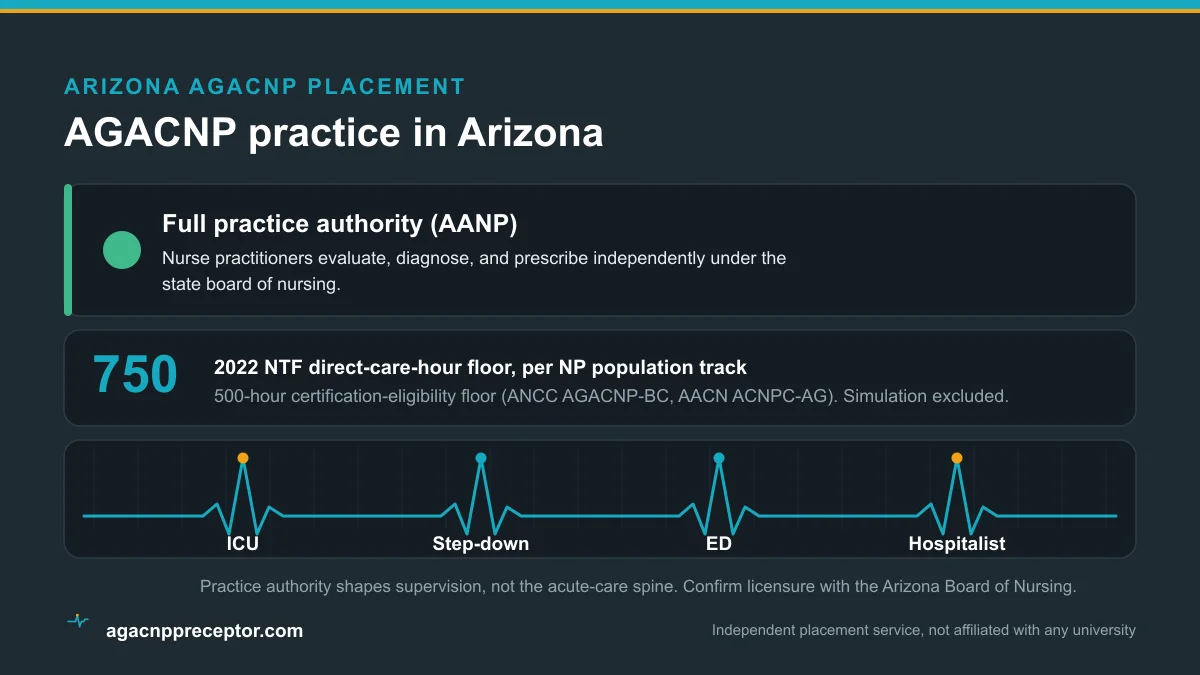
Arizona is a full-practice-authority state. A nurse practitioner licensed by the Arizona State Board of Nursing evaluates, diagnoses, and prescribes without a required collaborative agreement, once prescriptive and controlled-substance requirements are met. That autonomy affects who can precept you.
In a full-practice state an experienced acute care NP (AGACNP-BC or ACNPC-AG) can supervise your hours with more independence, so a seasoned AGACNP on an ICU or hospitalist team may serve as preceptor without the physician co-signature other states require. Intensivists and specialty physicians still precept broadly, because critical care runs as a team. The hospital credentials you either way, and your preceptor must practice in the setting your rotation targets. See our preceptor requirements.
The Arizona hours that are hardest to secure
Even with two strong metros, the scarce blocks are the high-acuity ones. Dedicated ICU subspecialty time and procedures and advanced skills concentrate in the Phoenix and Tucson academic and trauma centers, and their slots are pursued by students from many programs across the region.
The adolescent edge of the range is uneven here too. AGACNP scope begins at roughly age 13, so adolescent acute exposure depends on the site, while older adults and the frail elderly, including a large retiree population, fill Arizona's ICU and medicine services. Students in rural counties usually plan to spend their high-acuity blocks in a metro.
How we place your Arizona acute rotations
We run the inpatient search for you and aim it where Arizona's acute capacity actually sits. Tell us your city, your program, and the rotations you still need, and we source a qualified acute-care preceptor and an approvable hospital site, early enough to clear credentialing and any affiliation agreement your school requires.
We are independent and serve students at any university. We never guarantee placement, hours, or your school's approval of a site, and final sign-off rests with the hospital and your program. Start on the match form here or through contact, and read how it works for the process.
Good to know
Is Arizona a full-practice state for NPs?
Yes. Arizona grants nurse practitioners full practice authority under the Arizona State Board of Nursing, so no physician collaborative agreement is required to practice once prescriptive requirements are met. In acute care, intensivists and specialists still precept alongside acute care NPs because critical care is team-based. Confirm current requirements with the board.
Where are AGACNP rotations concentrated in Arizona?
In the Phoenix Valley and Tucson. Those metros hold the state's Level I trauma centers, academic ICUs, and busiest hospitalist and specialty services. Rural and tribal-area hospitals stabilize and transfer their sickest patients to the cities, so high-acuity ICU, procedure, and subspecialty hours generally happen in the two metros.
How many acute-care hours will my Arizona program require?
Your program decides, not the state. The 2022 NTF Standards recommend a minimum of 750 direct patient care hours per NP track, while ANCC and AACN Certification Corporation eligibility sets a 500-hour floor. AGACNP programs commonly publish totals from roughly 500 to 750 or more, and some fall below 750, so confirm your own. See clinical hours.
Do you guarantee an ICU rotation in Phoenix or Tucson?
No. ICU slots are credentialed and limited, and demand is high in both metros. We source and verify a qualified preceptor and an approvable site, prepare the paperwork, and start early so critical care does not stall your term, but final approval always rests with the hospital and your school.
Secure the rotation no one else will hand you
Tell us your school, your city, and the acute rotations you still need. We will come back with a plan for the full AGACNP trace and a realistic path to placed.