Building your AGACNP acute-care hours in Arkansas
Arkansas funnels its highest-acuity care toward a few hubs, so your acute-care rotations here follow the hospitals rather than the map. Little Rock holds the state's only Level I trauma center and academic medical center, a large statewide system spreads regional hospitals across the rest of Arkansas, and the northwest corridor has grown its own acute capacity, while the Delta and the Ozarks lean on critical access hospitals. This page shows where AGACNP students actually rotate in Arkansas and how we secure those hours. We are an independent service, open to students at any university.
Tell us your school and city. It is free to ask, with no obligation.
Where Arkansas keeps its high-acuity beds
Little Rock is the state's referral center. Its academic medical center holds Arkansas's only Level I trauma center and the deepest intensive care and subspecialty bench, and the metro also carries a large faith-based system with a Level II trauma program and other tertiary hospitals. This is where the sickest patients from across Arkansas end up.
The northwest corridor around Fayetteville, Springdale, Rogers, and Bentonville has grown quickly and now supports regional referral hospitals with solid ICU and inpatient capacity. Jonesboro anchors the northeast with two medical centers, and Fort Smith serves the western border, each with regional systems. These secondary hubs handle a real share of acute care and can host students who live nearby.
Beyond the hubs, much of Arkansas is rural. The Delta and the Ozark and Ouachita highlands are served largely by critical access hospitals, where intensive care is thin and unstable patients are stabilized and transferred. For students that usually means the ICU and specialty blocks happen in Little Rock or the northwest corridor.
The units that host AGACNP students in Arkansas
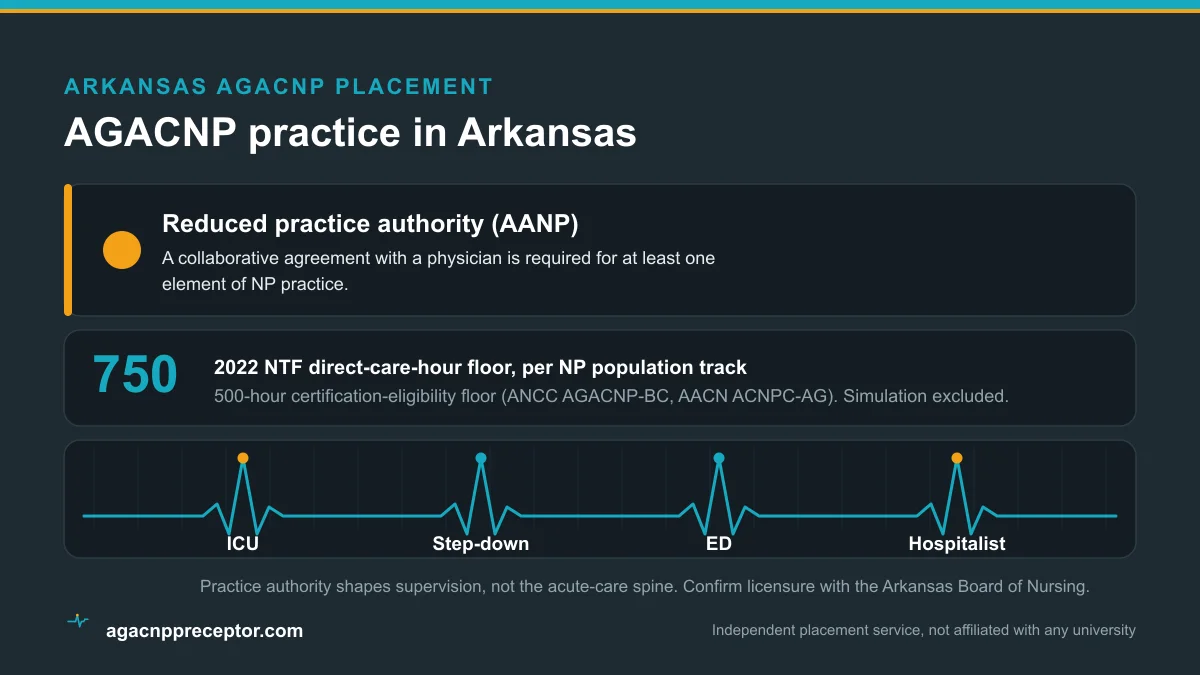
AGACNP rotations are inpatient and high-acuity, so your hours sit in the hospital. Across the Little Rock, northwest, and regional systems, the settings that take acute-care NP students include the intensive care unit, the step-down or progressive care unit, the emergency department, the hospitalist and inpatient medicine service, and inpatient specialty services such as cardiology, pulmonology, nephrology, and trauma or surgical care.
The Little Rock academic center carries the widest range, including the subspecialty and procedure-heavy services that are hard to find elsewhere in the state. Regional hospitals can be strong for hospitalist and step-down hours closer to home. What each unit counts toward is set by your program, so confirm your requirements before you plan around a site.
Reduced practice, and Arkansas's independent-practice pathway
Arkansas is a reduced-practice state. An advanced practice nurse with prescriptive authority keeps a collaborative practice agreement on file with the Arkansas State Board of Nursing. Notably, the state also offers a pathway to full independent practice: after a period of practice under a collaborative agreement, a nurse practitioner can apply through the state's credentialing committee for independent status.
For your rotation, this shapes the supervision structure more than the preceptor's qualifications. In critical care a collaborating intensivist, hospitalist, or specialist is usually part of the team regardless, and your preceptor is generally a board-certified acute care NP (AGACNP-BC or ACNPC-AG) or a physician in a matching acute role. Whether your preceptor holds a collaborative agreement or independent status, the hospital still credentials you. See our preceptor requirements.
The Arkansas hours that are hardest to secure
The tight blocks are high-acuity ICU time and procedures and advanced skills, which cluster in the Little Rock academic center and, increasingly, the northwest corridor. Central lines, airway management, and the sickest medical and surgical cases live where the tertiary volume is, and those slots fill early.
The youngest end of the range can be hard to cover. AGACNP scope reaches to roughly age 13, so adolescent acute exposure depends on the site, while older adults and the frail elderly fill Arkansas's ICU and medicine beds. Students in the Delta or the highlands often plan to travel to a hub for their high-acuity blocks.
How we place your Arkansas acute rotations
We run the inpatient search for you and aim it where Arkansas's acute capacity actually sits. Tell us your city, your program, and the rotations you still need, and we source a qualified acute-care preceptor and an approvable hospital site, early enough to clear credentialing and any affiliation agreement your school requires.
We are independent and serve students at any university. We never guarantee placement, hours, or your school's approval of a site, and final sign-off rests with the hospital and your program. Start on the match form here or through contact, and see how it works.
Good to know
Is Arkansas a full-practice state for nurse practitioners?
Not by default. Arkansas is a reduced-practice state, so a prescribing APRN keeps a collaborative practice agreement on file with the Arkansas State Board of Nursing. The state does offer a pathway to full independent practice after a required period of collaborative practice. In acute care a collaborating physician is common regardless, so this affects supervision structure more than preceptor qualifications. Confirm current rules with the board.
Where are AGACNP rotations concentrated in Arkansas?
In Little Rock and the northwest corridor. Little Rock holds the state's only Level I trauma center and academic medical center, with the deepest ICU and subspecialty bench, and the Fayetteville-to-Bentonville corridor has grown strong regional capacity. Jonesboro and Fort Smith add regional hubs. Rural Delta and highland areas rely on critical access hospitals and transfer their sickest patients.
How many acute-care hours will my Arkansas program require?
Your program sets it, not the state. The 2022 NTF Standards recommend at least 750 direct patient care hours per NP track, while ANCC and AACN Certification Corporation eligibility sets a 500-hour floor. AGACNP programs commonly publish totals from roughly 500 to 750 or more, and some sit below 750, so confirm your own. See clinical hours.
Can you guarantee an ICU rotation in Arkansas?
No. Inpatient units credential students and the tertiary ICU slots are limited, especially in Little Rock. We source and verify a qualified preceptor and an approvable site, prepare the credentialing paperwork, and start early so critical care does not run you short, but final approval rests with the hospital and your school.
Related
Secure the rotation no one else will hand you
Tell us your school, your city, and the acute rotations you still need. We will come back with a plan for the full AGACNP trace and a realistic path to placed.