AGACNP acute-care placement in California hospitals
California offers more acute-care capacity than almost anywhere, but it is spread unevenly and demand for student slots is intense. The coastal metros are dense with academic medical centers, large systems, and Level I trauma centers, while the Central Valley and the rural north run much thinner. This page maps where AGACNP students rotate in California, explains where AB 890 leaves nurse practitioner practice authority in 2026, and shows how we secure your inpatient hours. We are an independent service, open to students at any university.
Tell us your school and city. It is free to ask, with no obligation.
California's acute-care landscape, coast versus interior
The coastal metros hold some of the deepest acute capacity in the country. University-affiliated academic medical centers cluster in the Bay Area, Los Angeles, San Diego, Sacramento, and the Inland Empire, alongside large systems such as Kaiser Permanente, Sutter Health, Dignity Health, Providence, Scripps, and Sharp. California has roughly fifteen Level I trauma centers, most of them in these metros, and the ICU depth spans medical, surgical, cardiac, and neurocritical care.
The interior is a different story. In the Central Valley, a single Fresno hospital holds the only Level I trauma center between Los Angeles and Sacramento and covers a service area of thousands of square miles, so it carries acute demand well beyond its own walls. The far north, the Sierra, and the desert east are served largely by community and critical access hospitals that stabilize and transfer their sickest patients. That urban-versus-rural split decides where high-acuity hours are realistic.
Where AB 890 leaves NP practice authority in 2026
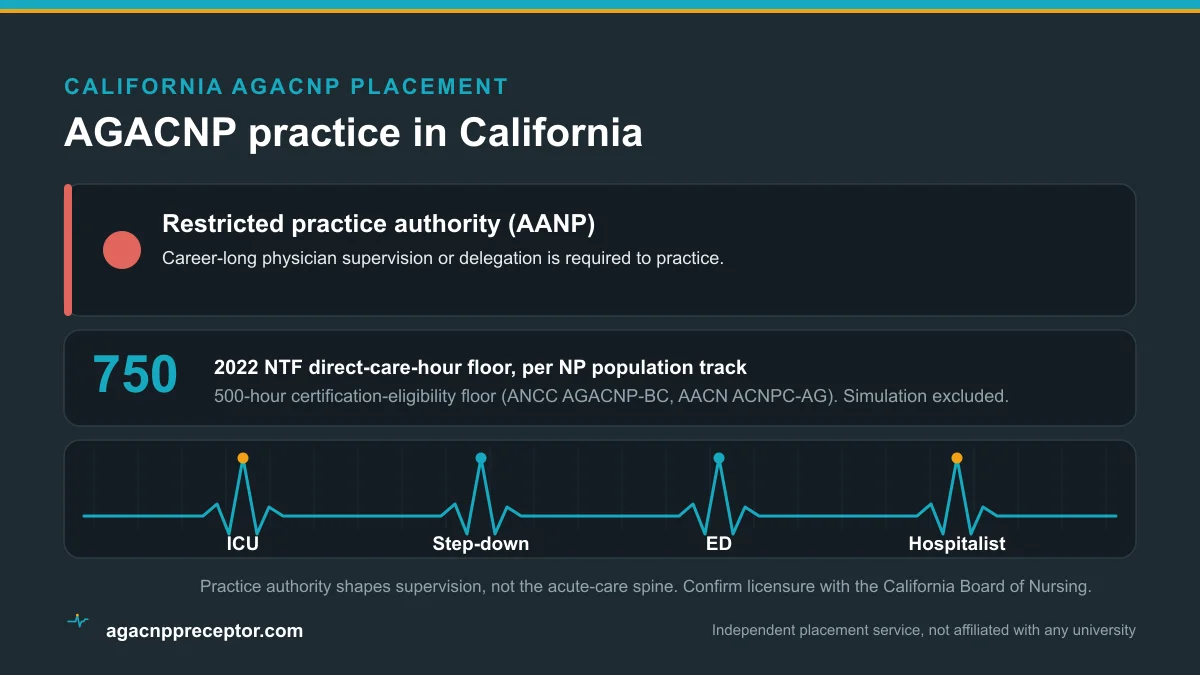
California is still classified as a restricted-practice state, but the rules are in transition. AB 890 created two nurse practitioner categories that can work without standardized procedures: the so-called 103 NP, who practices within a group setting that includes at least one physician after completing a transition-to-practice period of about three years, and the 104 NP, who can practice more independently within the population focus of their national certification. Nurse practitioners first became eligible for 104 status on January 1, 2026.
Adult-gerontology is one of the recognized population focuses, so an AGACNP is inside the scope of the pathway. For your rotation, the practical effect is on the supervision arrangement in the hospital: some acute-care NP preceptors now practice with more autonomy, while many acute settings still fold in a collaborating or supervising physician, which is common in critical care regardless of the state category. Because the rules are changing, confirm the current standing with the California Board of Registered Nursing.
The units that host AGACNP students in California
AGACNP rotations are inpatient and high-acuity, and California's larger hospitals carry the full range. The settings that take acute-care NP students include the intensive care unit and its many subtypes, the step-down or progressive care unit, the emergency department, the hospitalist and inpatient medicine service, and inpatient specialty services such as cardiology, pulmonology, nephrology, and trauma or surgical care.
The academic and trauma centers offer the widest mix, including the neurocritical, cardiac, and transplant-adjacent services that only large systems run. What each rotation counts toward is set by your program, so confirm your requirements before planning around a particular site.
Which California hours are hardest to secure locally
Capacity is not the same as availability. California has many AGACNP students and many competing health-professions programs, so even in the dense metros the high-acuity ICU blocks and procedures and advanced skills are pursued hard, and desirable slots fill early. In the Central Valley and the rural north, the challenge is supply: fewer tertiary beds mean students often travel toward a metro or the Fresno hub.
The adolescent edge of the range is uneven, since AGACNP scope reaches to roughly age 13 and adolescent acute exposure depends on the site, while older adults and the frail elderly fill California's ICU and medicine beds. Planning early is what secures the scarce blocks.
How we place your California acute rotations
We run the inpatient search for you across California's systems and aim it where the capacity and the openings actually are. Tell us your city, your program, and the rotations you still need, and we source a qualified acute-care preceptor and an approvable hospital site, early enough to clear credentialing and any affiliation agreement your school requires.
We are independent and serve students at any university. We never guarantee placement, hours, or your school's approval of a site, and final sign-off rests with the hospital and your program. Start on the match form here or through contact, and read how it works.
Good to know
Is California a full-practice state after AB 890?
Not yet. California is still classified as restricted, though AB 890 created transition pathways. A 103 NP practices without standardized procedures within a physician group after a transition-to-practice period, and a 104 NP can practice more independently within their certification's population focus, with eligibility beginning January 1, 2026. Confirm the current standing with the California Board of Registered Nursing.
Does AB 890 change what I need in an AGACNP preceptor?
It changes the supervision arrangement more than the preceptor's qualifications. Some acute-care NP preceptors now practice with more autonomy, while many critical-care settings still include a collaborating or supervising physician, which is normal in the ICU regardless. Your preceptor should be a board-certified acute care NP (AGACNP-BC or ACNPC-AG) or a physician in a matching acute role.
Where are AGACNP rotations concentrated in California?
In the coastal metros: the Bay Area, Los Angeles, San Diego, Sacramento, and the Inland Empire, where academic medical centers, large systems, and most of the state's Level I trauma centers sit. The Central Valley centers on the Fresno hub, and the rural north and desert east rely on community and critical access hospitals that transfer their sickest patients.
How many acute-care hours will my California program require?
Your program sets it. The 2022 NTF Standards recommend at least 750 direct patient care hours per NP track, while ANCC and AACN Certification Corporation eligibility sets a 500-hour floor. AGACNP programs commonly publish totals from roughly 500 to 750 or more, and some sit below 750, so confirm your own. See clinical hours.
Can you guarantee an ICU placement in California?
No honest service can. Slots are credentialed and competition is high, especially in the metros. We source and verify a qualified preceptor and an approvable site, prepare the paperwork, and start early so critical care does not stall your term, but final approval rests with the hospital and your school.
Related
Secure the rotation no one else will hand you
Tell us your school, your city, and the acute rotations you still need. We will come back with a plan for the full AGACNP trace and a realistic path to placed.