Acute-care AGACNP preceptors in a one-hub state
Delaware is a small, three-county state with one dominant acute-care hub, and that shapes where adult-gerontology acute care nurse practitioner students find hours. The high-acuity units you need, ICU, step-down, emergency, and hospitalist services, are concentrated in the Newark and Wilmington area in the north. Delaware grants full practice authority, which widens who can precept you.
Tell us your school and city. It is free to ask, with no obligation.
One Level I hub and a north-south split
Delaware's acute-care capacity is concentrated to an unusual degree. New Castle County in the north, anchored by Newark and Wilmington, holds the state's tertiary and academic care, while Kent and Sussex counties to the south are more rural and coastal, with community hospitals that handle a wide range of care but refer the sickest patients north.
Christiana Hospital in Newark is the state's only Level I trauma center and its only university-level tertiary academic medical center, part of the ChristianaCare system that also runs Wilmington Hospital. It carries the deep ICU, cardiac, and specialty benches acute-care students need. Downstate, systems such as Bayhealth in the Dover and Milford area and Beebe Healthcare on the coast provide community-level acute care and emergency volume.
For many downstate students, the practical answer for high-acuity hours is to travel north to the Newark corridor, or across a state line to a nearby metro, for ICU and specialty blocks. Because Delaware is compact, that commute is real but rarely enormous, and planning it early beats scrambling in your final term.
Full practice authority in Delaware
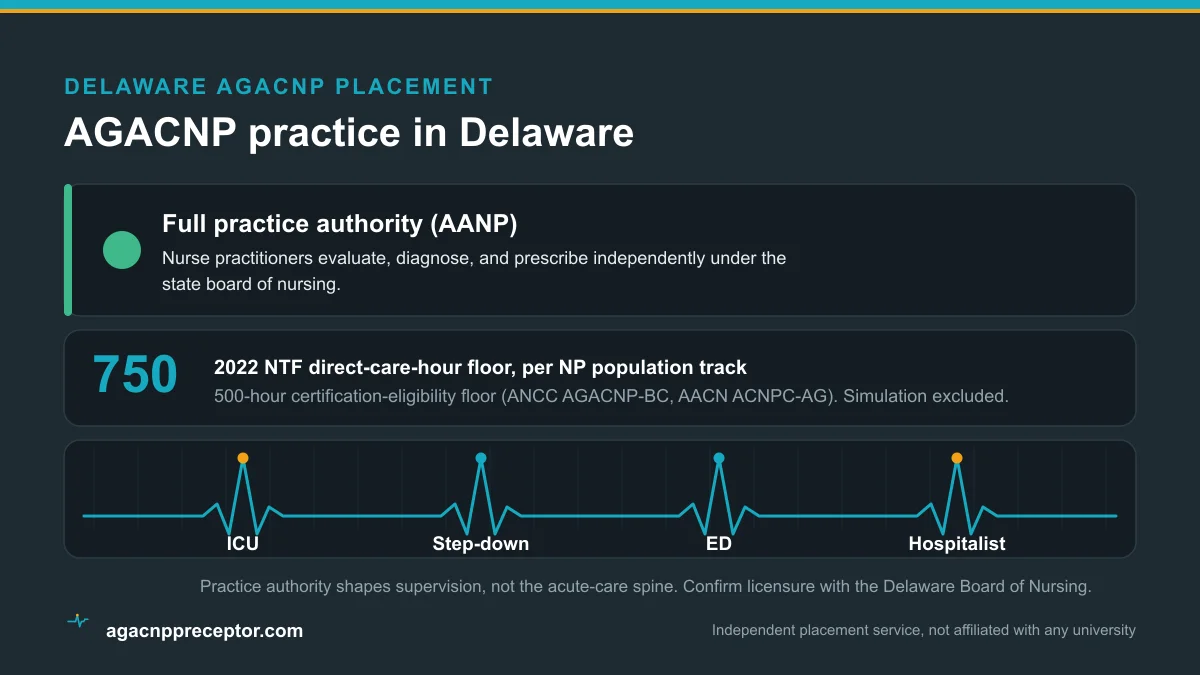
Delaware moved to full practice authority through legislation that gave the Delaware Board of Nursing exclusive authority over advanced practice and removed the required written collaborative agreement with a physician. The state sits in the AANP full-practice category, so an experienced nurse practitioner can evaluate, diagnose, order, and prescribe independently, though employers may still set their own supervision expectations.
For your search, that means a board-certified AGACNP-BC or ACNPC-AG can precept you on their own credential, and an intensivist, hospitalist, or specialist physician can precept as well. In critical care you will work within a physician-led team regardless, so the day-to-day feel is similar to a collaborative state. The benefit of full authority is a wider pool of nurse practitioners who can independently take a student.
The units where AGACNP students train
AGACNP is a hospital-based, high-acuity role. Your hours should come from settings that manage unstable, complex, and critically ill adults from adolescence, around age 13, through the frail elderly.
- Intensive care units, including medical, surgical, cardiac, and neuro
- Step-down and progressive care beds
- Emergency departments for time-critical presentations
- Hospitalist and inpatient internal medicine services
- Inpatient specialty teams in cardiology, pulmonology, nephrology, and trauma
We do not place AGACNP students in primary care or outpatient clinics. Those settings belong to the primary care track and will not build the acute decision-making your certification and your first inpatient job will demand.
Hours that are hardest to secure in a small state
With a single Level I hub, the toughest hours in Delaware are the highest-acuity ones. Deep ICU blocks, procedures and advanced skills such as line placement and airway management, and continuity with one preceptor across a rotation are the common pressure points, because a small number of sites carry the state's most complex patients.
The adolescent end of the AGACNP range, which starts near age 13, is also hard to capture in adult ICUs. If your program wants that exposure, or dedicated older adult and frail elderly time, we plan for it rather than leaving it to chance in a state with limited high-acuity sites.
Clinical hours to confirm with your program
Hour requirements are set by your program, not one national rule. National Task Force standards from 2022 recommend at least 750 direct patient care hours for an NP track, while ANCC and AACN Certification Corporation eligibility requires a minimum of 500 faculty-supervised hours. Many accredited AGACNP programs publish totals of roughly 500 to 750 or more, and some sit below 750, so confirm your own number and note that simulation usually does not count.
Once you know your remaining hours and units, matching in a one-hub state becomes far more realistic. See our clinical hours overview if you are still building your plan, and expect a preceptor credentialed as AGACNP-BC or ACNPC-AG, or a physician in the acute setting.
How we help you place
We are an independent placement service, not a school, and we help students from any program. Tell us where you live, the units you still need, your program's hour target, and your timeline, and we look for a credentialed acute-care preceptor and site. We advocate for you and are candid about a small state's limits; we do not guarantee a placement or your program's approval of any preceptor or site, which is your school's decision.
If you have an ICU, step-down, or hospitalist requirement and no lead, see how it works, check typical preceptor requirements, and reach us through the match form or contact page. Our cost page lays out fees plainly.
Good to know
Where do most AGACNP students get hours in Delaware?
Most high-acuity training happens in the Newark and Wilmington corridor in the north, where the state's only Level I trauma center and academic tertiary hospital sit. Downstate students in Kent and Sussex often travel north, or to a nearby out-of-state metro, for ICU and specialty blocks.
Does Delaware require a physician to supervise my preceptor?
No. Delaware grants full practice authority, so an experienced nurse practitioner can precept on their own credential without a collaborative agreement, though individual employers may add requirements. Physicians can precept too, and in critical care you will work within a physician-led team regardless.
I live downstate. Do I have to travel for acute-care hours?
Often, yes, for the highest-acuity blocks. Community hospitals downstate handle a lot, but the deepest ICU and specialty volume is concentrated in the north. Because Delaware is small, the commute is real but usually manageable, and we try to find the closest workable site.
Can a primary care rotation count for my AGACNP hours?
No. The acute care track is about unstable and critically ill patients in the hospital. Primary care and outpatient clinics belong to a different track and will not meet the intent of AGACNP training, so we place acute-care students in inpatient and high-acuity settings.
Will you guarantee my placement?
No. We search for and help arrange acute-care preceptors and sites and advocate for you, but we cannot guarantee a placement or your program's approval of a preceptor or site. Those approvals are made by your school.
Secure the rotation no one else will hand you
Tell us your school, your city, and the acute rotations you still need. We will come back with a plan for the full AGACNP trace and a realistic path to placed.