Acute-care AGACNP preceptor matching across Florida
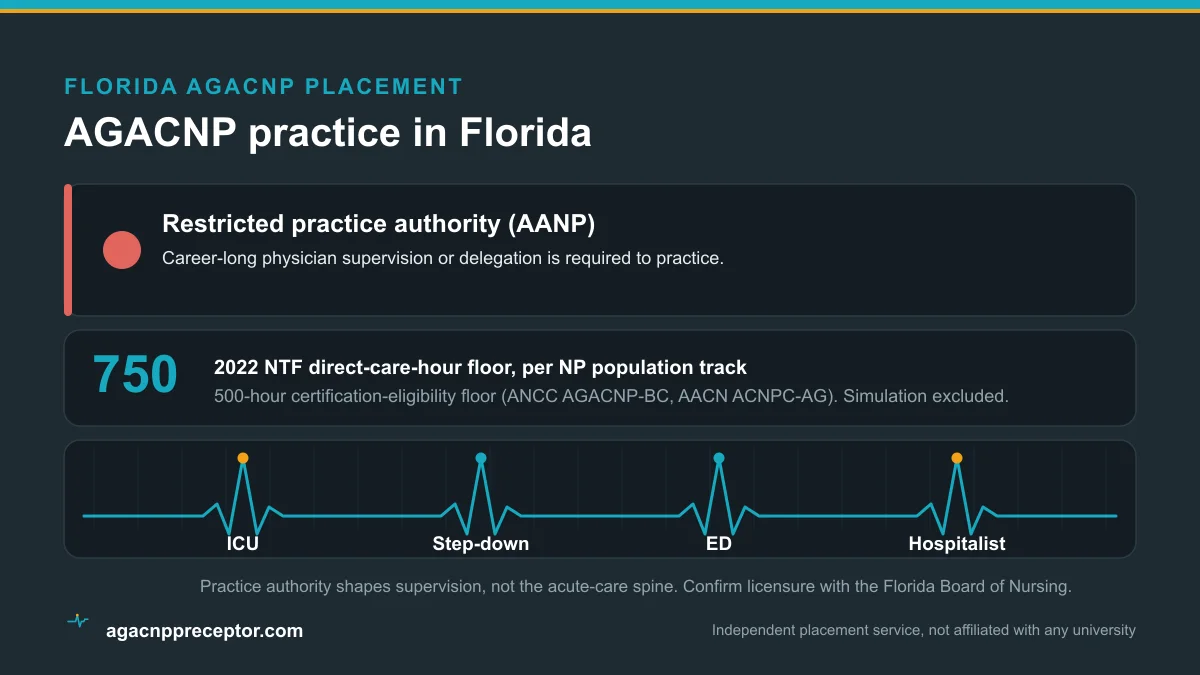
Florida has one of the busiest acute-care markets in the country, with a large older population that keeps ICUs, cardiology, pulmonology, and hospitalist services full. For an adult-gerontology acute care nurse practitioner student, that means real depth of high-acuity hours across several metros. Florida is a restricted-practice state, and its autonomous-practice law reaches only primary care, so acute-care roles here work under a collaborating physician.
Tell us your school and city. It is free to ask, with no obligation.
Why Florida runs deep on acute-care hours
Florida's demographics drive its hospital demand. A large and growing older population means high volumes of cardiac, pulmonary, renal, and neurologic admissions, the bread and butter of adult-gerontology acute care. That translates into a broad base of ICU, step-down, emergency, and hospitalist hours for students who can reach the right sites.
The state's high-acuity care spreads across several metro clusters rather than one center. Southeast Florida from Miami-Dade through Broward and Palm Beach, the Tampa Bay region, the Orlando corridor, and the Jacksonville area each host Level I or II trauma centers, academic medical centers, and large systems. Southwest Florida around Fort Myers and Naples and the Panhandle around Pensacola and Tallahassee add more.
The trauma centers and systems that anchor training
Florida's Level I trauma centers sit inside its major teaching hospitals. Tampa General Hospital anchors the Tampa Bay region, Orlando Regional Medical Center leads the Orlando Health system downtown, UF Health hospitals in Gainesville and Jacksonville serve north central and northeast Florida, and Jackson Memorial in Miami operates the Ryder Trauma Center. These are the settings with the deepest ICU and specialty benches.
Large systems run much of the rest. HCA Florida, AdventHealth, BayCare, Baptist Health, Memorial Healthcare, Lee Health, and Orlando Health operate tertiary hospitals with the intensive care and inpatient specialty volume acute-care students need. That breadth is a genuine advantage when you are hunting for a specific unit.
The interior of the state tells a different story. Rural counties in the Big Bend, the Panhandle, and the agricultural heartland have thin acute capacity and few high-level trauma resources, so students there usually travel to the nearest coastal metro for ICU and specialty blocks.
Restricted practice, and why acute care still needs a physician
Florida is classified by the AANP as a restricted-practice state, and the nuance matters for AGACNP students. Florida law does allow qualifying nurse practitioners to register for autonomous practice, but that autonomy is limited to primary care, meaning family medicine, general pediatrics, and general internal medicine. Acute and hospital-based practice is not covered.
In practice, that means an AGACNP working in an ICU, on a hospitalist service, or in an inpatient specialty operates under a collaborating or supervising physician. This is common in critical care anyway, since those services are physician-led. For your preceptor search it shapes who signs on: your preceptor may be a board-certified AGACNP-BC or ACNPC-AG working within a physician-supervised acute-care service, or a physician such as an intensivist or hospitalist. Licensure and supervision specifics are set by the Florida Board of Nursing, so confirm current rules there.
Settings where AGACNP students belong
The adult-gerontology acute care role is inpatient and high-acuity, covering unstable and complex patients from adolescence, around age 13, through the frail elderly. Your hours should reflect that.
- Intensive care in medical, surgical, cardiac, and neuro units
- Step-down and progressive care floors
- Emergency departments for acute presentations
- Hospitalist and inpatient internal medicine teams
- Inpatient specialty services in cardiology, pulmonology, nephrology, and trauma or surgery
We do not place AGACNP students in primary care clinics. Given that Florida's autonomous-practice pathway is itself limited to primary care, it is worth repeating that acute-care competency is built at the bedside in the hospital, not in an outpatient office.
The hours students struggle to secure
Even in a hospital-rich state, some hours are competitive. High-acuity ICU time, procedures and advanced skills, and steady continuity with one preceptor are the usual bottlenecks, because the strongest academic centers field requests from many programs.
The adolescent end of the range is hard to reach in adult ICUs that rarely admit patients under 18, and dedicated frail elderly blocks sometimes need to be arranged on purpose. We map these gaps against Florida's metro clusters so you are not left short in a final term.
How we match Florida AGACNP students
We are independent, unaffiliated with any school, and we help students from any program. Share your region, the units you still owe, your program's hour requirement, and your timeline, and we look for a credentialed acute-care preceptor and a site that fit within a physician-supervised service. We advocate for you but do not guarantee a placement or your program's approval of any preceptor or site, which remains your school's call.
If you have an ICU, hospitalist, or specialty requirement and no lead, start with how it works, review clinical hours and preceptor requirements, and tell us what you need through the match form or contact page.
Good to know
Is Florida a strong state for AGACNP clinical hours?
Yes, in terms of volume. A large older population keeps cardiac, pulmonary, and hospitalist services busy, and several metros host Level I trauma centers and large systems. The challenge is competition at the top academic centers and thin capacity in the rural interior.
Florida has autonomous practice, so why does acute care need a physician?
Because Florida's autonomous-practice registration only covers primary care: family medicine, general pediatrics, and general internal medicine. Acute and hospital-based practice is not included, so an AGACNP in an ICU or hospitalist role works under a collaborating physician. That is standard in physician-led critical care anyway.
Which parts of Florida have the most acute-care sites?
The southeast from Miami through Palm Beach, the Tampa Bay region, the Orlando corridor, and the Jacksonville area carry the deepest high-acuity capacity. Southwest Florida and the Panhandle add more. The interior is thinner, so inland students often travel to a coastal metro.
Can I do AGACNP hours in a primary care clinic?
No. The acute care track is built around unstable and critically ill hospital patients. Primary care belongs to a different track, and in Florida it is also the only setting the autonomous-practice law covers. We place acute-care students in inpatient and high-acuity units.
Do you guarantee placement in Florida?
No. We search for and help arrange acute-care preceptors and sites and advocate for you, but we cannot guarantee a placement or your school's approval of any preceptor or site. Those approvals belong to your program.
Secure the rotation no one else will hand you
Tell us your school, your city, and the acute rotations you still need. We will come back with a plan for the full AGACNP trace and a realistic path to placed.