Acute-care AGACNP preceptors across Georgia
Georgia concentrates its highest-acuity care in metro Atlanta and a short list of regional Level I trauma centers, with a large rural interior that runs thin on intensive care. For an adult-gerontology acute care nurse practitioner student, that geography decides where the hours are. Georgia is a restricted-practice state, where nurse practitioners work under a written protocol with a delegating physician.
Tell us your school and city. It is free to ask, with no obligation.
Metro Atlanta and Georgia's Level I centers
Georgia's acute-care center of gravity is metro Atlanta, home to large academic and safety-net hospitals and several major systems. Grady Memorial Hospital operates a Level I trauma center and one of the busiest emergency and critical care services in the Southeast, and systems such as Emory Healthcare, Piedmont Healthcare, WellStar, and Northside run tertiary hospitals with deep ICU and specialty capacity.
Outside Atlanta, the state's other Level I trauma centers anchor their regions: Augusta University Medical Center, home of the Medical College of Georgia, in the east; Memorial Health University Medical Center in Savannah on the coast; and Atrium Health Navicent in Macon for central Georgia. Level II centers in cities such as Gainesville, Rome, Athens, Columbus, and Marietta extend high-acuity coverage further out.
The rural gap and where students travel
Much of Georgia outside the metros is rural, and acute-care resources thin out quickly. Many rural counties rely on small community and critical access hospitals that stabilize and transfer their sickest patients, and the state has felt real strain from rural hospital closures. High-level trauma and deep ICU volume are simply not local in much of south and central Georgia.
For students in those areas, capturing acute-care hours usually means traveling to Atlanta, Augusta, Macon, Savannah, or a regional Level II city for ICU and specialty blocks. It is worth mapping that travel into your plan early, because the closest high-acuity site may be an hour or more away.
Restricted practice and the nurse protocol
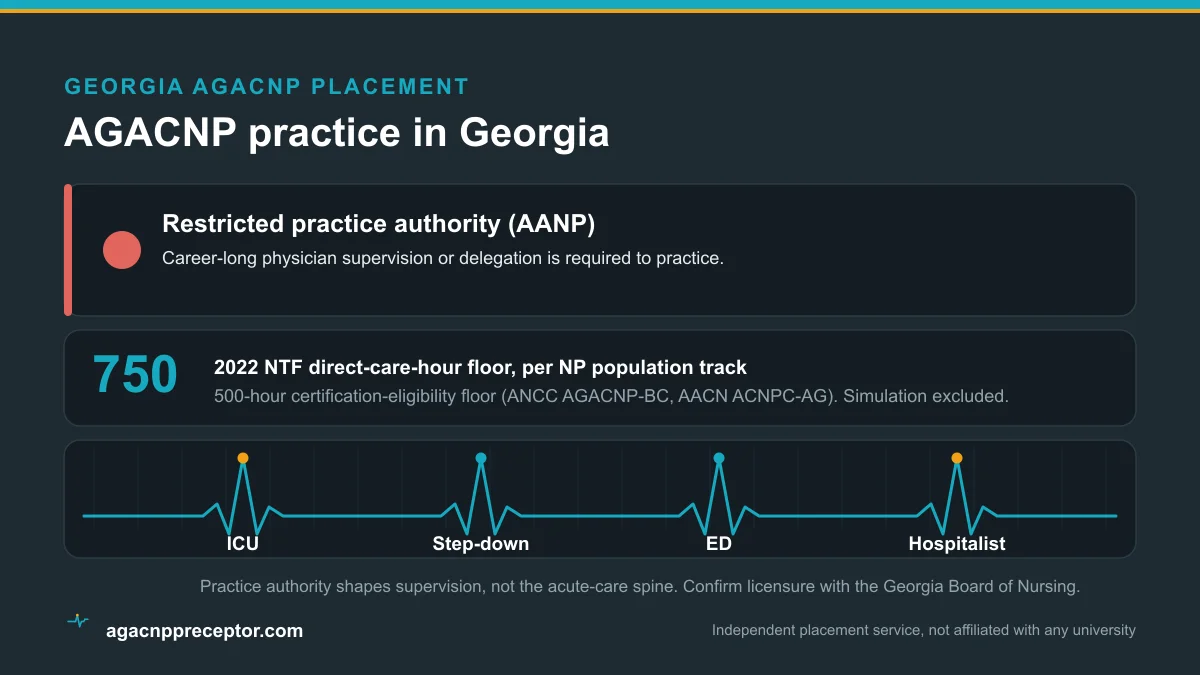
Georgia is an AANP restricted-practice state. Nurse practitioners practice under a written nurse protocol agreement with a delegating physician, and there is no pathway to fully independent practice regardless of experience. Licensure runs through the Georgia Board of Nursing, while protocol and prescriptive-authority rules also involve the state's medical board.
For AGACNP students, this fits the acute-care setting more naturally than it might sound. ICU, hospitalist, and inpatient specialty services are physician-led, so the delegating physician is often the same intensivist, hospitalist, or specialist you round with daily. Your preceptor may be a board-certified AGACNP-BC or ACNPC-AG practicing under that protocol, or a physician directly. The protocol shapes the supervision arrangement, not your preceptor's core acute-care qualifications. Confirm current protocol requirements with the state boards.
Inpatient settings that host AGACNP students
AGACNP is a hospital-based, high-acuity track built around unstable, complex, and critically ill patients from adolescence, near age 13, through the frail elderly. Your hours should come from inpatient units, not clinics.
- Intensive care units across medical, surgical, cardiac, and neuro
- Step-down and progressive care beds
- Emergency departments for acute, undifferentiated care
- Hospitalist and inpatient internal medicine services
- Inpatient specialty teams in cardiology, pulmonology, nephrology, and trauma
Primary care and outpatient clinics are not where acute-care competency is built, so we do not place AGACNP students there. The judgment your certification exam and first inpatient job require comes from the bedside of high-acuity patients.
The hardest hours to lock down
In Georgia the tightest hours are the high-acuity ones concentrated in a few systems. Deep ICU blocks, procedures and advanced skills such as central and arterial lines and airway management, and continuity with one preceptor across a rotation are the common bottlenecks, especially at the busiest Atlanta academic centers.
The adolescent end of the AGACNP age range is hard to reach in adult ICUs that seldom admit patients under 18, and focused older adult or frail elderly time sometimes has to be arranged deliberately. We plan those blocks against Georgia's real geography rather than assuming they will appear.
How placement works with us
We are an independent service, not a school, and we help students from any program. Tell us where you are, the units you still need, your program's hour target, and your timeline, and we search for a credentialed acute-care preceptor and site that fit under Georgia's protocol model. We advocate for you and are honest about the rural travel involved; we do not guarantee a placement or your program's approval of any preceptor or site, which is your school's decision.
If you have an ICU, step-down, or hospitalist requirement and no lead, see how it works, review typical preceptor requirements, and reach us through the match form or contact page. Fees are explained on the cost page.
Good to know
Where are the acute-care hours in Georgia?
They concentrate in metro Atlanta and at the state's regional Level I trauma centers in Augusta, Savannah, and Macon, plus Level II centers in cities like Gainesville, Rome, Athens, and Columbus. Rural Georgia has limited high-acuity capacity, so many students travel to those hubs.
How does Georgia's nurse protocol affect my preceptor?
Georgia is a restricted state where nurse practitioners work under a written protocol with a delegating physician, with no independent pathway. In the hospital that physician is often the intensivist or hospitalist you already work with. Your preceptor can be a board-certified acute-care NP under that protocol or a physician.
I am in rural Georgia. Will I have to travel for ICU hours?
Most likely, yes. Rural counties rely on smaller hospitals that transfer their sickest patients, so deep ICU and specialty hours usually mean traveling to Atlanta, Augusta, Macon, Savannah, or a regional Level II city. We help you find the closest workable site and plan the commute.
Can primary care rotations count toward AGACNP hours?
No. The acute care track is about unstable and critically ill patients in the hospital. Primary care and outpatient clinics belong to a different track and will not meet the intent of AGACNP training, so we place acute-care students in inpatient and high-acuity units.
Do you guarantee a placement in Georgia?
No. We search for and help arrange acute-care preceptors and sites and advocate for you, but we cannot guarantee a placement or your program's approval of any preceptor or site. Those approvals are made by your school.
Related
Secure the rotation no one else will hand you
Tell us your school, your city, and the acute rotations you still need. We will come back with a plan for the full AGACNP trace and a realistic path to placed.