Acute-care AGACNP rotations, matched across Minnesota
For an Adult-Gerontology Acute Care NP student in Minnesota, the clinical hours that count happen inside hospitals, in intensive care, step-down, the emergency department, and on hospitalist and inpatient specialty services. Minnesota pairs two of the country's strongest acute-care hubs with a wide rural reach, which makes for excellent teaching sites and long distances between them. We help students at any university source and verify acute-care preceptors and get the site approved.
Tell us your school and city. It is free to ask, with no obligation.
Two powerful hubs and a long rural reach
Minnesota's high-acuity care concentrates in two places. Rochester is a globally known quaternary academic medical center with a depth of ICU and subspecialty volume most students only read about, and the Twin Cities carry the rest, including multiple Level I trauma centers across Minneapolis, St. Paul, and Robbinsdale plus a large university-based academic center. Together they hold most of the state's complex critical-care beds.
- Duluth anchors the north with the only Level I trauma center in northern Minnesota, serving a very large catchment.
- Regional centers in St. Cloud and across the southeast and west handle tertiary volume.
- Greater Minnesota runs on dozens of critical-access hospitals, which stabilize and transfer rather than hold high-acuity ICU patients.
Where your acute-care hours sit
Plan on the ICU in its medical, surgical, cardiac, and neuro forms, the step-down or progressive care unit, the emergency department, and hospitalist service, with inpatient specialty time in cardiology, pulmonary and critical care, nephrology, and trauma or surgical critical care. The patients run from young adults to the frail elderly.
The Rochester and Twin Cities systems are where the most specialized units live, so a student based in a smaller market often schedules a block in one of the hubs to reach high-acuity and procedure hours. Cardiovascular and neurocritical care, transplant medicine, and complex surgical critical care are unusually deep in Minnesota's two hub systems, which is part of why students route their toughest requirements through them.
Full practice authority and the collaborative-management start
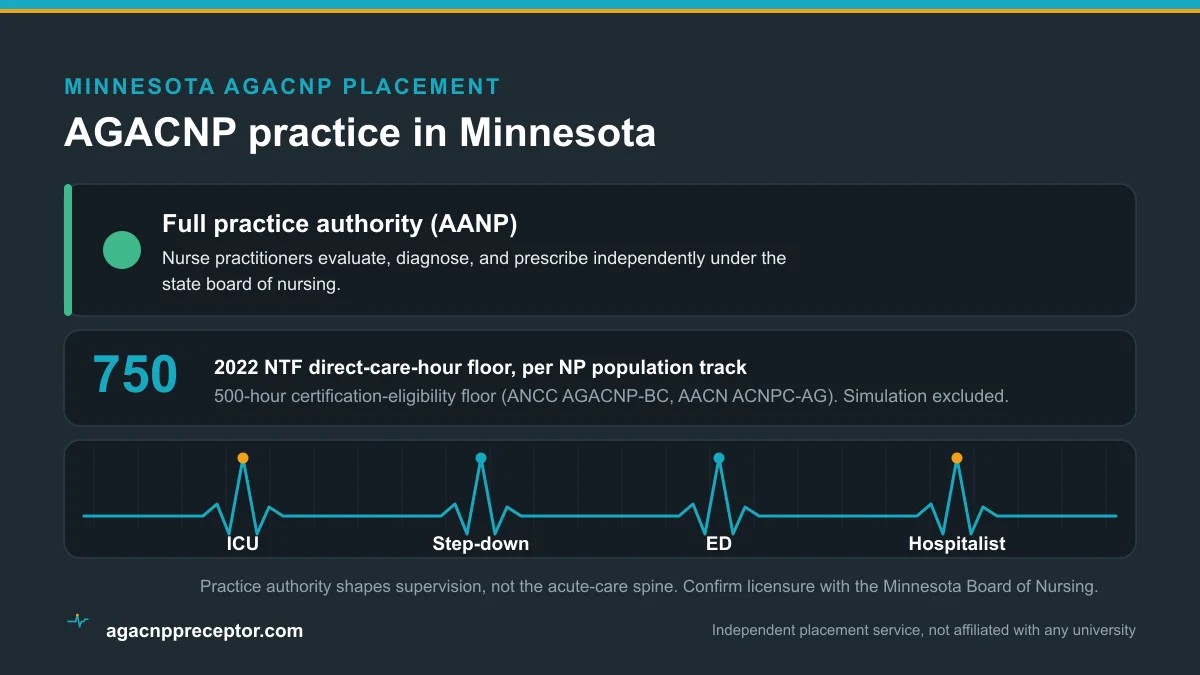
Minnesota has been a full practice authority state since 2015, one of the earlier states to get there. A licensed nurse practitioner can diagnose, treat, and prescribe without a standing physician contract, so a board-certified AGACNP on an ICU or hospitalist service can precept and sign your hours directly.
New nurse practitioners in Minnesota do complete an initial period of collaborative management, about 2,080 hours worked alongside a physician or experienced APRN, before that authority is fully unsupervised. For you as a student it means your preceptor is likely a well-established clinician, and in critical care a physician is part of the team regardless. Confirm any licensure specifics with the state board.
Who precepts in Minnesota critical care
Your preceptor is generally a board-certified acute-care nurse practitioner (AGACNP-BC or ACNPC-AG) or a physician in a matching acute role, an intensivist, hospitalist, or inpatient specialist. Programs set the exact standard, so read your school's preceptor form before you start. Our preceptor requirements guide covers what most accept.
Because the two hubs employ so many acute-care NPs, the qualified pool is deep near the metros. Farther out, the constraint is simply how many acute-care preceptors practice within a reasonable distance, which is where a wider sourcing search helps. Starting that search early matters most in the rural stretches, where a single added preceptor can change the whole plan.
The hours hardest to place locally
The scarce pieces are high-acuity ICU time, procedures and advanced skills such as line placement, airway, and point-of-care ultrasound, and the adolescent end of the range, which begins near age 13. Much of that capacity sits in Rochester and the Twin Cities academic centers. Winter distances across greater Minnesota are real, so a plan that pairs local step-down or emergency time with a scheduled hub block for the ICU and procedure hours tends to be the most workable.
Your program sets your total, so confirm it early. The 2022 National Task Force standards recommend a minimum of 750 direct patient care hours per track, certification eligibility through ANCC and AACN requires at least 500 supervised hours, and accredited programs publish varying totals, many below 750. See clinical hours and verify with your school.
Your Minnesota placement plan
Send us your school, the city or region you can reach, and the acute rotations you still owe. We map a route through the settings that can host you, then source and vet the preceptor and work the site approval so the inpatient piece does not stall your degree. See how it works and the cost.
Begin with the match form below or contact us. We are independent and serve students at any university, and we assist with placement without guaranteeing a specific site or a school's approval of any preceptor.
Good to know
Is Rochester realistic for an outside student, or is it only for one school?
We do not build placements around any single university. Rochester's academic center has enormous acute-care volume, but any inpatient rotation there depends on an open teaching slot and an affiliation agreement with your program. We help pursue it and plan a Twin Cities alternative in parallel.
Does Minnesota full practice authority remove the need for a physician preceptor?
A board-certified acute-care NP can precept and sign your hours on their own authority. In an ICU a physician is usually on the team anyway. Your program decides who qualifies, so confirm its rules.
Can I complete acute-care hours in greater Minnesota?
Some, especially step-down, emergency, and hospitalist time at regional centers. Critical-access hospitals mostly stabilize and transfer, so sub-specialty ICU and procedure hours usually mean a block in Rochester, the Twin Cities, or Duluth.
How many hours will I need?
Your program sets that, not the state. The 2022 NTF standards recommend at least 750 direct-care hours and certification eligibility requires at least 500. Accredited programs vary and many are below 750, so confirm your exact figure.
Related
Secure the rotation no one else will hand you
Tell us your school, your city, and the acute rotations you still need. We will come back with a plan for the full AGACNP trace and a realistic path to placed.