Placing AGACNP students in Nebraska's acute-care hospitals
Nebraska concentrates its serious acute care in two cities and stretches thin across everything west of them. Omaha holds the academic and trauma capacity, Lincoln backs it up, and the long rural west runs on smaller regional and critical-access hospitals. As a full-practice state with a transition step for new graduates, Nebraska shapes who signs as your preceptor more than what your preceptor can do, and we source those acute-care preceptors and inpatient sites for AGACNP students at any university.
Tell us your school and city. It is free to ask, with no obligation.
Nebraska's acute-care map: Omaha, Lincoln, and the long west
Because AGACNP training is inpatient and high-acuity by nature, your rotation plan tracks the state's ICU and specialty capacity, and that capacity is not spread evenly. Omaha is the hub, with two American College of Surgeons Level I trauma centers, Nebraska Medicine and the Bergan Mercy campus, plus a large nonprofit system presence. Lincoln follows, anchored by Bryan Medical Center and a second large hospital, with Bryan's west campus carrying Level II trauma designation.
Everything beyond the two metros gets sparser fast. Regional hospitals in North Platte, Kearney, Hastings, Grand Island, Norfolk, and Scottsbluff hold real inpatient and intensive-care volume for their areas, but the deepest critical-care and inpatient-specialty benches sit in Omaha and Lincoln. For an acute-care student, that means the units your program cares about most are usually an eastern-Nebraska arrangement, even when home is out west.
The hospital settings that count toward your hours
Your AGACNP hours come from acute and inpatient services, not primary-care clinics. Across Nebraska's hospitals the settings that carry those hours are consistent:
- Intensive care in its medical, surgical, cardiac, and neuro forms, the core of the role.
- Step-down and progressive care for patients too unstable for a general floor.
- Emergency departments, where acute presentations arrive undifferentiated.
- Hospitalist and inpatient internal medicine services that run day-to-day inpatient care.
- Inpatient specialty consults in cardiology, pulmonology, nephrology, and trauma or surgical care.
The patients span the adult-gerontology acute-care range, from adolescents near age 13 through older adults and the frail elderly. Nebraska's large systems see a heavy older-adult inpatient census, which makes the geriatric end of the range easier to reach and the younger end something to plan for.
Practice authority in Nebraska
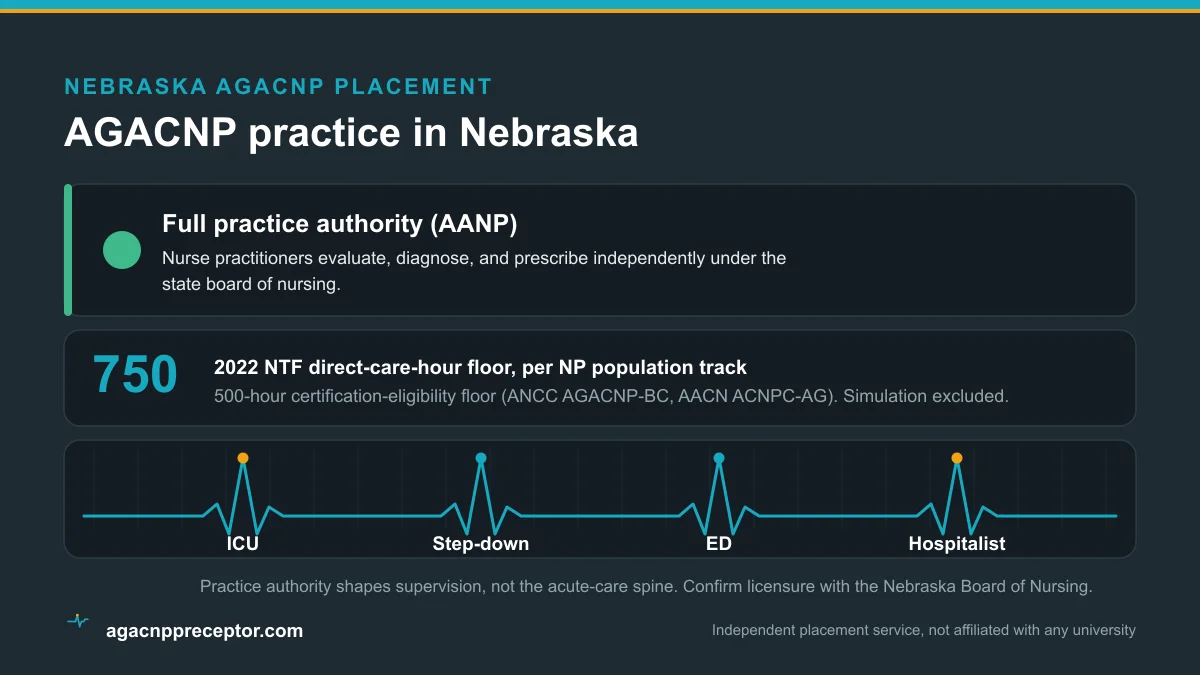
Nebraska is a full-practice authority state. Nurse practitioners diagnose, treat, and prescribe under their own license once they are past the state's entry step. That step matters for how a rotation is supervised: a newly graduated NP works under a transition-to-practice agreement for a defined block of practice hours with a physician or an experienced nurse practitioner before practicing fully independently.
For a student, the practical effect is small but worth understanding. In an ICU or on an inpatient service, a collaborating or supervising physician is usually part of the team regardless, so your preceptor may be a board-certified acute-care NP, a physician, or both working together. What matters for your placement is that the preceptor is licensed in Nebraska, practicing in the acute setting, and acceptable to your program. Confirm current rules with the Nebraska Board of Nursing within the state Department of Health and Human Services.
Greater Nebraska and where the ICU hours live
The rural stretch of the state is served admirably by critical-access hospitals, and those facilities are vital for their communities. They are not, however, where a high-acuity ICU block or a busy inpatient-specialty service usually comes together, because the volume and the subspecialty coverage are concentrated in the metros.
That leaves students in the Panhandle, the Sandhills, and the central corridor with a travel decision for their hardest rotations. We build placements around it: we look at where you live, which blocks can be done at a nearer regional hospital, and which ones are worth a stay in Omaha or Lincoln, so the critical-care and procedure hours land somewhere that can actually supply them.
Which rotations are hardest to arrange alone
The tight spots in a Nebraska AGACNP plan are the high-acuity ones. A genuine critical-care block, structured procedures and advanced skills, and time with adolescent acute patients all compete for a small number of qualified preceptors, and much of that sits inside the same Omaha and Lincoln hospitals that students from several programs are all trying to enter.
On hours, be exact rather than assuming. The 2022 National Task Force standards recommend a minimum of 750 direct patient care hours, while national certification eligibility requires at least 500 faculty-supervised hours, and accredited AGACNP programs commonly publish totals from roughly 500 to 750 or more. Your own program sets the number, so verify it, and use our clinical hours guide to see how the pieces add up.
Getting you placed
We match you with a board-certified acute-care nurse practitioner (AGACNP-BC or ACNPC-AG) or a qualifying acute-care physician at a real Nebraska hospital, then carry the affiliation-agreement and credentialing work that inpatient units demand. Our find a preceptor and how it works pages lay out the process. We serve students at any university, and we do not guarantee placement or a school's approval of any preceptor or site.
Ready to start? Send your program's requirements and your location through the form at #match, and see plain pricing on our cost page.
Good to know
Is Nebraska a full-practice state for nurse practitioners?
Yes, with an entry step. Nebraska grants full practice authority, but a new-graduate NP first completes a transition-to-practice agreement for a set block of hours with a physician or experienced NP. In acute care a collaborating physician is often on the team anyway, so this mainly affects the supervision arrangement, not your preceptor's core qualifications.
Where will most of my acute-care hours be in Nebraska?
Usually Omaha or Lincoln for the highest-acuity blocks. Omaha holds the state's two Level I trauma centers and the deepest ICU and specialty benches, and Lincoln adds significant capacity. Regional hospitals farther west can cover some inpatient hours closer to home.
Can a rural regional hospital host my rotation?
For some inpatient and emergency hours, yes. Critical-access and regional hospitals serve their areas well, but a high-acuity ICU or a busy inpatient-specialty block usually needs a metro hospital. We help you decide which blocks fit where.
Who qualifies to precept my AGACNP hours?
Generally a board-certified acute-care NP (AGACNP-BC or ACNPC-AG) or a physician working in the acute setting, such as an intensivist or hospitalist. Your program sets the final requirements, and we match to them and to a Nebraska-licensed preceptor.
Do you only place students from one school?
No. We are independent and work with AGACNP students at any university. We work independently of any school and cannot guarantee placement or a program's approval of a specific site.
Secure the rotation no one else will hand you
Tell us your school, your city, and the acute rotations you still need. We will come back with a plan for the full AGACNP trace and a realistic path to placed.