AGACNP acute-care placement across Nevada
Nevada is a two-metro acute-care state. The great majority of its intensive-care, trauma, and inpatient-specialty capacity sits in the Las Vegas valley and in Reno, with a wide rural frontier in between that leans on small hospitals. That concentration, plus a provider supply that has long trailed the state's population, is exactly why Adult-Gerontology Acute Care NP hours are worth locking down early, and it is the work we do for students at any university.
Tell us your school and city. It is free to ask, with no obligation.
Two metros carry Nevada's acute care
AGACNP is a hospital-based specialty, so your hours follow the state's high-acuity beds, and in Nevada those beds cluster tightly. Southern Nevada is the center of gravity: University Medical Center of Southern Nevada in Las Vegas is the state's only Level I trauma center and its public teaching hospital, and the valley also holds large facilities such as Sunrise Hospital and several multi-hospital systems running busy intensive-care and inpatient services.
Northern Nevada runs on Reno, where Renown Regional Medical Center is the region's largest hospital and its Level II trauma center, supported by other Reno-area hospitals. Between and beyond the two metros, the acute-care picture thins out quickly. For a student, this means the ICU, step-down, and specialty hours your program wants are almost always a Las Vegas or Reno arrangement.
The units where AGACNP rotations happen
Your clinical hours are built from acute and inpatient settings, and the ones that matter in Nevada are the ones that fill first in any supply-tight system:
- Intensive care across medical, surgical, cardiac, and neuro units, the defining AGACNP rotation.
- Step-down and progressive care for high-risk patients who are not ICU-level.
- Emergency departments, which in the valley run at high volume.
- Hospitalist and inpatient medicine services managing the bulk of admitted patients.
- Inpatient specialty services in cardiology, pulmonology, nephrology, and trauma or surgical care.
- Procedures and advanced skills, which reward a deliberate plan.
The patients run from adolescence at about age 13 through the frail elderly. The adolescent slice of that range is usually the toughest to log in an adult hospital, and the older-adult census is heavy, so we plan the age mix as carefully as the settings.
Practice authority in Nevada
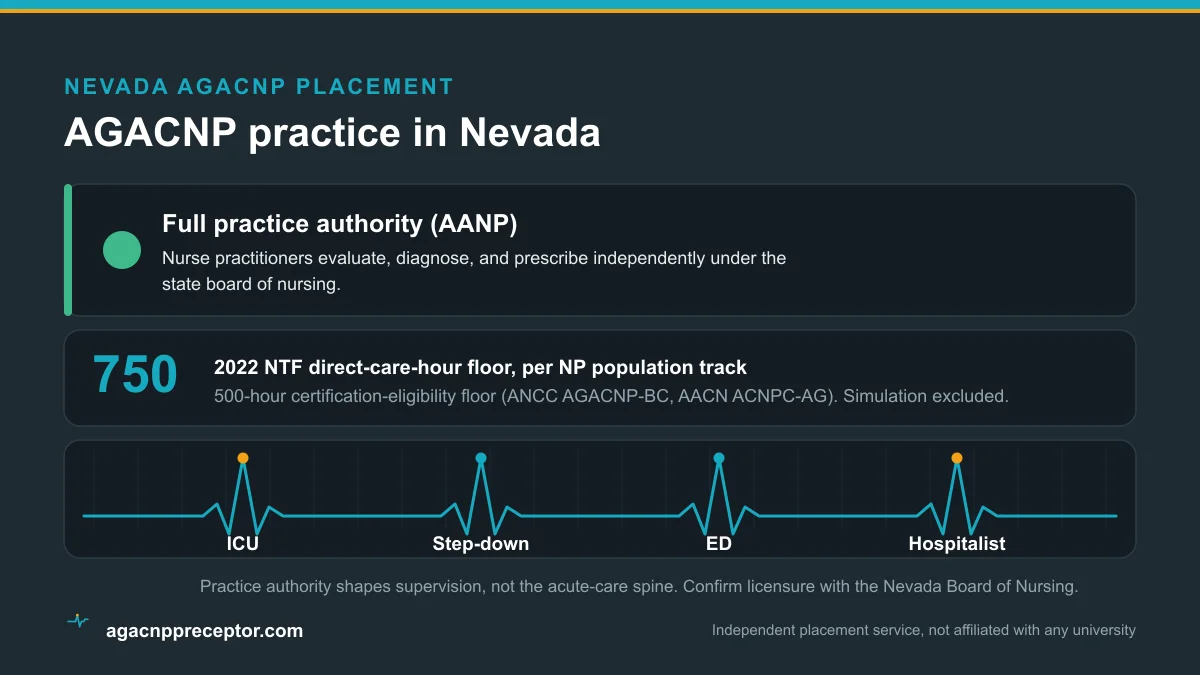
Nevada is a full-practice authority state and has been for more than a decade. Advanced practice registered nurses assess, diagnose, and prescribe under their own license, which means an experienced acute-care NP can serve as your preceptor on their own footing. In critical care, an intensivist or specialist physician is often part of the care team by design, so many preceptorships pair an acute-care NP with a physician regardless of what the practice law allows.
Some conditions can apply to newly licensed APRNs, particularly around certain prescriptive authority early in practice, so the safest move is to confirm current requirements with the Nevada State Board of Nursing. For placement purposes, the point is simpler: your preceptor must be licensed in Nevada, practicing in acute care, and acceptable to your program.
Outside Las Vegas and Reno
Most of Nevada is rural frontier, and the hospitals in places like Elko, Carson City, and the smaller counties are essential but limited in high-acuity volume. A critical-access or small regional hospital can offer some inpatient and emergency exposure, yet it rarely carries the ICU depth or subspecialty coverage that a core AGACNP block needs.
So students outside the two metros usually travel for their hardest hours. We plan for that head-on, weighing which blocks can be done closer to home against which ones justify a stay in the valley or in Reno, and we try to group the high-acuity and procedure hours so one arrangement does more of the heavy lifting.
The hours that are hardest in a supply-tight state
Nevada's provider supply has run behind its population for years, and that shows up first in the rotations everyone wants: deep ICU time, structured procedures and advanced skills, and adolescent acute care. Those hours concentrate in a small set of Las Vegas and Reno hospitals, and students from many programs compete for the same preceptors and the same units.
Be precise about hour counts rather than guessing. National Task Force standards from 2022 recommend a minimum of 750 direct patient care hours, certification eligibility requires at least 500 faculty-supervised hours, and accredited AGACNP programs frequently publish totals ranging from about 500 to 750 or more. Confirm your program's figure, and our clinical hours guide explains how the requirements stack up.
How placement works here
We match you with a board-certified acute-care NP (AGACNP-BC or ACNPC-AG) or a qualifying acute-care physician at a real Nevada hospital, then handle the affiliation agreement and credentialing that inpatient units require. See the steps on how it works and who qualifies on our preceptor requirements page. We are independent, we help students at any university, and we never guarantee placement or a school's approval of a site.
To get your Nevada ICU, step-down, or hospitalist hours moving, share your program details and location at #match or through contact. Pricing is on the cost page.
Good to know
Is Nevada a full-practice state for AGACNPs?
Yes. Nevada has granted nurse practitioners full practice authority for over a decade, so an experienced acute-care NP can precept independently. Some conditions may apply to newly licensed APRNs, so confirm current details with the Nevada State Board of Nursing. In an ICU a physician is often on the team regardless, which shapes supervision more than the preceptor's qualifications.
Will my hours be in Las Vegas or Reno?
Most likely, for the high-acuity blocks. Nevada concentrates its ICU, trauma, and inpatient-specialty capacity in the Las Vegas valley and Reno, including the state's only Level I trauma center in Las Vegas. Rural hospitals can cover some inpatient and emergency hours closer to home.
Can I do a rotation in rural Nevada?
Some of it, yes. Small regional and critical-access hospitals offer real inpatient and emergency exposure, but a core critical-care or procedure-heavy block usually needs a metro hospital. We help you split blocks between home and the metros.
Who can be my preceptor in Nevada?
Generally a board-certified acute-care NP (AGACNP-BC or ACNPC-AG) or a physician in the acute setting, such as an intensivist, hospitalist, or specialist. Your program sets the rules, and we match to them and to a Nevada-licensed preceptor.
Do you place students from any university?
Yes. We are an independent placement service for AGACNP students at any university. We work independently of any school, and we cannot guarantee placement or approval of a specific preceptor or site.
Related
Secure the rotation no one else will hand you
Tell us your school, your city, and the acute rotations you still need. We will come back with a plan for the full AGACNP trace and a realistic path to placed.