Securing AGACNP acute-care hours in New Hampshire
New Hampshire keeps its highest-acuity care in one place and its people in another. The state's only academic medical center and only Level I trauma center sit in the Upper Valley, while most residents live in the Manchester, Nashua, and Seacoast belt to the south, and the North Country runs on small critical-access hospitals. For an Adult-Gerontology Acute Care NP student, that split decides where the real ICU and specialty hours are, and we source those preceptors and sites for students at any university.
Tell us your school and city. It is free to ask, with no obligation.
New Hampshire's acute-care geography
AGACNP is an inpatient specialty, so your hours follow the state's intensive-care and referral capacity rather than its population map, and in New Hampshire the two do not sit in the same place. The Upper Valley, on the western edge, holds Dartmouth Hitchcock Medical Center in Lebanon, the state's only academic medical center, its only Level I trauma center, and its only air-ambulance base. That is where the deepest critical-care, neuro, cardiac, and inpatient-specialty benches live.
The population, though, clusters south. Manchester carries two large hospitals, Elliot Hospital and Catholic Medical Center, both trauma-designated and both running busy intensive-care and inpatient services; Concord Hospital anchors the capital region; and the Nashua and Seacoast areas add further capacity. So a student's nearest hospital and the state's highest-acuity hospital are frequently a long drive apart, and the plan has to reckon with that.
Practice authority in New Hampshire
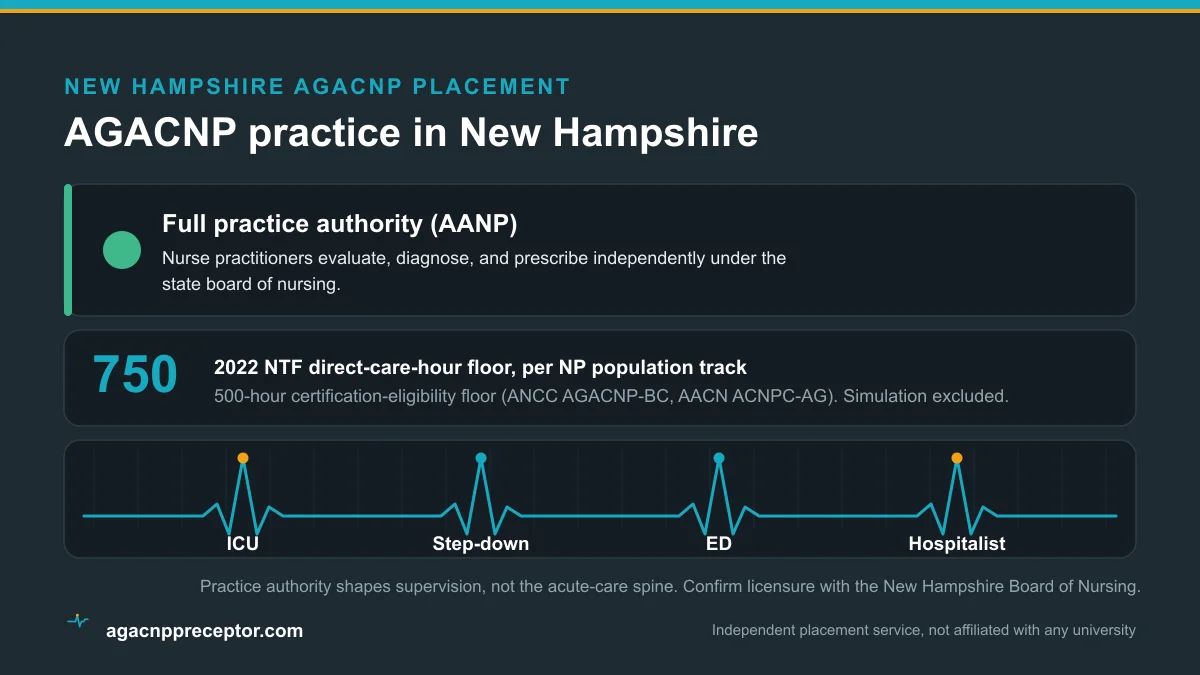
New Hampshire is a full-practice authority state, and has been for years. Under the Board of Nursing, which sits within the Office of Professional Licensure and Certification, an advanced practice nurse assesses, diagnoses, and prescribes independently, with no required collaborating-physician contract. That gives an experienced acute-care NP the standing to precept on their own.
Inside a hospital, though, critical-care patients are commonly co-managed, so an intensivist or specialist physician is often part of the team no matter the practice law. What this means for you is straightforward: your preceptor may be a board-certified acute-care NP, a physician, or the two working together, as long as the preceptor is licensed in New Hampshire, practicing in the acute setting, and accepted by your program. Confirm current rules with the New Hampshire Board of Nursing.
Where your inpatient hours happen
Acute-care rotations are assembled from high-acuity and inpatient settings, and these are the ones that carry New Hampshire AGACNP hours:
- Intensive care in medical, surgical, cardiac, and neuro units, the signature rotation.
- Step-down and progressive care for patients a notch below the ICU.
- Emergency departments, from tertiary volume in the referral centers to rural EDs.
- Hospitalist and inpatient medicine, the daily engine of inpatient care.
- Inpatient specialty services in cardiology, pulmonology, nephrology, and trauma or surgical care.
- Procedures and advanced skills, which reward starting early.
Patients here run from adolescents at roughly age 13 through older adults and the frail elderly. New Hampshire has one of the older populations in the country, so the geriatric end is well represented, while the adolescent end usually takes deliberate planning.
The North Country and the southern belt
Northern New Hampshire is served by critical-access hospitals in towns like Berlin, Littleton, Lancaster, and Colebrook. They are important to their communities, but they do not carry the ICU volume or the subspecialty coverage that a core acute-care block needs, so a student living up north generally travels for high-acuity hours, most often to the Upper Valley.
There is a second wrinkle unique to this state: much of southern New Hampshire sits within reach of Boston's teaching hospitals across the Massachusetts line, and some students look that way for tertiary exposure. That can broaden the options, but it also adds a second state's licensing and credentialing to the picture. We help you weigh which blocks stay in New Hampshire and which are worth arranging elsewhere.
The hours that are hardest to secure
In a small state with one academic center, the scarce hours are the predictable ones: deep critical-care time, procedures and advanced skills, and adolescent acute care. Much of that capacity concentrates in the Upper Valley and in the Manchester hospitals, and it is claimed early by students from several programs at once.
Get the hour numbers right for your own program. The 2022 National Task Force standards recommend at least 750 direct patient care hours, national certification eligibility requires a minimum of 500 faculty-supervised hours, and accredited AGACNP programs commonly publish totals from about 500 to 750 or more. The figure that governs you is your school's, so confirm it, and see our clinical hours guide for the details.
How we match you
We connect you with a board-certified acute-care NP (AGACNP-BC or ACNPC-AG) or a qualifying acute-care physician at a real New Hampshire hospital, then take on the affiliation-agreement and credentialing work that inpatient units require. Our how it works and find a preceptor pages show the process. We are independent, we serve students at any university, and we do not guarantee placement or a school's approval of any preceptor or site.
To get started, send your program's requirements and your location through the form at #match or our contact page, and review straightforward pricing on the cost page.
Good to know
Is New Hampshire a full-practice state?
Yes. New Hampshire grants nurse practitioners full practice authority through its Board of Nursing, so an experienced acute-care NP can precept independently. In critical care a physician is often part of the team anyway, which affects the supervision arrangement more than your preceptor's core qualifications.
Do I have to go to the Upper Valley for ICU hours?
Not always, but often for the highest-acuity blocks. The state's only academic medical center and Level I trauma center are in Lebanon, while Manchester's hospitals also carry strong intensive-care and inpatient services. We match your critical-care hours to a site that can actually supply them.
Can I complete part of my rotation near Boston?
Some students in southern New Hampshire do look toward Massachusetts teaching hospitals for tertiary exposure. It can widen your options but adds another state's licensing and credentialing. We help you decide which blocks are worth arranging out of state.
Who can precept my AGACNP hours here?
Generally a board-certified acute-care NP (AGACNP-BC or ACNPC-AG) or a physician in the acute setting, such as an intensivist or hospitalist. Your program sets the requirements, and we match to them and to a New Hampshire-licensed preceptor.
Are you tied to a particular school?
No. We are independent and work with AGACNP students at any university. We work independently of any program, and we cannot guarantee placement or approval of a given site.
Related
Secure the rotation no one else will hand you
Tell us your school, your city, and the acute rotations you still need. We will come back with a plan for the full AGACNP trace and a realistic path to placed.