Finding an AGACNP acute-care preceptor in New Mexico
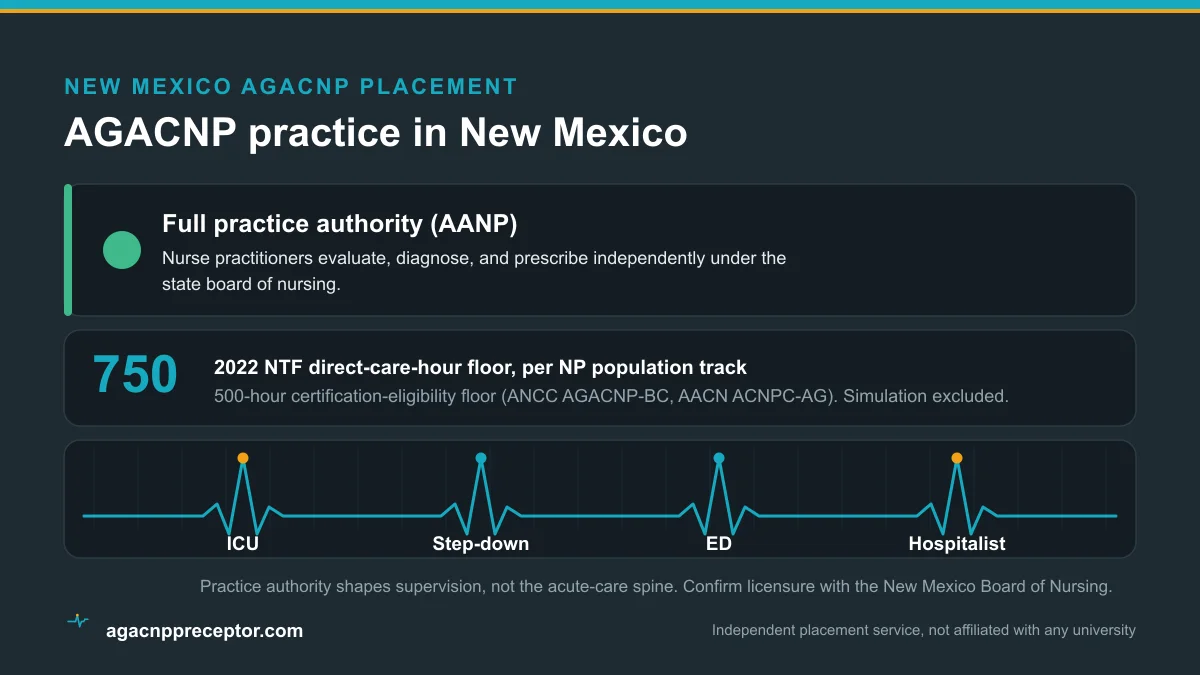
New Mexico grants nurse practitioners full practice authority, so an experienced acute-care NP can sign on as your preceptor without a physician contract required by law. The harder question for an Adult-Gerontology Acute Care NP student is geography, because most of the state's high-acuity inpatient beds sit in Albuquerque while much of New Mexico is rural or frontier. We source AGACNP preceptors and inpatient sites so your ICU, step-down, emergency, and hospitalist hours are lined up before the term starts, for students at any university.
Tell us your school and city. It is free to ask, with no obligation.
Where AGACNP students actually train in New Mexico
AGACNP is a hospital specialty, not a clinic one, so your hours follow the state's intensive-care and inpatient capacity rather than its map of towns. In New Mexico that capacity is concentrated. Albuquerque holds the deepest bench by far, and a short list of regional hospitals in Santa Fe, Las Cruces, Farmington, and the southeast oil-patch cities carries the rest. Your medical, surgical, cardiac, and neuro ICU time, your step-down beds, and your inpatient specialty consults are where competencies turn into real patient management, and those services cluster in the metro.
- Medical, surgical, cardiac, and neuro intensive care, the signature AGACNP setting.
- Step-down and progressive care for patients too unstable for a general floor.
- Emergency departments and rapid response, for undifferentiated acute presentations.
- Hospitalist and inpatient internal medicine, the backbone of inpatient volume.
- Inpatient cardiology, pulmonology, and nephrology consult services.
The patients across these units run from adolescence, which the acute-care population begins at roughly age 13, through the frail elderly who fill most inpatient beds.
Albuquerque anchors the state's high-acuity capacity
Albuquerque is where New Mexico's most serious acute care happens. The University of New Mexico Hospital is the only academic medical center in the state and its only Level I trauma center, which makes it the tertiary and quaternary referral point for the sickest and most complex patients across New Mexico and parts of the surrounding region.
Two large systems round out the metro. Presbyterian Healthcare Services is the largest locally based system in the state, and Lovelace Health System also runs inpatient and critical care in the city, while a regional medical center just north in Rio Rancho adds Level III trauma coverage. For an AGACNP student, this concentration is the reason so many high-acuity hours are earned in or near Albuquerque.
Beyond the metro: regional hospitals and rural reality
Outside Albuquerque, acute-care capacity thins quickly. Santa Fe and Las Cruces host the next largest hospitals, and regional referral centers serve the corners of the state: the northwest around Farmington and the Four Corners, the southeast communities near Hobbs and Carlsbad, and cities such as Roswell, Clovis, Gallup, and Alamogordo.
Many rural New Mexico hospitals are critical-access facilities with small units and limited specialty depth. A student living in a rural county can often find emergency and general medical hours locally, but high-acuity ICU time and inpatient specialty experience usually mean traveling to Albuquerque. We plan around that early rather than pretending it away, and try to cluster the hardest hours so a single trip does more work.
What full practice authority changes for your preceptor
New Mexico grants nurse practitioners full practice authority. On licensure through the New Mexico Board of Nursing, an NP may assess, diagnose, order tests, and prescribe under their own license, with no state-mandated collaborating-physician contract. That is the legal backdrop; the supervision inside a hospital unit is a separate matter.
In critical care, a physician is often part of the team no matter what the practice law says, because intensivists and specialists co-manage unstable patients by design. What full practice changes is who may sign as your preceptor: an experienced board-certified acute-care NP (AGACNP-BC or ACNPC-AG) can take that role on their own, and a physician in the unit can as well. Your program still sets the final preceptor requirements, and current licensure detail should be confirmed with the board.
The hours students struggle to secure alone
In a state with one academic center, the scarce pieces of an AGACNP plan are predictable. High-acuity ICU time, especially in cardiac and neuro units, is limited by how many such beds the state has. Hands-on procedures and advanced skills depend on a preceptor willing to supervise them at the bedside, and slots concentrate in the same few hospitals that students from many programs are trying to enter.
The younger end of the adult-gerontology range is another gap, since most inpatient beds hold adults and the frail elderly rather than adolescent acute patients. On totals, be precise rather than assuming a single number. The 2022 National Task Force standards recommend at least 750 direct patient care hours, and national certification eligibility requires at least 500 faculty-supervised hours. Accredited AGACNP programs commonly publish totals somewhere between roughly 500 and 750 or more, and many sit below 750, so confirm your own program's figure. Our clinical hours guide shows how the counts work, and simulation is excluded.
How we place you in New Mexico
We match you with a board-certified acute-care NP or an acute-care physician at a real New Mexico hospital, then handle the affiliation agreement and credentialing paperwork that inpatient units require. You can see the steps on our how it works page. We are independent, we work with students at any university, and we never guarantee a placement or your school's approval of any preceptor or site.
If you want your New Mexico ICU, step-down, or hospitalist hours arranged early, tell us your program's requirements and your location through the form at #match or our contact page. Fees are listed plainly on our cost page.
Good to know
Is New Mexico a full-practice state for AGACNPs?
Yes. New Mexico grants nurse practitioners full practice authority, so on licensure through the New Mexico Board of Nursing an NP can diagnose and prescribe independently. In an ICU a physician is still commonly part of the care team, which shapes the supervision arrangement more than your preceptor's core qualifications.
Do all my rotations have to be in Albuquerque?
No. Santa Fe, Las Cruces, Farmington, and other regional hospitals host inpatient and hospitalist hours. The catch is high-acuity ICU and procedure-heavy time, which is concentrated in the larger Albuquerque hospitals, so many students combine local and metro rotations.
Will I have to travel for my ICU hours?
Often, if you live far from the metro. High-acuity intensive care in New Mexico centers on Albuquerque, and rural critical-access hospitals usually cannot offer the same volume or subspecialty coverage. We plan blocks and distances with that in mind.
How many clinical hours will my program require?
It depends on your program. National standards recommend at least 750 direct patient care hours and certification eligibility requires at least 500 faculty-supervised hours, but published program totals vary, with many landing between roughly 500 and 750 or more. Confirm the exact number with your school. Simulation is excluded.
Do you only work with one university's students?
No. We are an independent placement service and help AGACNP students at any university. We work independently of any school, and we cannot guarantee placement or a school's approval of a given preceptor or site.
Secure the rotation no one else will hand you
Tell us your school, your city, and the acute rotations you still need. We will come back with a plan for the full AGACNP trace and a realistic path to placed.