Matching AGACNP students to North Carolina hospitals
North Carolina is a restricted practice state, so an AGACNP student trains under an arrangement that includes a supervising physician, which is already the norm in most intensive care units. The state's acute-care depth is strong but clustered in Charlotte, the Research Triangle, the Triad, and a short list of regional trauma centers. We source acute-care preceptors and inpatient sites for AGACNP students at any university, and this page maps where those hours actually sit.
Tell us your school and city. It is free to ask, with no obligation.
North Carolina's acute-care map: metros and trauma centers
North Carolina's high-acuity care concentrates in a few regions. Charlotte anchors the southern Piedmont, where Atrium Health runs Carolinas Medical Center, a Level I trauma center and teaching hospital, and Novant Health operates additional large facilities. The Research Triangle adds several major hospitals across Chapel Hill, Durham, and Raleigh, including Level I trauma centers, and the Triad around Winston-Salem and Greensboro carries more tertiary volume.
Farther east, ECU Health Medical Center in Greenville is the only Level I trauma center east of Raleigh and the referral point for a large rural region, while the Asheville area serves as the western hub. The state has six Level I trauma centers in all, and they are the backbone of where the sickest patients, and therefore AGACNP training, land.
The hospital units that carry your hours
AGACNP training happens with hospitalized, unstable, and critically ill adults, not in primary-care clinics. In North Carolina that puts your hours in the inpatient and high-acuity services of these larger hospitals.
- Medical, surgical, cardiac, and neuro ICUs.
- Progressive and step-down care.
- Emergency departments and rapid response.
- Hospitalist and inpatient medicine.
- Inpatient cardiology, pulmonology, nephrology, and trauma or surgical services.
The largest teaching hospitals carry the widest specialty mix, which is why students often anchor their most competitive hours at a tertiary center and fill other rotations closer to home. Patients run from adolescence near age 13 through the frail elderly.
Rural North Carolina and the travel question
Away from the metros, acute-care capacity drops off. The eastern coastal plain and the far western mountains are largely rural, served by community and critical-access hospitals with small ICUs and limited specialty coverage. For much of the east, Greenville is the tertiary referral hub; for the west, the Asheville area plays that role.
A student in a rural county can usually find emergency and general inpatient hours locally, but high-acuity ICU and inpatient specialty time generally means traveling to Charlotte, the Triangle, the Triad, Greenville, or Asheville. We build that travel into the plan and try to cluster the hardest hours into fewer trips.
Restricted practice and what it means for your preceptor
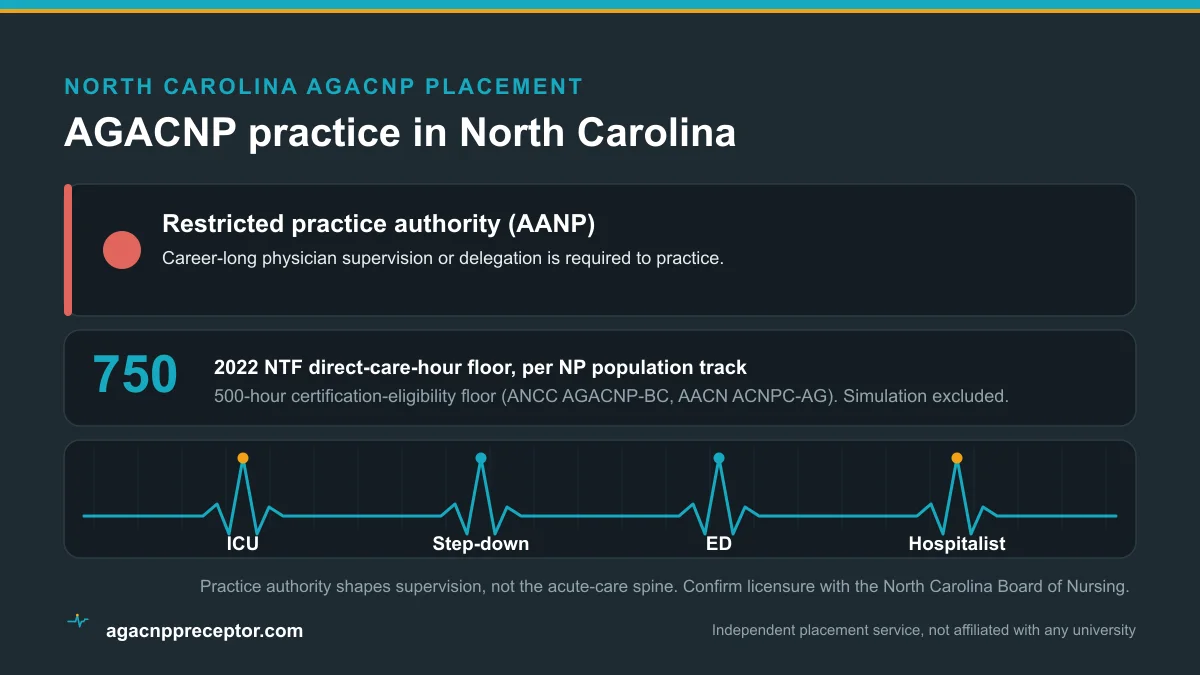
North Carolina is a restricted practice state, and nurse practitioner approval is shared between the North Carolina Board of Nursing and the North Carolina Medical Board. To practice, an NP registers a primary supervising physician and signs a collaborative practice agreement that is reviewed and signed at least once a year, spelling out the drugs, tests, and procedures the NP may order and perform.
In day-to-day acute care, this supervision requirement often blends into how critical care already works, since intensivists and hospitalist physicians are part of the team. For your placement it usually means your preceptor is a board-certified acute-care NP (AGACNP-BC or ACNPC-AG) tied to a supervising physician, or a physician directly, such as an intensivist or hospitalist. Your program still sets the final preceptor requirements.
The hours that are hardest to secure alone
Some hours take extra planning in North Carolina. High-acuity ICU time at the busiest teaching hospitals is shared with residents and other advanced-practice learners, so competitive units fill early. Procedures and advanced skills need a preceptor who will supervise them hands-on.
The younger end of the adult-gerontology range is another gap. AGACNP scope starts at roughly age 13, and most inpatient beds are filled by adults and frail elderly patients, so time with adolescent acute patients can be harder to document. On totals, the 2022 National Task Force standards recommend at least 750 direct patient care hours, while certification eligibility through ANCC or the AACN Certification Corporation requires at least 500 faculty-supervised hours. Many accredited programs publish fewer than 750, so verify your own clinical hours total, and note that simulation is excluded.
How we place you in North Carolina
We match you with a board-certified acute-care NP or an acute-care physician at a real North Carolina hospital, then handle the affiliation agreement and credentialing paperwork that inpatient units and the supervising-physician arrangement require. Our find a preceptor and how it works pages explain the steps. We are independent, we work with students at any university, and we never guarantee placement or a school's approval of any preceptor or site.
To start on your North Carolina hours, send your program's requirements and your location through the form at #match or our contact page. Fees are listed plainly on our cost page.
Good to know
What does restricted practice mean for an AGACNP student in North Carolina?
It means nurse practitioners work under a collaborative practice agreement with a supervising physician, approved jointly by the Board of Nursing and the Medical Board. In acute care this is close to how ICU and hospitalist teams already operate, so it mostly shapes who signs on as preceptor rather than the day-to-day work.
Which parts of North Carolina have the most acute-care hours?
Charlotte, the Research Triangle, and the Triad hold the most, with additional Level I trauma centers in Greenville for the east and the Asheville area serving the west. Rural students often travel to one of these hubs for high-acuity ICU and specialty time.
Do I need a supervising physician to be my preceptor?
Your preceptor is often a board-certified acute-care NP whose practice is tied to a supervising physician, or a physician directly, such as an intensivist or hospitalist. The supervision arrangement is a state requirement, but your school sets the final preceptor criteria.
How many clinical hours are required?
There is no single state figure. The 2022 National Task Force standards recommend at least 750 direct patient care hours, and certification eligibility requires at least 500 faculty-supervised hours. Many accredited AGACNP programs publish totals below 750, so confirm your number with your program. Simulation does not count.
Can you place students from any university?
Yes. We are independent and work with AGACNP students at any North Carolina school. We handle acute-care and inpatient matches only and never guarantee a school's approval of a specific preceptor or site.
Related
Secure the rotation no one else will hand you
Tell us your school, your city, and the acute rotations you still need. We will come back with a plan for the full AGACNP trace and a realistic path to placed.