Finding AGACNP acute-care hours across North Dakota
North Dakota grants nurse practitioners full practice authority, so an experienced AGACNP can precept with real independence here. The bigger challenge is scale, because this is a rural, frontier state where high-acuity inpatient care concentrates in a few cities and most communities rely on small critical-access hospitals. We source AGACNP preceptors and inpatient sites so your ICU, step-down, and hospitalist hours are confirmed early, for students at any university.
Tell us your school and city. It is free to ask, with no obligation.
North Dakota's acute-care map: a few cities carry it
North Dakota is one of the least densely populated states, and its acute-care capacity reflects that. The bulk of high-acuity inpatient care sits in a short list of cities. Fargo is the largest referral hub and carries the state's most advanced trauma and critical care, including a hospital verified by the American College of Surgeons as a Level I adult trauma center, with Sanford Health and Essentia Health both running major facilities there.
Bismarck follows, where Sanford and CHI St. Alexius operate tertiary hospitals verified at the Level II trauma level, and Grand Forks and Minot add further regional hospitals through Altru Health System and Trinity Health. Together these cities hold most of the intensive care, hospitalist, and inpatient specialty volume an AGACNP student needs, which is why placement here usually centers on one of them.
Critical-access country and the travel reality
Outside those cities, North Dakota runs largely on critical-access hospitals, dozens of them serving rural and frontier communities. By design they are small, with limited or no intensive care and little specialty depth. They are essential for emergency stabilization and general inpatient care, but they are not where most AGACNP high-acuity hours come from.
For students in rural counties, that means emergency and general medical hours may be available close to home, while ICU and inpatient specialty time usually requires traveling to Fargo, Bismarck, Grand Forks, or Minot. We plan around distance and block scheduling so a single trip does as much work as possible.
The hospital settings that count toward your hours
AGACNP is built around complex, unstable, and critically ill adults in the hospital, not primary care, so your North Dakota hours come from the high-acuity services of the tertiary hospitals.
- Medical, surgical, and cardiac intensive care units.
- Step-down and progressive care.
- Hospitalist and inpatient medicine services.
- Inpatient cardiology, pulmonology, and nephrology consults.
- Emergency and rapid response coverage.
Because the pool of large hospitals is small, coordinating early with a specific unit and preceptor matters more here than in a big-city market. Patients span adolescence near age 13 through older adults and the frail elderly.
Full practice authority in North Dakota
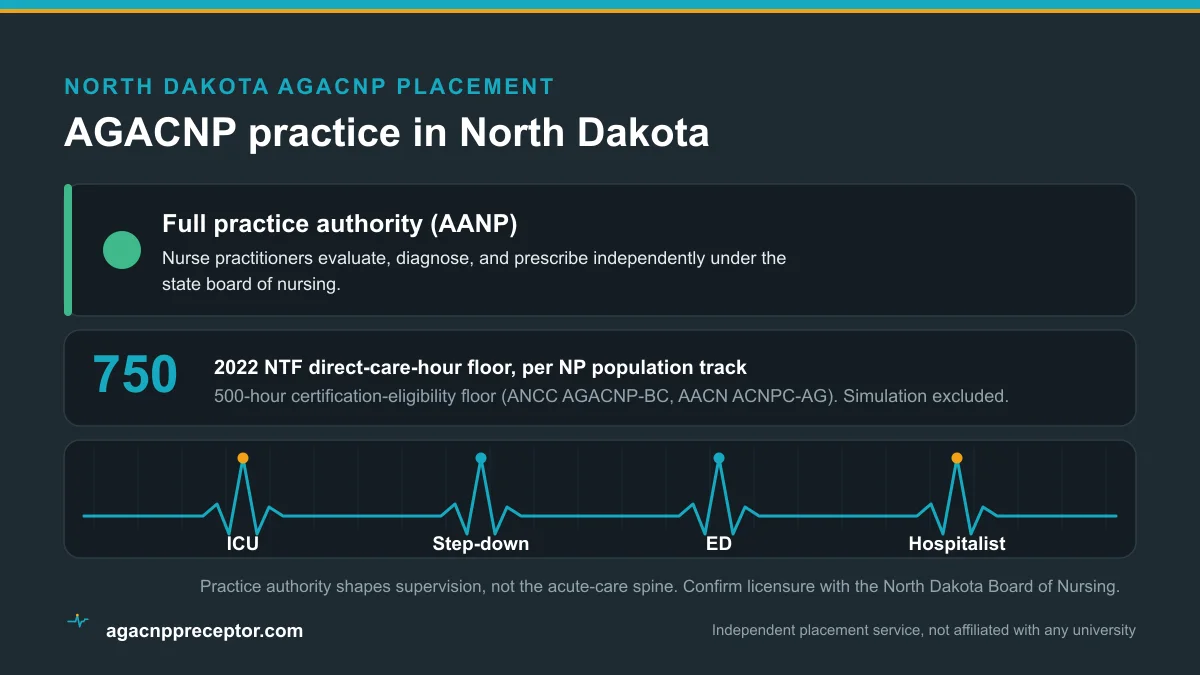
North Dakota grants nurse practitioners full practice authority. On licensure through the North Dakota Board of Nursing, an NP evaluates, diagnoses, orders tests, and prescribes under their own license, with no required collaborating or supervising physician. In an acute-care setting, this affects the supervision arrangement more than the qualifications your preceptor needs.
An experienced AGACNP or an intensivist-led team can precept with independence here, though critical care is still delivered by a team, so a physician is often involved regardless of the law. Your preceptor is generally a board-certified acute-care NP (AGACNP-BC or ACNPC-AG) or a licensed physician working in the acute setting, and your program sets the final requirements. Confirm current licensure detail with the board.
The hours that are hardest to secure
In a small market, a few kinds of hours are the hardest to line up. High-acuity subspecialty ICU time, such as dedicated cardiac or neuro critical care, is limited by how many such units the state supports. Procedures and advanced skills depend on finding a preceptor with the caseload and the willingness to teach them at the bedside.
The adolescent end of the adult-gerontology range, starting at about age 13, can also be hard to document, since inpatient beds are filled mostly by adults and older patients. On hours, the 2022 National Task Force standards recommend at least 750 direct patient care hours, and certification eligibility through ANCC or the AACN Certification Corporation requires at least 500 faculty-supervised hours. Programs differ and many publish fewer than 750, so confirm your clinical hours with your school. Simulation is excluded.
How we place you in North Dakota
We match you with a board-certified acute-care NP or an acute-care physician at a real North Dakota hospital, then handle the affiliation agreement and credentialing paperwork that inpatient units require. Because the state's high-acuity hospitals are few, we focus on your location, your program's required units, and realistic travel. Our how it works page lays out the steps.
We are independent, we work with students at any university, and we never guarantee placement or a school's approval of any preceptor or site. To get started, send your program's requirements and your location through the form at #match or our contact page, and see plain pricing on our cost page.
Good to know
Is it realistic to complete AGACNP acute-care hours in North Dakota?
Yes, but placement usually centers on Fargo, Bismarck, Grand Forks, or Minot, where the tertiary hospitals and their ICUs are located. Rural students commonly find emergency and general medical hours locally and travel to one of those cities for high-acuity time.
Does full practice authority change who can precept me?
It gives an experienced AGACNP more room to precept independently. In critical care a physician is still frequently part of the team, so the practical effect is mostly about independence, not about the certification your preceptor holds.
Why is travel such a big factor here?
North Dakota is rural and frontier, and many communities are served by small critical-access hospitals without intensive care or deep specialty services. ICU and inpatient specialty hours are concentrated in a few cities, so students often travel to reach them.
How many clinical hours will I need?
It depends on your program. The 2022 National Task Force standards recommend at least 750 direct patient care hours, while certification eligibility requires at least 500 faculty-supervised hours. Many accredited programs publish totals below 750, so confirm your own requirement. Simulation is excluded.
Do you only work with certain schools?
No. We are independent and place AGACNP students from any university. We handle acute-care and inpatient matches only and never guarantee that a school will approve a given preceptor or site.
Related
Secure the rotation no one else will hand you
Tell us your school, your city, and the acute rotations you still need. We will come back with a plan for the full AGACNP trace and a realistic path to placed.