Acute-care AGACNP preceptors in Vermont, centered on Burlington
Vermont is a full-practice state with a single dominant acute-care hub: the University of Vermont Medical Center in Burlington, the state's academic center and only Level I trauma center. It is also one of the oldest states in the country, so adult-gerontology acute care here leans heavily toward older and frail-elderly patients. We help AGACNP students secure inpatient rotations in a small state where the high-acuity beds are concentrated in one place.
Tell us your school and city. It is free to ask, with no obligation.
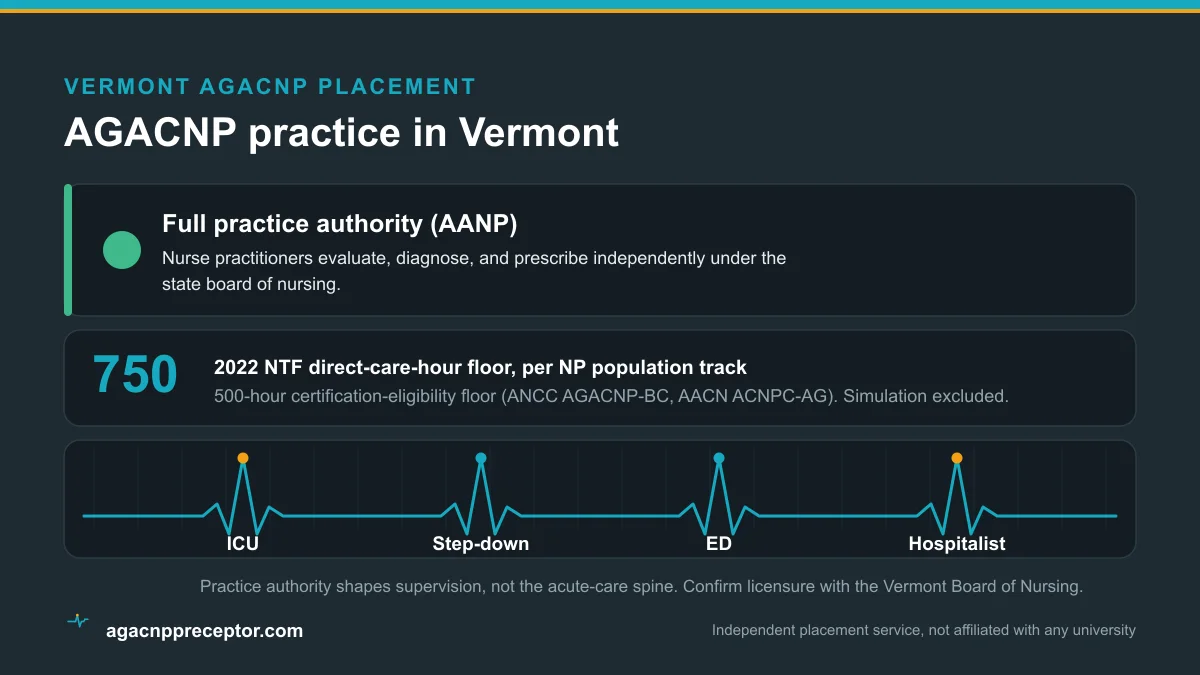
One hub carries the state's high-acuity care
Vermont is small and rural, and its acute-care volume gathers in Burlington. The University of Vermont Medical Center is the state's academic medical center and its only Level I trauma center, serving Vermont and parts of northern New York as the tertiary and quaternary referral base. Its intensive care units, step-down floors, emergency department, and hospitalist services hold the high-acuity capacity that AGACNP training depends on.
The rest of Vermont runs on mid-size community hospitals such as those in Rutland, Berlin, and Bennington, plus a set of small critical access hospitals. These stabilize and transfer complex cases rather than hold them, which routes the sickest patients toward Burlington and makes it the center of gravity for acute placement.
- Intensive care in medical, surgical, and cardiac units
- Step-down and progressive care floors
- Emergency department shifts
- Hospitalist and inpatient medicine carrying most admissions
- Inpatient specialty care in cardiology, pulmonology, and nephrology
An older state means an older acute-care caseload
Vermont has one of the oldest populations in the United States, with a large share of residents over 60 and a median age near the top of the national list. For an AGACNP student that shapes the daily caseload: much of the inpatient and critical-care work here involves older adults and the frail elderly, with complex chronic disease, delirium, heart failure, and post-surgical recovery. Sepsis, respiratory failure, and the acute decompensation of long-standing illness are everyday admissions, and managing them across an aging inpatient census is exactly the competency AGACNP certification tests.
That is a strength for adult-gerontology acute-care training, since the population focus and the patient reality line up closely. The thinner end is the adolescent range, which begins near age 13 and is harder to reach outside the referral hospital, so those hours need deliberate planning.
Full practice authority and hospital supervision
Vermont grants nurse practitioners full practice authority after a transition period of at least 24 months and 2,400 hours worked under a collaborative provider agreement. Once that is complete, an NP can practice independently. The Vermont State Board of Nursing, within the Office of Professional Regulation, sets the current terms, so confirm them there.
In the intensive care unit, full authority lets an experienced acute-care nurse practitioner precept with independence, while an intensivist or physician-led team is commonly present as well. Your preceptor should hold a Vermont license and practice in the acute setting that matches your rotation, whether that is a certified AGACNP-BC or ACNPC-AG or a physician in a matching inpatient role. In a small state, the pool of qualified acute-care preceptors is limited, so securing one early matters more here than in a large metro market.
Rural Vermont and the border option
For students outside the Burlington area, distance is the practical hurdle. Critical access and community hospitals across the state handle lower-acuity inpatient care but transfer the complex cases, so high-acuity intensive care and procedures and advanced skills usually mean traveling to Burlington for a block.
Eastern Vermont sits close to a large academic center across the Connecticut River in New Hampshire, which is why some residents there receive tertiary care out of state. For an AGACNP student, that geography is worth mapping early so your clinical hours do not stall waiting on a single hub.
How we place AGACNP students in Vermont
We source and vet acute-care preceptors, then handle the credentialing and affiliation paperwork that slows most students. Tell us your town, your program, and the rotations you still need, and we build a plan around Burlington and any community hospital within reach. Review the pricing, then start with the match form on this page or contact us.
Because Vermont concentrates its acute care in one hospital, timing is everything. We start the credentialing conversation early, confirm your program's paperwork, and keep a realistic backup in mind, whether that is a community hospital rotation for lower-acuity hours or a planned block in Burlington for the high-acuity ones. Matched first, so you never chase a site alone.
Good to know
Is everything really centered on Burlington?
For high-acuity care, largely yes. The University of Vermont Medical Center is the state's only Level I trauma center and academic hub, so the deepest intensive care and specialty volume is there. Community hospitals can cover some inpatient hours closer to home.
Does Vermont's older population help my training?
It fits adult-gerontology acute care well. With one of the oldest populations in the country, much of the inpatient caseload involves older and frail-elderly patients, which is central to the AGACNP focus. The adolescent end of the range is the harder piece to reach.
What does full practice authority require first?
Vermont asks new nurse practitioners to complete a transition period of at least 24 months and 2,400 hours under a collaborative provider agreement before independent practice. Confirm the current terms with the Vermont State Board of Nursing.
How many clinical hours will I need?
The 2022 NTF Standards recommend at least 750 direct patient care hours, while ANCC and AACN certification eligibility require at least 500 supervised hours. Programs publish totals from roughly 500 to 750 or more, so confirm your own program's figure.
Do you work with students from any school?
Yes. We are independent and place AGACNP students at any university. Your Vermont location and the acute rotations you still need shape the plan, not which school you attend.
Related
Secure the rotation no one else will hand you
Tell us your school, your city, and the acute rotations you still need. We will come back with a plan for the full AGACNP trace and a realistic path to placed.