Acute-care preceptors for AGACNP students across Virginia
If you are an Adult-Gerontology Acute Care Nurse Practitioner student in Virginia, your clinical hours belong in hospitals: medical, surgical, cardiac, and neuro intensive care, step-down and progressive care, emergency departments, and hospitalist services that manage acutely ill and unstable adults from adolescence through the frail elderly. Those hours cluster around a short list of academic and Level I trauma centers in Richmond, Northern Virginia, Charlottesville, Hampton Roads, and Roanoke, while much of the commonwealth is rural. We help you find a board-certified acute-care preceptor and inpatient site, and we do not guarantee placement or your school's approval of any preceptor or facility.
Tell us your school and city. It is free to ask, with no obligation.
The acute-care settings that host AGACNP students here
Adult-gerontology acute care is a hospital specialty, not a clinic one, so your Virginia rotations follow the state's intensive-care and inpatient capacity rather than its list of towns. The hours that fill an AGACNP transcript sit in intensive care of every type, in progressive care and step-down, in the emergency department, and on hospitalist and inpatient internal medicine teams that carry most admissions. Larger centers add inpatient specialty consult services in cardiology, pulmonology, nephrology, and trauma or surgery, where the acute-care NP role is well established.
- Intensive care in medical, surgical, cardiac, and neuroscience units
- Step-down and progressive care for the recovering but still fragile patient
- Emergency department shifts that sharpen undifferentiated acute assessment
- Hospitalist and inpatient medicine, the backbone of inpatient volume
- Inpatient specialty consults in cardiology, pulmonology, nephrology, and surgery
Virginia's trauma and referral map
Virginia concentrates its highest acuity in a handful of academic medical centers and Level I trauma centers spread across the state. Richmond anchors the center with an academic medical center and a second large hospital, both carrying Level I trauma verification. Charlottesville's academic medical center serves central and western Virginia as a Level I center. In the northern suburbs, Inova Fairfax Hospital holds the region's only Level I trauma designation. In Hampton Roads, Sentara Norfolk General Hospital runs the area's Level I center, and Carilion Roanoke Memorial Hospital serves the southwest as its Level I referral point.
Around those hubs sit broad health systems that own community and regional hospitals across the commonwealth. For an AGACNP student the geography is the whole story, because the sickest patients, and therefore the richest acute-care hours, flow toward these referral centers. If you live near one, high-acuity ICU and specialty time is within reach; if you do not, you will likely commute to a metro for the units that can supply it.
Practice authority and who can precept you
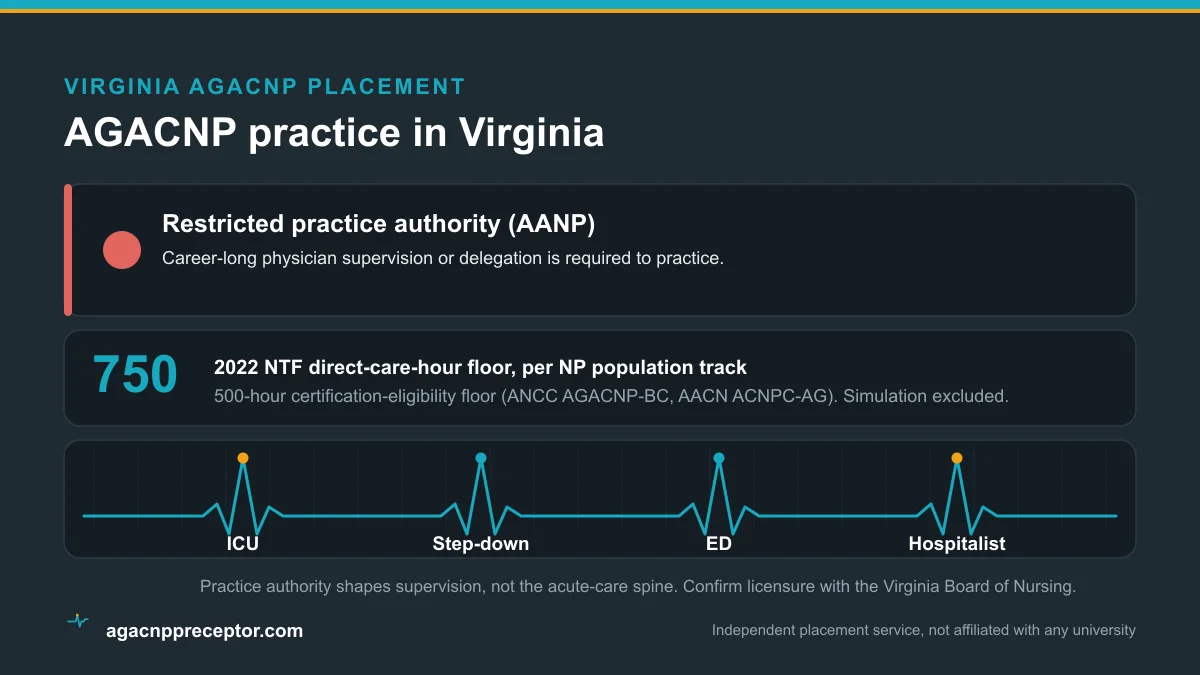
The Virginia Board of Nursing, working with the Board of Medicine through a joint committee, licenses nurse practitioners. The American Association of Nurse Practitioners currently classifies Virginia as a restricted-practice state, which means most nurse practitioners work under a practice agreement with a patient care team physician. Virginia also offers a pathway to autonomous practice: after the equivalent of several years of full-time clinical experience and an attestation from a patient care team physician, an eligible NP may apply to the boards to practice without that agreement. Confirm the current requirement with the board before you rely on it.
For your rotations this is less about your future license and more about who signs on as preceptor. A board-certified acute-care nurse practitioner (AGACNP-BC or ACNPC-AG) or a licensed physician such as an intensivist, hospitalist, or specialist can serve. In critical care a collaborating or supervising physician is usually part of the team no matter what the state label says, so Virginia's restricted status rarely changes the day-to-day teaching relationship in an ICU. Our preceptor requirements page covers the details your program will check.
The hours that are hardest to secure locally
Across Virginia the hours students chase most are high-acuity ICU time, procedural and advanced-skills exposure, and the younger end of the adult-gerontology range. The acute-care population begins at around age 13, so adolescent acute encounters can be scarce outside larger centers with mixed services. Procedures such as central and arterial lines, airway assistance, and point-of-care ultrasound tend to cluster where volume is high, which again points toward the academic and trauma centers.
The other end of the age span is easier to fill. Virginia's aging population keeps older adult and frail elderly acute cases plentiful on almost every medicine and step-down floor. Balancing your log so it is not weighted entirely toward geriatric medicine is part of what a deliberate placement plan solves, and our overview of procedures and advanced skills explains what to look for.
Southwest Virginia and the rural travel question
Outside the metros, acute capacity thins quickly. Southwest Virginia's Appalachian counties rely on smaller community and critical-access hospitals that stabilize and transfer their most unstable patients rather than keeping them, and parts of the Shenandoah Valley and the Eastern Shore face the same reality. Students in these areas frequently arrange a block of hours in Roanoke, Richmond, or another metro to reach a true medical or surgical ICU and the specialty services that come with it.
None of that makes rural training a dead end. Community emergency departments and small ICUs teach broad stabilization and resource-limited decision making that large centers cannot replicate. The practical answer is often a hybrid: local hours where you live plus a scheduled high-acuity block elsewhere, which we help map out.
How we help you match in Virginia
We are an independent placement service for AGACNP students at any school, so we are not tied to one university's clinical office or one health system. You tell us where you are in Virginia, what your program requires, and which settings you still need, and we work our network to find a board-certified acute-care preceptor and site that fit. We assist with the search and the coordination, and we never promise a placement or your school's sign-off on any preceptor or facility.
If that is the help you want, share your details through the form at #match or reach the desk through our contact page. You can also read how it works and our plainly listed cost page first.
Good to know
Is Virginia a good state to find AGACNP acute-care hours?
It can be, if you are near or willing to travel to one of its referral hubs. Richmond, Charlottesville, Northern Virginia, Hampton Roads, and Roanoke all host academic or Level I trauma centers with the ICU, step-down, and specialty volume AGACNP students need. Rural southwest Virginia usually requires a commute for high-acuity blocks.
Does Virginia's restricted-practice status limit who can be my preceptor?
Not really. Your preceptor is generally a board-certified acute-care NP (AGACNP-BC or ACNPC-AG) or a physician such as an intensivist or hospitalist, and in critical care a collaborating physician is usually present anyway. Restricted status shapes a nurse practitioner's independent license, not the core qualifications of who teaches you.
How many clinical hours will I need in Virginia?
That is set by your program, not the state. The 2022 National Task Force standards recommend at least 750 direct patient care hours per track, while certification eligibility requires at least 500 faculty-supervised hours. Many accredited AGACNP programs publish totals between roughly 500 and 750 or more, and some sit below 750, so confirm your own program's number. See our AGACNP clinical hours guide.
I live in rural Virginia. Can you still help?
Yes. We often build a plan that combines acute hours near your home with a scheduled high-acuity block in Roanoke, Richmond, or another metro so you reach a full medical or surgical ICU and the procedures that come with it.
Do you guarantee a placement?
No. We are an independent service that assists with the search and coordination. We do not guarantee a placement, and your school always decides whether to approve a given preceptor or site.
Related
Secure the rotation no one else will hand you
Tell us your school, your city, and the acute rotations you still need. We will come back with a plan for the full AGACNP trace and a realistic path to placed.