Placing AGACNP students in West Virginia's acute-care units
In West Virginia, Adult-Gerontology Acute Care Nurse Practitioner students earn their hours inside hospitals, not clinics: intensive care and step-down units, emergency departments, and hospitalist and inpatient medicine services treating unstable adults from adolescence through the frail elderly. Two academic anchors, one in the north-central region and one in the Kanawha Valley, hold most of the state's highest acuity, and much of West Virginia is rural. We help AGACNP students at any school find a board-certified acute-care preceptor, and we do not guarantee placement or a school's approval.
Tell us your school and city. It is free to ask, with no obligation.
West Virginia's two acute-care anchors
West Virginia funnels its most complex patients toward two large centers. In the north-central part of the state, J.W. Ruby Memorial Hospital in Morgantown is an 880-bed tertiary and academic medical center whose Jon Michael Moore Trauma Center is the state's only nationally verified Level I trauma center. In the Kanawha Valley, Charleston Area Medical Center is the other major referral hospital, with a high-level trauma program that treats thousands of injured patients each year. Between them they carry a large share of the state's ICU and specialty volume.
Other regions add capacity. Huntington in the west is an academic teaching city, the Eastern Panhandle around Martinsburg sits within reach of the Washington and Baltimore corridor, and the Northern Panhandle near Wheeling anchors the state's top. For an AGACNP student the practical point is that the deepest acute-care hours cluster around Morgantown and Charleston.
The inpatient settings where AGACNP hours happen
Acute care is inpatient by definition. In West Virginia that means intensive care, medical, surgical, cardiac, and neuro where available, along with step-down and progressive care, the emergency department, and hospitalist teams that admit and manage most patients. Larger centers extend into inpatient specialty consults, and the state's disease burden keeps several of those services busy.
- Intensive care, the signature AGACNP setting
- Step-down and progressive care for closely watched patients short of the ICU
- Emergency departments for undifferentiated acute presentations
- Hospitalist and inpatient medicine services that carry inpatient volume
- Inpatient specialty consults in cardiology, pulmonology, and nephrology
Reduced practice and the collaborating physician in critical care
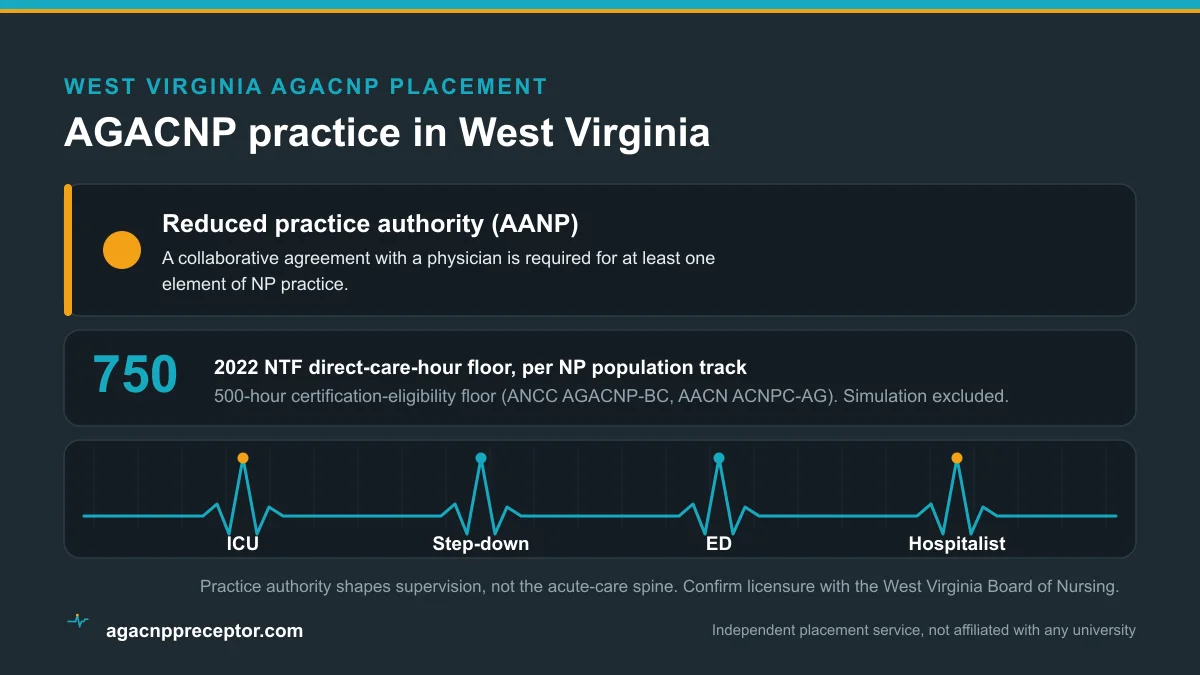
The West Virginia Board of Registered Nurses licenses advanced practice registered nurses. The American Association of Nurse Practitioners classifies West Virginia as a reduced-practice state, meaning a nurse practitioner generally works under a collaborative agreement with a physician and can apply for independent prescriptive authority after a period of documented collaborative practice. Confirm the current rule with the board before relying on it.
In an ICU this label changes little about your training. Critical care is team based, and a collaborating or supervising physician is usually present regardless of the state category. Your preceptor may be a board-certified acute-care nurse practitioner (AGACNP-BC or ACNPC-AG) or a physician such as an intensivist or hospitalist. What your program cares about is the preceptor's acute-care qualification, which our preceptor requirements page covers.
Appalachian acuity and the rural travel problem
West Virginia is one of the most rural states in the country, and its Appalachian geography shapes acute care. Chronic cardiovascular, pulmonary, and metabolic disease is common, which keeps inpatient medicine and step-down floors full of genuinely sick older adults and frail elderly patients. At the same time many communities depend on small critical-access hospitals that stabilize and transfer their most unstable patients to Morgantown or Charleston.
For students that combination is a double message. Local acute hours are real and valuable, but the highest-acuity ICU and procedural time usually sits at the two anchors. A common plan pairs hours near home with a scheduled block at a referral center.
Which hours are hardest to log locally
The toughest hours to secure in West Virginia are high-acuity ICU time, procedures and advanced skills, and the adolescent end of the acute-care range, which begins near age 13 and is thin outside larger mixed-service hospitals. Central and arterial lines, airway management, and bedside ultrasound concentrate where patient volume supports them, again pointing toward Morgantown and Charleston.
Geriatric and general medicine acute hours, by contrast, are widely available. Building a balanced log rather than one weighted only toward older-adult medicine is usually the real challenge, and it is one a deliberate plan can solve. Our procedures and advanced skills page lists what to seek out.
How the placement desk helps in West Virginia
We are independent and work with AGACNP students at any university, so we are not limited to one school's affiliations. Tell us where you are in West Virginia, what your program requires, and the settings you still need, and we search our network for a board-certified acute-care preceptor and site. We assist with the search and the coordination and do not guarantee a placement or your school's approval of any preceptor or facility.
If you want that help, send your details through the form at #match or reach us on our contact page. You can review how it works and our cost page first.
Good to know
Where are the best AGACNP acute-care hours in West Virginia?
They cluster at the two major referral centers: the academic hospital in Morgantown, whose trauma center is the state's only verified Level I, and the Charleston medical center with its high-level trauma program. These carry the deepest ICU, step-down, and specialty volume.
Does reduced-practice status affect my preceptor options?
Only modestly. West Virginia nurse practitioners work under a collaborative agreement, but ICU care already involves a physician team, so a board-certified acute-care NP or a physician can precept you. The state category shapes an NP's license, not who is qualified to teach in critical care.
I live in a rural part of the state. Is that a problem?
Not an insurmountable one. Many students combine acute hours at a nearby community hospital with a scheduled high-acuity block in Morgantown or Charleston to reach a full ICU and procedural experience. We help arrange that pairing.
How many hours will my program require?
The number comes from your program. The 2022 National Task Force standards recommend at least 750 direct patient care hours, while certification eligibility requires at least 500 faculty-supervised hours. Accredited AGACNP programs vary and some are below 750, so confirm your own. See our AGACNP clinical hours guide.
Do you promise to find me a placement?
No. We are an independent placement service that helps with the search and paperwork. We do not guarantee a placement, and your school decides whether to approve any preceptor or site.
Related
Secure the rotation no one else will hand you
Tell us your school, your city, and the acute rotations you still need. We will come back with a plan for the full AGACNP trace and a realistic path to placed.