Acute-care preceptor matching for AGACNP students in Wisconsin
For Adult-Gerontology Acute Care Nurse Practitioner students in Wisconsin, the hours that matter are inpatient: intensive care and step-down units, emergency departments, and hospitalist services managing acutely ill adults from adolescence to the frail elderly. Two academic Level I trauma centers, in Milwaukee and Madison, anchor the state, while strong regional systems cover the Fox Valley, Green Bay, La Crosse, and the rural center and north. We help students at any program find a board-certified acute-care preceptor, and we never guarantee placement or a school's approval.
Tell us your school and city. It is free to ask, with no obligation.
Wisconsin's acute-care hubs and regional systems
Wisconsin's highest acuity concentrates in two cities. Milwaukee's Froedtert Hospital, the primary teaching affiliate of a local medical college, runs the only adult Level I trauma center in the eastern half of the state. Madison's university-affiliated academic hospital carries Level I trauma care for both adults and children. Those two are the deepest pools of ICU, trauma, and specialty hours in Wisconsin.
The rest of the state is covered by large regional systems rather than a single dominant one. Hospitals based in the Fox Valley and Appleton, Green Bay, La Crosse in the west, and the central hub around Marshfield operate substantial facilities with real ICU capacity, and Marshfield Clinic, currently a Level II trauma center, has been working toward Level I verification. This spread means acute-care hours exist well beyond Milwaukee and Madison, though the very highest acuity still trends toward the two anchors.
The inpatient settings that take AGACNP students
Because adult-gerontology acute care is a hospital specialty, your Wisconsin rotations sit in intensive care, medical, surgical, cardiac, and neuro, in step-down and progressive care, in the emergency department, and on hospitalist and inpatient medicine services. Larger centers add inpatient specialty consults in cardiology, pulmonology, nephrology, and surgery.
- Intensive care across medical, surgical, cardiac, and neuro units
- Step-down and progressive care for stabilizing high-risk patients
- Emergency department shifts for acute, undifferentiated cases
- Hospitalist and inpatient medicine, the core of inpatient volume
- Inpatient specialty consults in cardiology, pulmonology, and nephrology
Reduced practice now, Act 17 next
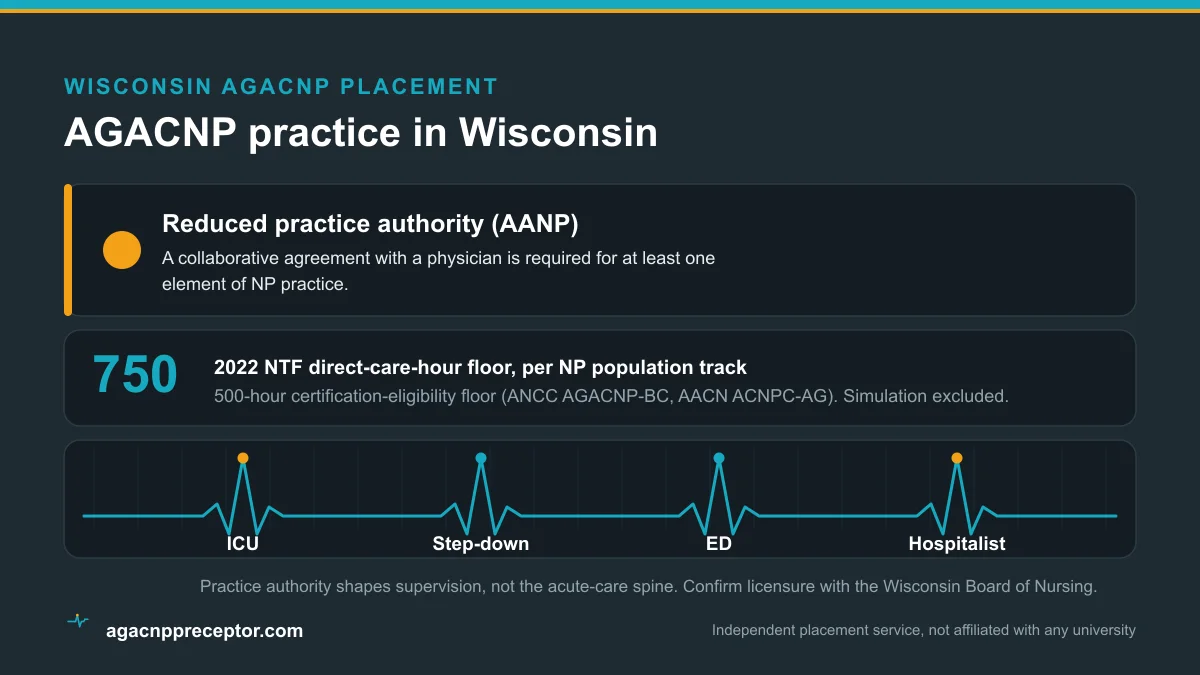
Wisconsin's Board of Nursing sits within the state Department of Safety and Professional Services, which credentials advanced practice nurse prescribers. Today the American Association of Nurse Practitioners classifies Wisconsin as a reduced-practice state, meaning nurse practitioners work with a collaborating physician relationship. That is changing: 2025 Wisconsin Act 17, the APRN modernization law, was signed in 2025, and its independent-practice provisions take effect on September 1, 2026, creating a pathway to independent practice after 3,840 hours of collaborative practice completed over at least 24 months. Because the timing is close to this update, confirm the current status with the board.
For your rotations the effect is small either way. Critical care is delivered by teams that include physicians, so an intensivist, hospitalist, or specialist, or a board-certified acute-care nurse practitioner (AGACNP-BC or ACNPC-AG), can precept you now and after the law takes effect. Our preceptor requirements page covers what your school will verify.
The hours that go first
In Wisconsin, as elsewhere, the scarce hours are high-acuity ICU time, procedures and advanced skills, and the adolescent portion of the acute-care age span that begins around 13. Procedural volume, meaning lines, airway support, and bedside ultrasound, favors the Milwaukee and Madison centers and the larger regional hospitals. Older adult and frail elderly acute cases fill medicine and step-down units across the state, so the usual task is balancing the log rather than finding geriatric volume. Our procedures and advanced skills page explains what to target.
Northern and rural Wisconsin
North of the population belt, Wisconsin turns rural. The forested northern counties and much of the center rely on critical-access hospitals and the regional referral reach of systems like the one centered in Marshfield, which serves a wide rural catchment. Students in these areas commonly plan a high-acuity block in Milwaukee, Madison, or a large regional hospital to reach a full medical or surgical ICU and specialty services they cannot get close to home.
That travel is normal and worth planning early, because the best acute rotations book up. A hybrid of local hours plus a scheduled ICU block is often the most realistic route, and it is the kind of plan we help build.
Matching with our Wisconsin desk
We place AGACNP students from any Wisconsin program with board-certified acute-care preceptors, independent of any one school or system. Share your location, your program's requirements, and the settings you still need, and we work our network to find a suitable preceptor and site. We help with the search and the logistics; we do not guarantee a placement or your school's approval of a preceptor or facility.
To begin, use the form at #match on this page or reach the desk through our contact page. Our how it works and cost pages explain the rest.
Good to know
Is Wisconsin about to become a full-practice state?
It is moving in that direction. 2025 Wisconsin Act 17 creates an independent-practice pathway with provisions effective September 1, 2026, after which qualifying nurse practitioners can practice without a collaborative agreement. Until the change is fully in effect the state is classified as reduced practice, so confirm the current status with the board.
Where are the strongest AGACNP hours in Wisconsin?
The Level I trauma and academic centers in Milwaukee and Madison hold the deepest ICU, trauma, and specialty volume. Large regional systems in the Fox Valley, Green Bay, La Crosse, and the Marshfield area add substantial acute capacity across the rest of the state.
Will Act 17 change who can precept me?
Not in a way that matters for training. Critical care already involves physician teams, so an intensivist, hospitalist, specialist, or a board-certified acute-care NP can precept you before and after the law takes effect. Your program sets the preceptor criteria.
How many clinical hours does my program require?
The number is your program's, not the state's. The 2022 national standards recommend at least 750 direct patient care hours, and certification eligibility requires at least 500 supervised hours. Accredited AGACNP programs differ and some fall below 750, so verify yours. See our AGACNP clinical hours guide.
Can you help if I train in rural northern Wisconsin?
Yes. We often combine acute hours near you with a scheduled block in Milwaukee, Madison, or a large regional hospital so you reach a full ICU and the procedures rural sites cannot offer.
Secure the rotation no one else will hand you
Tell us your school, your city, and the acute rotations you still need. We will come back with a plan for the full AGACNP trace and a realistic path to placed.