Placing your AGACNP acute-care hours in Hawaii
Hawaii is a full-practice state for nurse practitioners, and nearly all of its high-acuity beds sit on Oahu, so your AGACNP rotations tend to orbit Honolulu. The islands hold one Level I trauma center and a small number of tertiary hospitals, which makes ICU, step-down, and inpatient specialty time genuinely scarce and worth planning early. We source and vet acute-care preceptors and inpatient sites across the state so your hardest hours are not left to chance.
Tell us your school and city. It is free to ask, with no obligation.
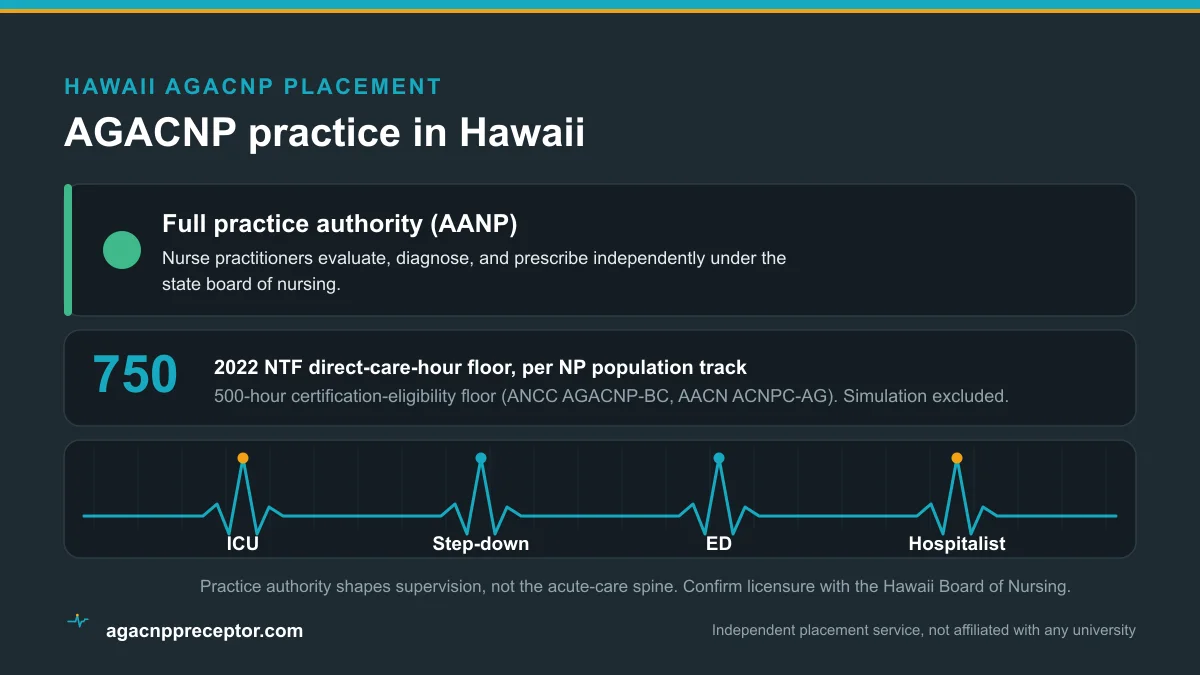
Where your AGACNP hours actually happen here
The Adult-Gerontology Acute Care NP role lives inside the hospital, not the clinic. In Hawaii that means the medical, surgical, and cardiac intensive care units, the step-down and progressive care floors, the emergency department, and the hospitalist and inpatient medicine services that run the wards. Your patients span adolescence, from roughly age thirteen, through adults and the frail elderly, all of them acutely ill or unstable.
The rotations we work most for Hawaii students are:
- ICU and critical care, where the highest-acuity hours live
- step-down and progressive care for the post-ICU and telemetry population
- emergency department shifts for undifferentiated acute presentations
- hospitalist and inpatient medicine, often the backbone of a placement
- inpatient specialty services such as cardiology, pulmonology, and nephrology
None of these open with a phone call. Hospitals gatekeep inpatient students through credentialing and affiliation paperwork, which is exactly the part we handle.
One Level I center, one island hub
Honolulu carries the weight of Hawaii acute care. The Queen's Medical Center is the first and only Level I trauma center in the state and across the Pacific, and it teaches medical students for the University of Hawaii, which puts intensivists, hospitalists, and inpatient specialists in one place. Kaiser Permanente Moanalua and Straub Medical Center add more tertiary and critical-care capacity on Oahu, with Hawaii Pacific Health and Kaiser operating as the large systems.
For an AGACNP student, that concentration cuts both ways. The high-acuity ICU and procedure hours you need are here, but so is every other learner competing for the same preceptors. Starting your search a term or two out is the difference between a matched rotation and a scramble.
Neighbor islands and the travel question
Off Oahu, acute capacity thins fast. Maui Memorial Medical Center is the main hospital for Maui County, Hilo Medical Center and Kona Community Hospital cover Hawaii Island, and Wilcox Medical Center serves Kauai. Several neighbor-island facilities are small or critical-access, and the most complex or unstable patients are stabilized and flown to Honolulu.
If you live on a neighbor island, plan for the reality that deep ICU, trauma, and inpatient specialty hours may require time on Oahu. We build that into your placement plan rather than letting it surprise you late in the program.
Full practice authority, and what it means for your preceptor
Hawaii grants full practice authority to nurse practitioners under the state Board of Nursing, so a licensed NP can evaluate, diagnose, and prescribe without a required collaborating physician. In critical care that independence still sits inside a team, and an experienced AGACNP or an intensivist commonly signs on as your preceptor, because that is who is at the bedside in the unit.
Your preceptor is generally a board-certified acute-care NP, meaning AGACNP-BC or ACNPC-AG, or a physician such as an intensivist or hospitalist working in the setting you are rotating through. The exact requirements are set by your own program, not by one national rule, so confirm your school criteria and tie your rotation to a preceptor who practices in acute care.
The hours that are hardest to secure
Three pieces are consistently tight in Hawaii: deep, high-acuity ICU time; procedures and advanced skills like central lines, intubation exposure, and ventilator management; and the adolescent end of the age range, which the AGACNP population begins at around age thirteen. Because so much of this capacity sits in a small number of Honolulu hospitals, the supply is real but limited.
Everything else, the adult and older adult inpatient medicine and step-down hours, is more available, though still behind hospital credentialing. We work the whole trace so no single rotation stalls your degree.
How we place AGACNP students in Hawaii
Tell us your program, your island, and the acute rotations you still need. We source qualified preceptors, confirm the site will host you, and handle the affiliation and credentialing legwork that students should not be cold-calling hospitals to arrange. You are matched first and pay when the placement is secured; see pricing and how it works.
Ready to start? Use the match form on this page or contact us, and we will map a realistic path to your ICU, step-down, and inpatient specialty hours across Hawaii.
Good to know
How many clinical hours will I need for my AGACNP program in Hawaii?
It depends on your school. The 2022 NTF Standards recommend a minimum of 750 direct patient care hours per NP track, while ANCC and AACN certification eligibility requires at least 500 faculty-supervised hours. Many accredited AGACNP programs publish totals between roughly 500 and 750 or more, and some sit below 750, so confirm the exact figure with your own program. Simulation hours do not count toward the direct-care total.
Can I complete all of my acute-care hours on a neighbor island?
Sometimes for the general inpatient and step-down portions, but not usually for the deepest ICU, trauma, and inpatient specialty hours. Those concentrate in Honolulu, so neighbor-island students often plan a block of time on Oahu. We tell you honestly what your island can support before you commit.
Does Hawaii full practice authority mean I do not need a physician preceptor?
Not necessarily. Full practice authority describes what a licensed NP may do independently, not who must precept you. In critical care an experienced AGACNP or an intensivist physician commonly serves as preceptor because that is who staffs the unit. Your program sets the preceptor requirements.
Do you guarantee a placement at a specific Hawaii hospital?
No. We are an independent service, and we never guarantee placement or that any named hospital will accept you, and we do not control your school approval of a site or preceptor. What we do is source and vet qualified acute-care preceptors and inpatient sites, then handle the paperwork to give you the strongest realistic shot.
Related
Secure the rotation no one else will hand you
Tell us your school, your city, and the acute rotations you still need. We will come back with a plan for the full AGACNP trace and a realistic path to placed.