Securing AGACNP inpatient rotations in Illinois
Illinois has deep acute-care capacity, but it is lopsided: metropolitan Chicago holds one of the densest clusters of Level I trauma and academic hospitals in the country, while much of the rest of the state is rural. Illinois is also a reduced-practice state, so a collaborating physician is part of the picture, which is routine in critical care anyway. We source and vet AGACNP preceptors and inpatient sites statewide so your ICU, step-down, and specialty hours are covered.
Tell us your school and city. It is free to ask, with no obligation.
Chicago holds most of the acute capacity
Few metros in the country match Chicago for inpatient teaching volume. The city and its suburbs hold a cluster of Level I trauma centers and academic medical centers, including Northwestern Memorial, University of Chicago Medicine, Rush University Medical Center, University of Illinois Hospital, Loyola University Medical Center in Maywood, Advocate Christ Medical Center in Oak Lawn, and the John H. Stroger safety-net hospital. Advocate Health, Northwestern Medicine, and Endeavor Health run large systems across the region.
For an AGACNP student, this is where the deepest ICU, procedure, and inpatient specialty hours are, along with the most competition for them. The volume is a real advantage if your placement is arranged early and behind the hospital credentialing that gatekeeps inpatient students.
Downstate acute care: Peoria, Urbana, Springfield
Outside Chicago, Illinois still has genuine high-acuity anchors. OSF Saint Francis Medical Center in Peoria and Carle Foundation Hospital in Urbana are Level I centers, and Springfield hosts Southern Illinois University School of Medicine alongside major hospitals. These downstate systems, including OSF HealthCare, Carle Health, and HSHS, host AGACNP rotations across their ICUs, step-down units, and specialty services. Peoria and Springfield carry regional referral roles for large stretches of central Illinois, which keeps their critical care, cardiac, and pulmonary services busy enough to teach inpatient students.
If you live in central or southern Illinois, these hubs are usually your realistic path to critical-care hours without a move to Chicago.
The AGACNP settings inside these systems
AGACNP is a hospital-based, high-acuity role, so your rotations sit inside the units rather than a clinic:
- intensive care, medical, surgical, cardiac, and neuro, for the highest-acuity hours
- step-down and progressive care for telemetry and post-ICU patients
- the emergency department for acute presentations
- hospitalist and inpatient medicine as a placement backbone
- inpatient specialty services such as cardiology, pulmonology, nephrology, and trauma or surgical care
Your patients run from adolescence, from about age thirteen, through adults and the frail elderly, all of them acute or unstable.
Reduced practice and inpatient supervision
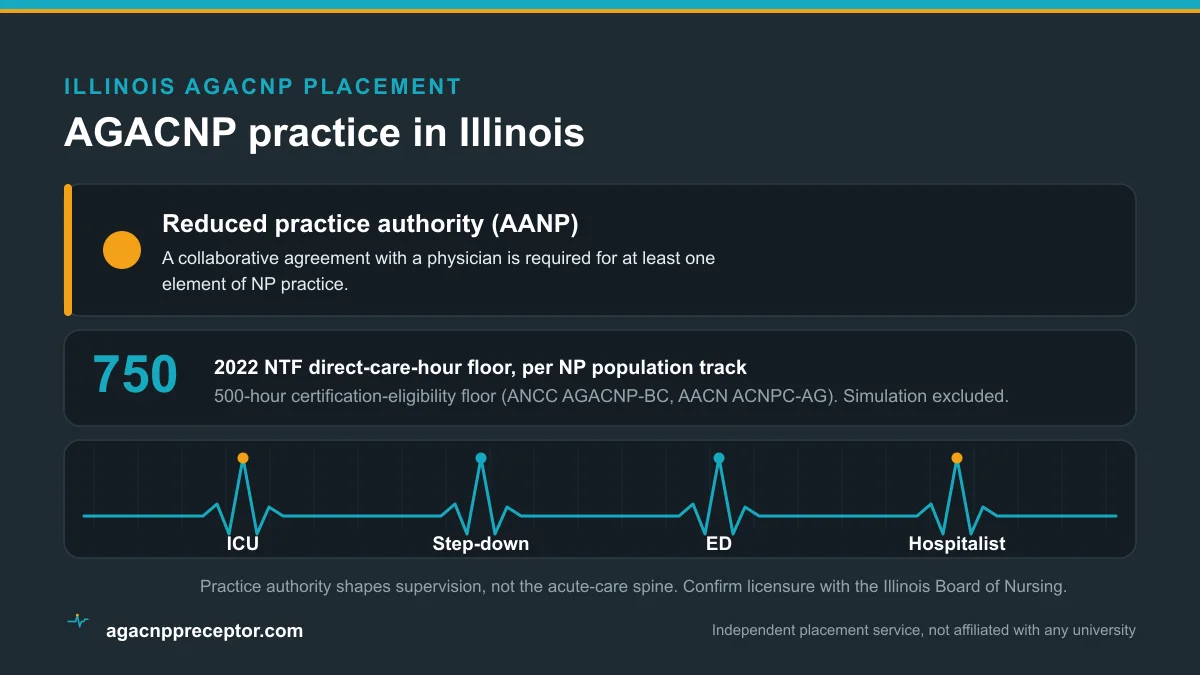
Illinois is a reduced-practice state. Advanced practice nurses generally maintain a written collaborative agreement with a physician, with narrower requirements in hospital and ambulatory surgical settings, which is where AGACNPs work. After 4,000 hours of clinical practice and 250 hours of continuing education, an APRN can attest to full practice authority with the state under the licensing agency. Your Board of Nursing sits within the Illinois Department of Financial and Professional Regulation.
In practice, this changes the supervision arrangement more than your preceptor qualifications. A collaborating or supervising physician is common in critical care regardless of the label. Your preceptor is generally a board-certified acute-care NP, AGACNP-BC or ACNPC-AG, or a physician such as an intensivist or hospitalist, with the exact rules set by your program.
Rural Illinois and where your hours come from
Between the metros, much of Illinois is served by smaller and critical-access hospitals that handle stabilization rather than sustained critical care. Students in these areas usually travel to Peoria, Urbana, Springfield, or Chicago for their deepest ICU and inpatient specialty hours. That travel is normal for downstate AGACNP students, and planning it early keeps a single ICU block from delaying graduation.
We plan for that rather than assuming a small local hospital can host a rotation it is not staffed for. The tightest hours to place are high-acuity ICU time, procedures and advanced skills, and the adolescent end of the range; general adult and older adult inpatient hours are easier.
Place your Illinois rotation with us
Tell us your program, your city, and the acute rotations you still need. We source qualified preceptors, confirm the site will host you, and handle the collaborative-agreement and credentialing paperwork that stalls students who try to arrange inpatient sites alone. Matched first, pay when secured; see pricing and how it works.
Use the match form here or contact us, and we will map your ICU, step-down, and specialty hours across Illinois.
Good to know
Does Illinois reduced practice mean I must have a physician preceptor?
Not exactly. Reduced practice describes the collaborative agreement an APRN maintains, not who precepts you. In acute care a collaborating or supervising physician is common regardless, and your preceptor may be a board-certified acute-care NP or a physician such as an intensivist or hospitalist. Your program sets the preceptor requirements.
Do I have to place in Chicago?
No. Chicago has the densest acute capacity, but downstate hubs in Peoria, Urbana, and Springfield host AGACNP rotations across their ICUs, step-down units, and specialty services. If you live in central or southern Illinois, those are often your realistic path to critical-care hours.
How many AGACNP clinical hours will I need?
Check with your own program. The 2022 NTF Standards recommend at least 750 direct patient care hours per NP track, and ANCC and AACN certification eligibility requires at least 500 faculty-supervised hours. Accredited AGACNP programs commonly publish totals from roughly 500 to 750 or more, with some below 750. Simulation hours are excluded.
Can you guarantee a spot at a specific Illinois hospital?
No. We are an independent service and never guarantee placement or that a named hospital will accept you, and we do not control your school approval of a site or preceptor. We source and vet qualified acute-care preceptors and inpatient sites and carry the paperwork to give you the strongest realistic shot.
Secure the rotation no one else will hand you
Tell us your school, your city, and the acute rotations you still need. We will come back with a plan for the full AGACNP trace and a realistic path to placed.