Building your AGACNP acute-care placement in Indiana
Indiana acute care has a clear center of gravity in Indianapolis, where the state Level I trauma capacity and its largest academic system sit within a few miles of each other. Indiana remains a reduced-practice state, so a collaborating physician is part of prescriptive practice, which is routine in the hospital anyway. We source and vet AGACNP preceptors and inpatient sites across the state so your ICU, step-down, and specialty hours are covered.
Tell us your school and city. It is free to ask, with no obligation.
Indianapolis is the acute-care center of gravity
Most of Indiana highest-acuity beds are in Indianapolis. Indiana University Health Methodist Hospital is the largest hospital in the state and a Level I trauma center tied to the Indiana University School of Medicine, and Sidney and Lois Eskenazi Hospital is a Level I trauma and burn center serving as the metro safety net. Ascension St. Vincent, Community Health Network, and Franciscan Health add more inpatient and critical-care capacity across the city.
For an AGACNP student, this concentration is where the deepest ICU, procedure, and inpatient specialty hours live, along with the heaviest competition for preceptors. Volume helps only if your site is arranged early and behind the credentialing that gatekeeps inpatient students.
Regional high-acuity hubs
Indiana acute care is not only Indianapolis. Fort Wayne anchors the northeast with Parkview Regional Medical Center and Lutheran Hospital, both Level II trauma centers. Evansville anchors the southwest through Deaconess, also Level II. South Bend and the north are served by Beacon Health, and northwest Indiana often draws on the Chicago metro across the state line. That northwest corner means some students commute toward Illinois hospitals for high-acuity hours rather than driving down to Indianapolis.
These regional systems host AGACNP rotations in their ICUs, step-down units, emergency departments, and inpatient specialty services, which matters if you would rather not relocate to Indianapolis for every hour.
The inpatient rotations you actually need
AGACNP is a high-acuity, hospital-based role, so the settings that count are inside the units:
- intensive care, medical, surgical, cardiac, and neuro, for the scarcest hours
- step-down and progressive care for post-ICU and telemetry patients
- the emergency department for acute presentations
- hospitalist and inpatient medicine, often the steadiest block
- inpatient specialty services such as cardiology, pulmonology, and nephrology
Your patients span adolescence, from roughly age thirteen, through adults and the frail elderly, all acutely ill or unstable.
Reduced practice and the collaborating physician
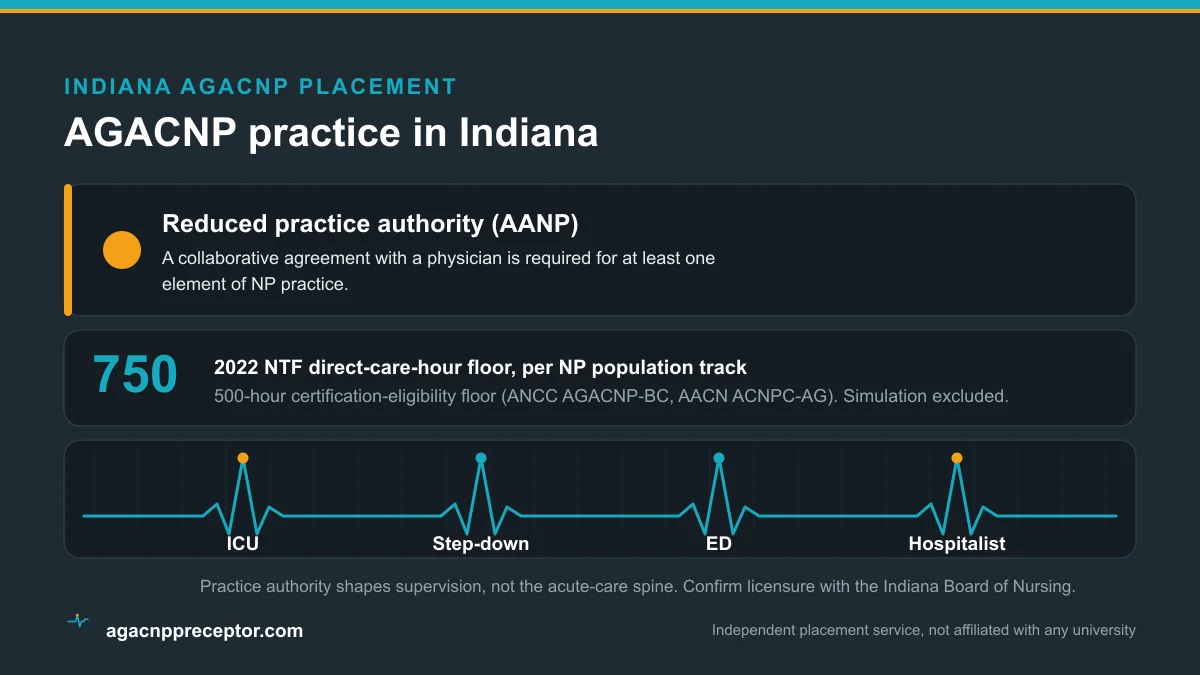
Indiana is a reduced-practice state. An APRN with prescriptive authority practices under a written collaborative agreement with a physician, filed through the Indiana State Board of Nursing within the state licensing agency. Legislation to remove that requirement has been introduced in recent sessions but was not enacted, so confirm the current rule with the board before you rely on it. The collaborative agreement names a physician and the shared scope, and hospitals often fold that relationship into their own credentialing for inpatient providers.
In the hospital this shapes the supervision arrangement more than your preceptor core qualifications, because a collaborating or supervising physician is common in critical care regardless. Your preceptor is generally a board-certified acute-care NP, AGACNP-BC or ACNPC-AG, or a physician such as an intensivist or hospitalist, with requirements set by your program.
Rural Indiana and the tight hours
Outside the metros, much of Indiana is served by smaller and critical-access hospitals geared to stabilization rather than sustained critical care. Students in those areas usually travel to Indianapolis, Fort Wayne, or Evansville for their deepest ICU and inpatient specialty hours.
The hardest hours to place are high-acuity ICU time, procedures and advanced skills such as lines and airway management, and the adolescent end of the range. General adult and older adult inpatient and step-down hours are more available. We work the whole trace so no single block stalls your degree.
Start your Indiana placement
Send us your program, your city, and the rotations you still need. We source qualified acute-care preceptors, confirm the site will host you, and carry the collaborative-agreement and credentialing paperwork so you are not cold-calling hospital education offices. Matched first, pay when secured; see pricing and start a preceptor search.
Use the match form on this page or contact us, and we will map a realistic path to your acute hours in Indiana.
Good to know
Is Indiana a full practice or reduced practice state for NPs?
Reduced practice as of this update. An APRN with prescriptive authority practices under a written collaborative agreement with a physician. Bills to move Indiana to full practice authority have been introduced but not enacted, so confirm the current status with the Indiana State Board of Nursing. For placement it mainly shapes the supervision arrangement, which is common in critical care anyway.
Do I have to place in Indianapolis?
No. Indianapolis holds the state Level I trauma capacity and the most specialty hours, but Fort Wayne, Evansville, and South Bend host AGACNP rotations through their regional systems. If you would rather not relocate, we look for a hub closer to you that can support the rotations you need.
How many clinical hours does my AGACNP program require?
Confirm the figure with your own school. The 2022 NTF Standards recommend at least 750 direct patient care hours per NP track, while ANCC and AACN certification eligibility sets a floor of 500 faculty-supervised hours. Accredited AGACNP programs commonly publish totals from roughly 500 to 750 or more, and some sit below 750. Simulation hours do not count.
Do you guarantee placement at a specific Indiana hospital?
No. We are independent and never guarantee placement or that a named hospital will accept you, and we do not control your school approval of a site or preceptor. We source and vet qualified acute-care preceptors and inpatient sites and handle the paperwork to give you the best realistic chance.
Secure the rotation no one else will hand you
Tell us your school, your city, and the acute rotations you still need. We will come back with a plan for the full AGACNP trace and a realistic path to placed.