How AGACNP acute-care placement works in Iowa
Iowa runs its acute care through two Level I poles, the academic medical center in Iowa City and a major system in Des Moines, with the rest of the state covered by one of the largest networks of critical-access hospitals in the country. Iowa is a full-practice state, and it uses the ARNP title for nurse practitioners. We source and vet AGACNP preceptors and inpatient sites across Iowa so your ICU, step-down, and specialty hours are covered.
Tell us your school and city. It is free to ask, with no obligation.
Iowa acute care runs through two Level I poles
Iowa highest-acuity care concentrates in two places. University of Iowa Hospitals and Clinics in Iowa City is the state only comprehensive academic medical center and a Level I trauma and quaternary referral hospital, drawing the most complex cases in Iowa. In Des Moines, UnityPoint Health Iowa Methodist Medical Center is the other adult Level I trauma center, and MercyOne Des Moines adds a large Level II hospital nearby.
For an AGACNP student, these poles hold the deepest ICU, procedure, and inpatient specialty hours in the state. That capacity is real, but it is also where every learner competes, so early planning behind hospital credentialing is what turns volume into a placed rotation.
Full practice authority for ARNPs in Iowa
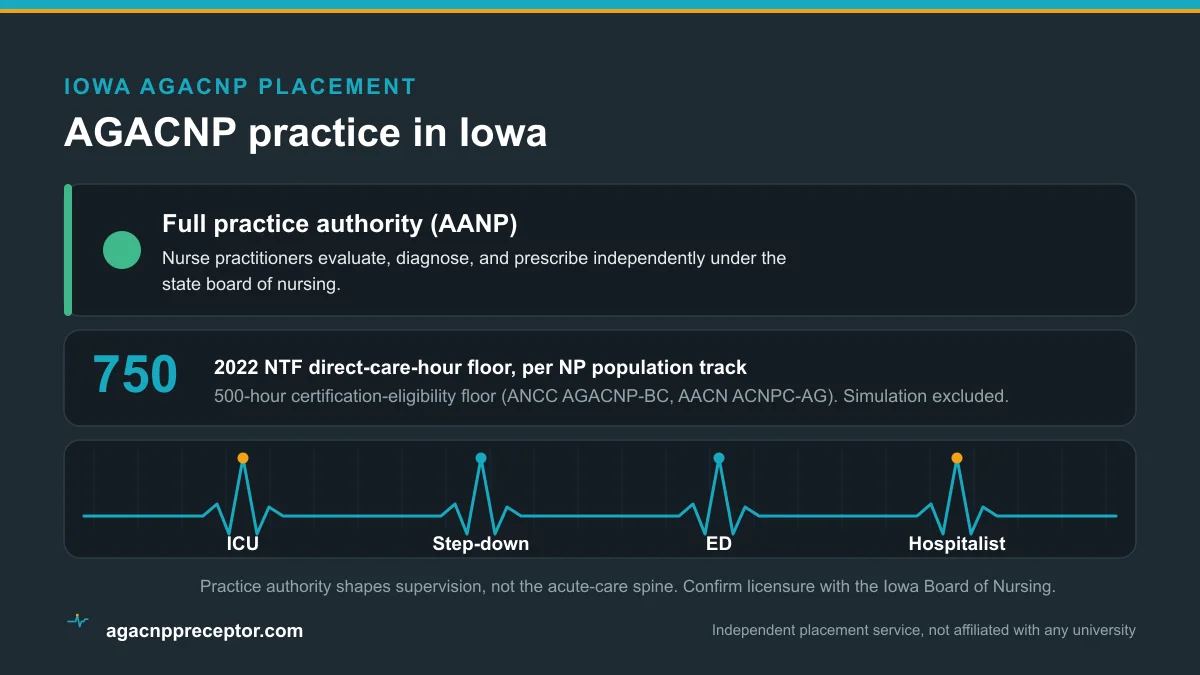
Iowa grants full practice authority to nurse practitioners, who hold the Advanced Registered Nurse Practitioner, or ARNP, credential under the Iowa Board of Nursing. An ARNP may practice and prescribe independently, and a collaborative agreement with a physician is allowed but not required by the board.
In critical care that independence still sits inside a team. An experienced AGACNP or an intensivist commonly precepts because that is who staffs the unit, and your preceptor is generally a board-certified acute-care NP, AGACNP-BC or ACNPC-AG, or a physician such as an intensivist or hospitalist. Your program sets the exact preceptor rules, so confirm them before committing to a site.
The inpatient settings that host AGACNP students
AGACNP is an inpatient, high-acuity specialty, so your rotations live inside the hospital:
- intensive care, medical, surgical, and cardiac, for the highest-acuity hours
- step-down and progressive care for telemetry and post-ICU patients
- the emergency department for acute, undifferentiated presentations
- hospitalist and inpatient medicine, usually the steadiest source of hours
- inpatient specialty services such as cardiology, pulmonology, and nephrology
Your patients range from adolescence, beginning around age thirteen, through adults and the frail elderly, all of them acute or unstable. Larger regional hospitals in Cedar Rapids and other cities can supply solid inpatient medicine and step-down hours even when subspecialty ICU time means a trip to Iowa City or Des Moines.
Critical-access Iowa and the metro commute
Iowa has one of the highest counts of critical-access hospitals of any state, and those facilities are built to stabilize and transfer rather than to run sustained critical care. If you live in a rural county, expect your deepest ICU and inpatient specialty hours to require travel to Iowa City, Des Moines, or another regional hub.
We plan around that instead of hoping a small local hospital can host a rotation it is not staffed for. We line up a site at the right pole and build the logistics into your schedule.
Which hours are hardest to secure
The tight pieces in Iowa are the deepest ICU hours, procedures and advanced skills such as central lines and airway and ventilator management, and the adolescent end of the AGACNP range. Because much of this capacity sits at the two Level I poles, the supply is real but competed for.
General adult and older adult inpatient and step-down hours are easier to secure, though still behind hospital credentialing. We work the full rotation trace so one hard-to-place block does not hold up your graduation.
Start your Iowa placement
Tell us your program, your city, and the acute rotations you still need. We source qualified preceptors, confirm the site will host you, and handle the affiliation and credentialing legwork that students should not have to chase. Matched first, pay when secured; see pricing and AGACNP clinical hours.
Use the match form on this page or contact us, and we will map a realistic path to your ICU, step-down, and specialty hours across Iowa.
Good to know
Where are the best AGACNP acute-care hours in Iowa?
The two Level I poles, University of Iowa Hospitals and Clinics in Iowa City and UnityPoint Iowa Methodist in Des Moines, hold the deepest ICU and inpatient specialty hours, with MercyOne Des Moines and regional hospitals adding capacity. Rural students usually travel to one of these hubs for high-acuity time, which is why we plan early.
What is an ARNP, and does full practice authority remove the need for a preceptor?
ARNP is Iowa title for an advanced practice nurse, including nurse practitioners. Full practice authority describes independent practice for a licensed ARNP, not who precepts you. In critical care an experienced AGACNP or an intensivist commonly serves as preceptor, and your program sets the requirements.
How many AGACNP clinical hours will I need?
Confirm the number with your own program. The 2022 NTF Standards recommend at least 750 direct patient care hours per NP track, and ANCC and AACN certification eligibility requires at least 500 faculty-supervised hours. Accredited AGACNP programs commonly publish totals from roughly 500 to 750 or more, and some sit below 750. Simulation is excluded.
Do you guarantee placement at a specific Iowa hospital?
No. We are an independent service and never guarantee placement or that a named hospital will accept you, and we do not control your school approval of a site or preceptor. We source and vet qualified acute-care preceptors and inpatient sites and carry the paperwork to give you the strongest realistic shot.
Related
Secure the rotation no one else will hand you
Tell us your school, your city, and the acute rotations you still need. We will come back with a plan for the full AGACNP trace and a realistic path to placed.