Acute-care preceptors for AGACNP students across Massachusetts
If you are an Adult-Gerontology Acute Care NP student in Massachusetts, your clinical hours belong inside hospitals, in the ICU, the step-down unit, the emergency department, and on hospitalist and inpatient specialty services, not in a clinic. Massachusetts is unusually rich in acute-care teaching sites, yet those inpatient seats are gatekept by credentialing and affiliation paperwork, so the hard part is access, not distance. We source and vet qualified acute-care preceptors for students at any university, then help get the site approved.
Tell us your school and city. It is free to ask, with no obligation.
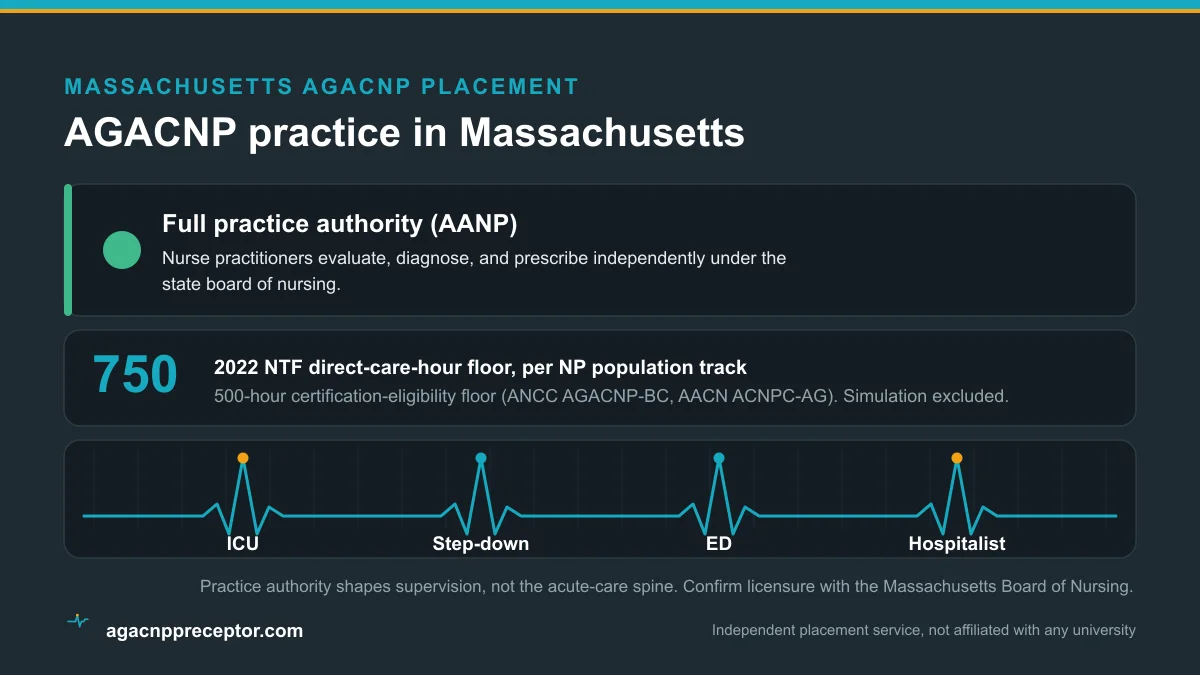
Where your AGACNP hours actually happen
AGACNP is an inpatient specialty, so your rotations live in high-acuity settings: medical, surgical, cardiac, and neuro intensive care units, the step-down or progressive care unit, the emergency department, and hospitalist and inpatient medicine services. Rounding, rapid response, and consult-driven work replace the clinic visit.
Massachusetts hospitals also run deep inpatient specialty services, in cardiology and heart failure, pulmonary and critical care, nephrology, and trauma and surgical critical care, where AGACNP students pick up the complex, unstable patients the certification is built around. The patient span reaches from young adults through older adults and the frail elderly.
The Boston teaching core, and the state beyond it
Massachusetts carries seven adult Level I trauma centers, and most of them sit inside Boston, among them Massachusetts General Hospital, Brigham and Women's Hospital, Beth Israel Deaconess Medical Center, and Boston Medical Center, whose emergency department and trauma service rank among the busiest in New England. That concentration of academic medical centers is rare, and it is why students across the region try to route their high-acuity hours through the metro.
- Central Massachusetts centers on Worcester, whose largest hospital is the only Level I trauma center for that region.
- Western Massachusetts runs through Springfield, home to the only Level I trauma center west of Worcester and the referral hub for the Pioneer Valley and Berkshires.
- The South Shore, Cape Cod, and the islands lean on community hospitals and a Level II center near the coast, so students chasing ICU and procedure hours often commute inbound to Boston or Worcester.
What full practice authority changes on the unit
Massachusetts is a full practice authority state under the American Association of Nurse Practitioners. In plain terms, an experienced nurse practitioner can hold prescriptive and clinical authority without a standing physician contract, which means a board-certified AGACNP on staff can serve as your preceptor and sign off on your hours directly.
There is one wrinkle worth knowing. New nurse practitioners in Massachusetts complete a supervised transition period, commonly described as about two years, before fully independent prescriptive authority. As a student that does not change your requirements, but it shapes who is far enough along to precept. In critical care a physician intensivist is usually in the mix regardless, so the collaborating-versus-independent question matters less on an ICU service than it does in a clinic. Licensure specifics should be confirmed with the state board.
Who signs on as your preceptor here
A preceptor is generally a board-certified acute-care nurse practitioner (AGACNP-BC or ACNPC-AG) or a physician, often an intensivist, hospitalist, or inpatient specialist, practicing in the setting that matches your rotation. Your program, not a single national rule, sets the exact standard, so check your school's preceptor form early. Our preceptor requirements guide breaks down what most programs accept.
Because Massachusetts has so many teaching hospitals, the credentialed acute-care NP pool is genuinely deep. The limiter is rarely whether a qualified preceptor exists; it is whether a given service has an open teaching slot and whether the affiliation agreement between your school and that system is already in place.
The hours that are hardest to secure
Even in a hospital-rich state, a few pieces stay scarce. High-acuity ICU time, hands-on procedures and advanced skills such as line placement, airway, and point-of-care ultrasound, and the adolescent end of the age range, which begins near age 13, are the requests we hear most. These sit disproportionately in the academic centers, which are also the most credentialing-heavy.
Confirm your own program's total early, because it drives the plan. The 2022 National Task Force standards recommend a minimum of 750 direct patient care hours per track, while ANCC and AACN certification eligibility rests on at least 500 supervised hours, and accredited AGACNP programs publish totals that vary, many below 750. See our clinical hours guide, and always verify with your school.
Building your Massachusetts placement
Here is how we work. Tell us your school, your city or the metro you can reach, and the acute rotations you still owe, and we map a route through the settings that can actually host you, then chase the preceptor and the site approval so you are not cold-calling hospital education offices. See how it works and what it costs.
Ready to start? Use the match form below or contact us, and we will come back with a realistic plan for the full trace. We are an independent service and we assist with placement; we never guarantee a site or your school's approval of any preceptor.
Good to know
Do I have to do my AGACNP rotations in Boston?
No, but the deepest concentration of ICU, trauma, and inpatient specialty capacity is in Boston, with strong secondary hubs in Worcester and Springfield. Many students combine a local step-down or hospitalist rotation with a metro block for high-acuity ICU and procedure hours.
Does Massachusetts full practice authority mean I do not need a physician preceptor?
It means a board-certified acute-care NP can precept and sign your hours without a standing physician contract. In critical care an intensivist is often involved anyway. Your program sets who qualifies, so confirm its preceptor rules first.
How many clinical hours will I need in Massachusetts?
That is set by your program, not the state. The 2022 NTF standards recommend at least 750 direct-care hours, while certification eligibility requires at least 500. Accredited programs vary and many publish totals below 750, so confirm your exact number with your school.
Can you guarantee a placement at a specific Boston hospital?
No. We source and vet qualified preceptors and help with site approval, but we never name a hospital that accepts our students or promise a specific site. Final approval always rests with the hospital and your school.
Related
Secure the rotation no one else will hand you
Tell us your school, your city, and the acute rotations you still need. We will come back with a plan for the full AGACNP trace and a realistic path to placed.