Where Michigan AGACNP students find acute-care rotations
Adult-Gerontology Acute Care NP training in Michigan happens where the sickest patients are, in the intensive care unit, the step-down floor, the emergency department, and on hospitalist and inpatient specialty teams. Michigan has strong acute-care capacity in a handful of metros and thin coverage across large rural stretches, so where you live changes your search as much as the rules do. We help students at any university source and verify acute-care preceptors and get the site approved.
Tell us your school and city. It is free to ask, with no obligation.
Michigan's acute-care map, metro by metro
The state's high-acuity beds cluster in a few systems. Metro Detroit anchors the largest pool, with Level I trauma centers such as Detroit Receiving Hospital and Henry Ford Hospital and several large health systems running deep ICU, step-down, and emergency volume. Ann Arbor adds a major academic medical center, and Grand Rapids anchors West Michigan with its own Level I trauma center.
- Flint and Lansing carry regional Level I and tertiary capacity for mid-Michigan.
- Kalamazoo, Saginaw, and Traverse City support the rest of the Lower Peninsula.
- The Upper Peninsula runs on a regional referral center in Marquette plus a ring of critical-access hospitals, with long transport times to anything higher.
The inpatient settings that host AGACNP students
Your hours belong in the ICU in its medical, surgical, cardiac, and neuro forms, the step-down or progressive care unit, the emergency department, and hospitalist medicine, with inpatient specialty blocks in cardiology, pulmonary critical care, nephrology, and trauma or surgical services. The patients span adults to older adults and the frail elderly.
The Detroit and Ann Arbor systems are where the most sub-specialized units sit, so students elsewhere in the state often plan a block or two in one of the metros to round out high-acuity and procedure hours. Neuro-critical care, cardiothoracic ICU, and burn or complex trauma surgical services are especially concentrated in the largest teaching hospitals, so a student who needs those specific hours should expect to travel toward Detroit, Ann Arbor, or Grand Rapids for at least part of the plan.
Restricted practice, and who precepts you
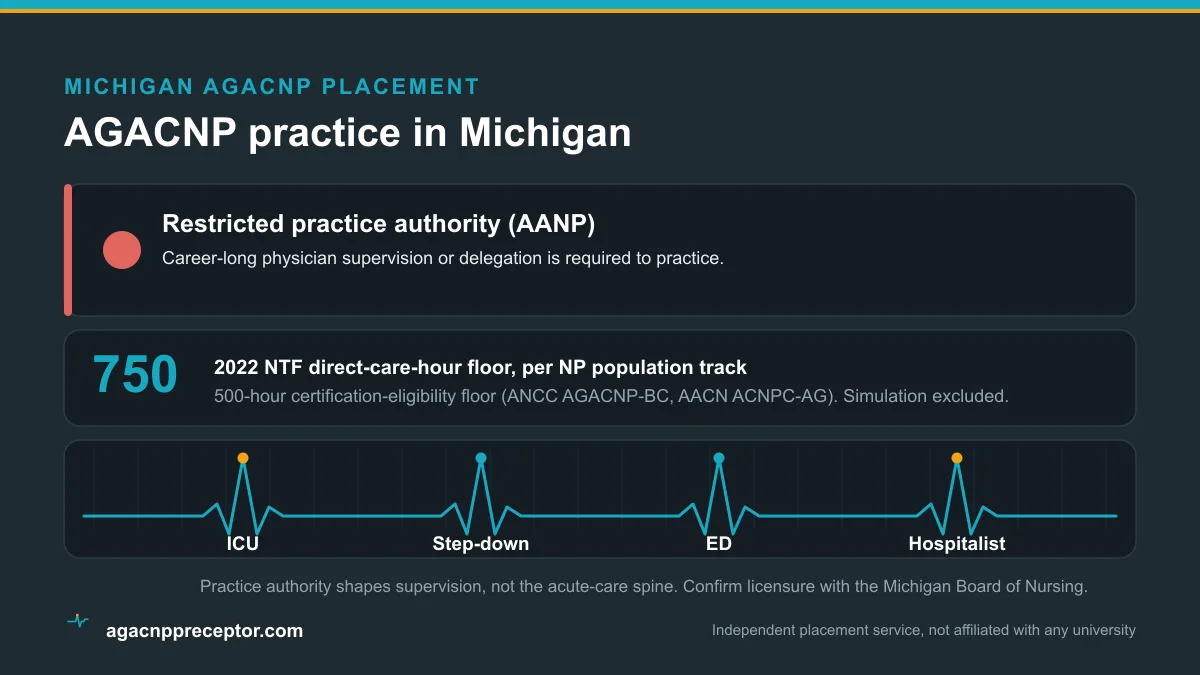
The American Association of Nurse Practitioners classifies Michigan as a restricted practice state. Michigan does not grant nurse practitioners an independent scope; NPs carry an RN license plus a specialty certification, physician delegation is required to prescribe controlled substances, and NPs cannot own an independent practice. Most work under a written collaborative or delegation arrangement with a physician somewhere in the chart flow.
On an acute-care service this matters less than it sounds. Critical care is a team setting, and an intensivist or attending is usually part of the picture no matter what the license allows, so a physician co-signing is routine. Your preceptor is generally a board-certified AGACNP (AGACNP-BC or ACNPC-AG) or an acute-care physician such as an intensivist or hospitalist. Legislation to grant full practice authority has been introduced but not enacted, so confirm current rules with the state board.
The Upper Peninsula and rural Michigan
Outside the metros, acute capacity thins quickly. Many rural counties are served by critical-access hospitals that stabilize and transfer rather than hold complex ICU patients, which means the highest-acuity hours are concentrated downstate. Upper Peninsula students in particular face longer travel and a smaller preceptor pool, and often plan a downstate block for the sub-specialty and procedure requirements. Winter travel across the Upper Peninsula and the northern Lower Peninsula can add real time to a commute, which is worth building into any schedule that spans two regions.
That geography is exactly where a sourcing service earns its keep, because the search radius is wider and the number of qualified acute-care preceptors nearby is smaller.
Which hours are scarcest here
The requests that take the most work are high-acuity ICU time, procedures and advanced skills like central lines, airway, and bedside ultrasound, and the adolescent end of the AGACNP span, which starts around age 13. These lean toward the academic and large-system hospitals, which also carry the heaviest credentialing.
Your program sets the total you owe, so pin it down early. The 2022 National Task Force standards recommend a minimum of 750 direct patient care hours, certification eligibility through ANCC and AACN requires at least 500 supervised hours, and accredited AGACNP programs publish a range, many under 750. Our clinical hours page has the detail; confirm yours with your school.
Locking your Michigan rotation
Tell us your program, the part of the state you can reach, and the acute rotations you still need, and we will source and vet a qualified preceptor, then work the site approval and affiliation piece so you are not chasing hospital education offices yourself. See how it works and the cost.
Start with the match form below or reach out. We are independent, we serve students at any university, and we assist with placement without ever guaranteeing a site or your school's approval of a preceptor.
Good to know
Does Michigan's restricted status make it harder to find an AGACNP preceptor?
Not dramatically. Critical care already runs as a physician-led team, so the collaboration a restricted state expects is usually present anyway. The bigger factor is geography, since high-acuity units cluster in Detroit, Ann Arbor, and Grand Rapids.
I am in the Upper Peninsula. Can I do all my hours locally?
Some, yes, especially step-down, emergency, and hospitalist time near Marquette. But sub-specialty ICU and procedure hours are concentrated downstate, so many UP students plan a metro block. We help map that.
Who can serve as my preceptor in Michigan?
Generally a board-certified acute-care NP (AGACNP-BC or ACNPC-AG) or an acute-care physician such as an intensivist or hospitalist, practicing in the setting that matches your rotation. Your program sets the exact rule, so check its preceptor form.
How many clinical hours does Michigan require?
The state does not set your hours; your program and its accreditor do. The 2022 NTF standards recommend at least 750 direct-care hours and certification eligibility requires at least 500. Totals vary by program, so confirm yours.
Related
Secure the rotation no one else will hand you
Tell us your school, your city, and the acute rotations you still need. We will come back with a plan for the full AGACNP trace and a realistic path to placed.