Placing AGACNP students in Mississippi hospitals
In Mississippi, Adult-Gerontology Acute Care NP hours happen inside the hospital, in the ICU, on step-down, in the emergency department, and on hospitalist and inpatient specialty teams. The state's high-acuity capacity is concentrated in a few centers and thin across a very rural map, so an acute-care search here is really a question of where the complex beds are and how far you can travel. We help students at any university source and verify acute-care preceptors and get the site approved.
Tell us your school and city. It is free to ask, with no obligation.
One academic hub, and a very rural state
Mississippi's most complex care runs through Jackson, home to the state's only academic medical center and its only Level I trauma center, along with the only Level IV newborn ICU and the only organ transplant programs. For the highest-acuity ICU, trauma, and subspecialty hours, that campus is the center of gravity. That single-hub pattern is unusual, and it shapes almost every high-acuity placement decision in the state.
- Tupelo anchors the northeast with a large regional referral center, one of the biggest rural hospitals in the country.
- Hattiesburg carries a Level II trauma center and referral volume for the Pine Belt.
- The Gulf Coast, around Gulfport, Biloxi, and Pascagoula, runs its own hospitals, and the Delta and much of rural Mississippi depend on critical-access facilities that stabilize and transfer.
The acute settings where you will log hours
Your rotations belong in the ICU in its medical, surgical, and cardiac forms, the step-down or progressive care unit, the emergency department, and hospitalist medicine, with inpatient specialty exposure in cardiology, pulmonary critical care, and nephrology. The patient span reaches from adults to older adults and the frail elderly.
Because so much high-acuity volume sits in Jackson and Tupelo, students elsewhere in the state frequently plan a block in one of those cities to complete their sub-specialty and procedure requirements. Neurocritical care, cardiothoracic surgery, and the most complex trauma work are concentrated in Jackson, so students who need those specific hours should plan for time in the capital.
Reduced practice and your collaborating physician
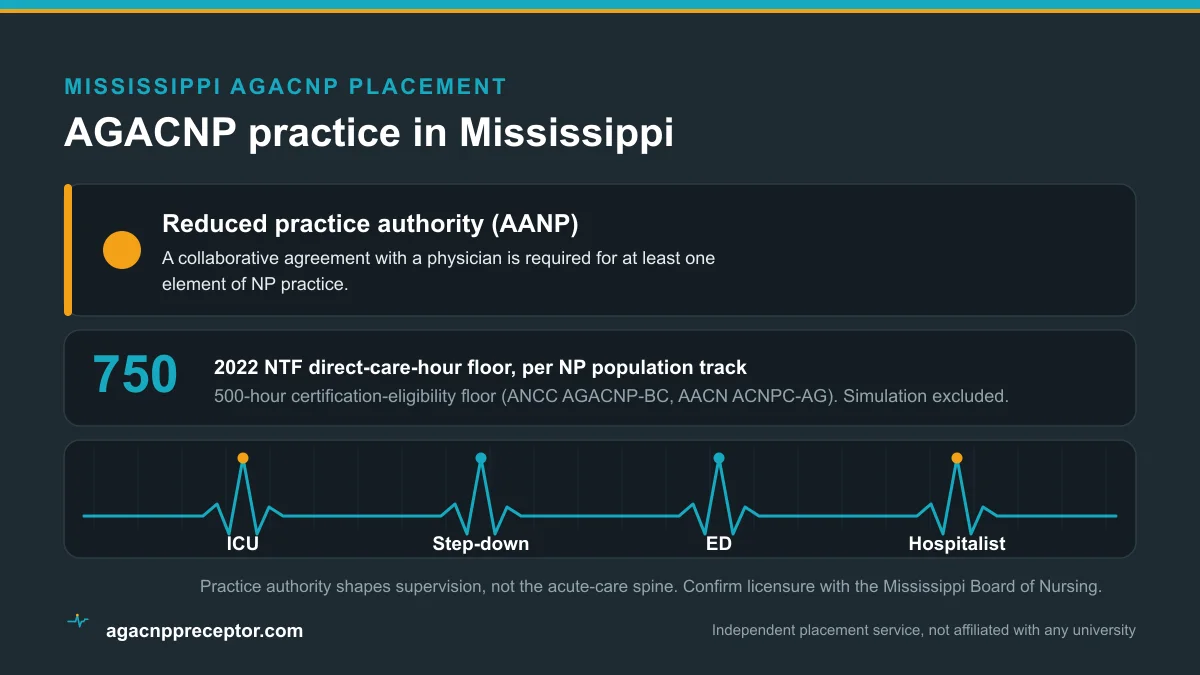
The American Association of Nurse Practitioners classifies Mississippi as a reduced practice state. Nurse practitioners hold prescriptive authority but must maintain a collaborative or consultative relationship with a Mississippi-licensed physician who has a compatible practice, and that collaborator is recorded with the board. It is a career-long arrangement rather than a temporary transition.
In acute care this fits the way the units already run. An intensivist or hospitalist attending is typically part of the team, so folding a collaborating physician into your supervision is routine. Your preceptor is generally a board-certified AGACNP (AGACNP-BC or ACNPC-AG) or an acute-care physician. Confirm current collaboration rules with the state board.
Rural Mississippi and the travel question
Mississippi is among the most rural states, and many counties sit in health professional shortage areas served by critical-access hospitals. Those facilities are valuable for emergency and general inpatient exposure, but they rarely hold the sickest ICU patients, who are transferred to Jackson, Tupelo, or a coastal center. That referral pattern is exactly why high-acuity hours can be hard to secure close to home. Distances between a rural home county and the nearest referral hospital can run well over an hour, which is worth planning around before a term begins.
A sourcing service matters more in this kind of geography, because the pool of qualified acute-care preceptors within driving distance can be small, and the search has to reach into the referral hubs.
The hours you may need help securing
The pieces that take the most legwork are high-acuity ICU time, procedures and advanced skills such as central lines, airway, and bedside ultrasound, and the adolescent end of the AGACNP range, which begins around age 13. These concentrate in the academic and large referral centers.
Your program, not the state, sets the total you owe. The 2022 National Task Force standards recommend a minimum of 750 direct patient care hours, certification eligibility through ANCC and AACN requires at least 500 supervised hours, and accredited programs publish a range, many under 750. See our clinical hours guide and confirm with your school.
How we place AGACNP students in Mississippi
Tell us your program, the part of the state you can reach, and the rotations you still need, and we will source and vet a qualified acute-care preceptor, then work the site approval so you are not calling hospital education offices on your own. See how it works and what it costs.
Start with the match form below or contact us. We are independent, we serve students at any university, and we assist with placement without ever guaranteeing a site or a school's approval of a preceptor.
Good to know
Is Jackson the only place to get high-acuity hours in Mississippi?
It holds the most, as the state's only academic medical center and Level I trauma center, but Tupelo, Hattiesburg, and the Gulf Coast carry real inpatient volume too. Many students combine a local step-down or emergency rotation with a block in a referral hub for ICU and procedures.
What does reduced practice mean for my preceptor?
Mississippi expects a nurse practitioner to keep a collaborative relationship with a physician, which acute-care teams already have. A board-certified AGACNP can precept you, with the physician folded in as the units normally operate. Your program sets the final rule.
I live in a rural county. How do I get ICU hours?
Critical-access hospitals near you are good for emergency and general inpatient time, but the sickest patients transfer to Jackson or another referral center. Plan on traveling for high-acuity ICU and procedure blocks, which we help arrange.
How many clinical hours does Mississippi require?
The state does not set your hours; your program and its accreditor do. The 2022 NTF standards recommend at least 750 direct-care hours and certification eligibility requires at least 500. Totals vary and many programs publish fewer than 750, so confirm yours.
Related
Secure the rotation no one else will hand you
Tell us your school, your city, and the acute rotations you still need. We will come back with a plan for the full AGACNP trace and a realistic path to placed.