Your AGACNP acute-care rotations, placed across Oklahoma
In Oklahoma, most AGACNP clinical hours are earned in two places, the Oklahoma City metro and the Tulsa metro, because that is where the state's academic and Level I trauma hospitals sit. Acute-care rotations are inpatient rotations, so your ICU, step-down, emergency, and hospitalist time depends on getting inside those hospital systems. Sourcing that access is the work we take off your plate.
Tell us your school and city. It is free to ask, with no obligation.
Where Oklahoma's acute hours concentrate
Oklahoma runs on two hospital hubs, and an acute-care search here almost always points at one of them. Oklahoma City anchors the center of the state, where OU Health operates the flagship academic medical center and a Level I trauma center, and where large systems such as INTEGRIS Health and SSM Health carry tertiary inpatient services, a trauma ICU, and heavy emergency volumes. Tulsa anchors the northeast, where Saint Francis runs a Level I trauma and referral hub and systems such as Ascension St. John and Hillcrest add inpatient beds.
Beyond those two metros, high-acuity capacity thins quickly. That single fact shapes how an Oklahoma AGACNP student plans a schedule, because the intensive care and specialty units you need for the hardest hours are not spread evenly across the state.
The units that host AGACNP rotations
Adult-gerontology acute care is a hospital specialty, so your rotations live inside inpatient and high-acuity services rather than clinics. In Oklahoma those settings look like this:
- Intensive care, in its medical, surgical, cardiac, and neuro forms, where the most unstable adults are managed hour to hour.
- Step-down and progressive care, the bridge unit between the ICU and the general floor.
- Emergency departments, where undifferentiated and unstable patients arrive first.
- Hospitalist and inpatient medicine teams that carry the general adult census.
- Inpatient specialty services in cardiology, pulmonology, nephrology, and trauma or surgical care.
The patients run from younger adults through older adults and the frail elderly, the core of the adult-gerontology acute-care population.
Rural Oklahoma and the drive to high acuity
Most of Oklahoma outside the two metros is served by community and critical-access hospitals. These sites keep an emergency department and general medical beds, but they rarely run the multi-tier intensive care, cardiac catheterization, or trauma programs an AGACNP student needs for high-acuity hours. Students in the panhandle, the southeast, and the smaller regional towns usually plan to travel to Oklahoma City or Tulsa for at least part of their clinical time.
We build that travel reality into a plan rather than leaving it to chance, so your local hours and your metro hours fit together instead of colliding at the end of the term.
Practice authority, and what the 2025 change did not do
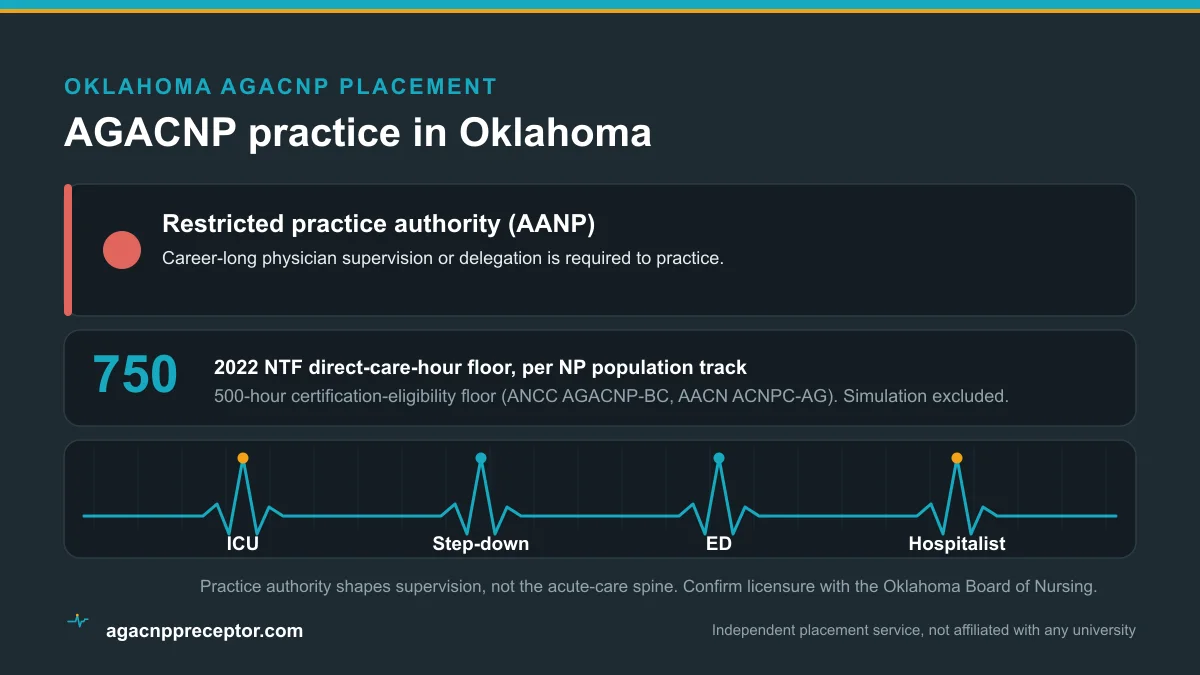
Oklahoma has long sat in the restricted tier of the AANP State Practice Environment. A 2025 law changed one piece of that: effective November 1, 2025, nurse practitioners who complete a large block of supervised practice, reported at 6,240 hours, may apply for independent prescriptive authority for Schedule III through V medications. Schedule II drugs stay outside that authority, and less experienced nurse practitioners still work under a supervised arrangement, so the category is genuinely in transition. Confirm the current rules with the Oklahoma Board of Nursing before you rely on any single label.
For your rotation this matters less than students expect. In an intensive care unit or on a hospitalist service, an AGACNP works inside a team that includes an intensivist or attending physician regardless of state law, so a collaborating physician is normal in acute care everywhere. Practice authority shapes who formally signs on as your preceptor, not the clinical qualifications that preceptor needs.
The hours that are hardest to secure here
Three kinds of hours run short in Oklahoma. High-acuity intensive care seats are limited because they sit in a small number of academic and Level I centers. Procedures and advanced skills, such as line placement, airway support, and point-of-care work, depend on a preceptor willing to teach them at the bedside. And the adolescent end of the range, which begins around age 13, is thin outside larger centers, because most community hospitals move younger teens elsewhere.
Knowing which of these you still need lets us aim your search at the sites that can actually deliver them, instead of sending you to a unit that cannot.
How we place AGACNP students in Oklahoma
We are an independent service, not tied to any university, and we work for students at any program. You tell us your school, your city, and the rotations you still need, and we source a qualified acute-care preceptor and an inpatient site, then handle the vetting and the site-approval legwork that hospitals require. We never guarantee placement or your school's approval of a site, but you are matched before you pay, and you pay only when a placement is secured.
If you are staring at an ICU or hospitalist requirement with no idea where to start, tell us on the match form or through contact, and we will map a realistic path to placed.
Good to know
Which Oklahoma cities give me the best shot at ICU hours?
Oklahoma City and Tulsa. The state's academic and Level I trauma centers, and the multi-tier intensive care units that come with them, are concentrated in those two metros. Most students outside them plan to travel in for high-acuity and specialty hours.
Did Oklahoma's 2025 law change who can precept me?
No. The 2025 change affects prescriptive authority for experienced nurse practitioners, not preceptor eligibility. Your preceptor rules are set by your program and its accreditor. A preceptor is generally a board-certified acute-care nurse practitioner or a physician working in the acute or inpatient setting that matches your rotation.
I live in a rural part of the state. Will I have to travel?
For the highest-acuity hours, most likely yes. Critical-access hospitals cover emergencies and general medicine well, but the multi-tier ICU, cardiac, and trauma services that AGACNP students need usually mean time in Oklahoma City or Tulsa. We plan for that up front.
How many acute-care clinical hours will I need?
It depends on your program. The 2022 NTF Standards recommend at least 750 direct patient care hours per track, while certification eligibility requires at least 500 faculty-supervised hours, and accredited AGACNP programs commonly publish totals in that range, with many below 750. Confirm your own program's number and see our clinical hours guide.
Can you help if my AGACNP program is online or out of state?
Yes. We place students at any university, including online and out-of-state programs, into acute-care sites in Oklahoma. Your clinical hours happen where you live, under Oklahoma's rules, so the state landscape on this page is what matters for your rotations.
Related
Secure the rotation no one else will hand you
Tell us your school, your city, and the acute rotations you still need. We will come back with a plan for the full AGACNP trace and a realistic path to placed.